 Retro Replay Retro Replay gaming reviews, news, emulation, geek stuff and more!

Retro Replay Review
Gameplay
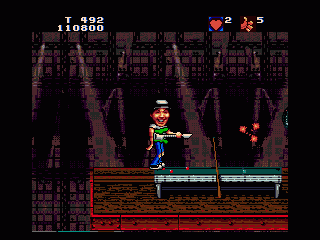
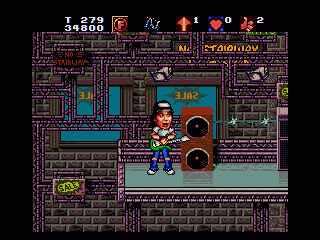
Wayne’s World delivers a straightforward platforming experience that leans heavily on precision jumping and close-quarters combat. Players guide Wayne through a series of four distinct stages—Kramer’s Music Store, Stan Mikita’s Donut Store, Gas Works, and Suburbia—each populated with unique environmental hazards and thematic obstacles. The controls are responsive, with dedicated buttons for jumping, attacking with Wayne’s guitar, and performing a limited “rock blast” special move that clears weaker foes in a satisfying burst of pixelated sound waves.
(HEY YOU!! We hope you enjoy! We try not to run ads. So basically, this is a very expensive hobby running this site. Please consider joining us for updates, forums, and more. Network w/ us to make some cash or friends while retro gaming, and you can win some free retro games for posting. Okay, carry on 👍)
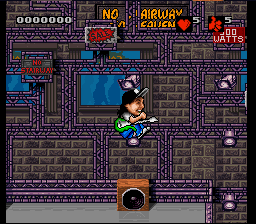
The level design balances horizontal runs with occasional vertical climbs, ensuring that each area feels fresh. Secret alcoves hide extra lives or score bonuses, rewarding careful exploration rather than blind sprinting. Enemies range from animated instruments and sentient donuts to purple-skinned minions of the evil Zantar, whose attack patterns are simple yet effective at ramping up challenge. Early levels serve as a soft introduction, while the final stages demand precise timing and a firm grasp of Wayne’s double-tap dash mechanics.
Combat centers on Wayne’s trusty guitar, which serves as both a melee baton and a projector of “sonic death.” Repeated plucking of strings unleashes rhythmic pulses that knock back and sometimes instantly defeat lesser enemies. While the move set is relatively limited—no mid-air attacks or complex combos—the learning curve feels well-paced. Boss encounters, including a showdown with a giant donut golem, mix pattern memorization with well-timed dodges, culminating in a satisfying final battle to rescue Garth.
Graphics
Visually, Wayne’s World embraces the late-80s platformer aesthetic with bright, blocky sprites and bold color palettes. Each stage features distinct backgrounds—racks of guitars in Kramer’s Music Store, neon signage at Gas Works, pastel suburban homes—rendered with enough detail to capture the quirky charm of the film’s universe. Sprite animations are economical but effective: Wayne’s guitar swings have a satisfying arc, and enemy movements cycle smoothly to suggest liveliness despite hardware limitations.
The game’s use of color is particularly notable. The purple and black hues of Zantar’s lair stand in sharp contrast to the warm tones of the first two levels, reinforcing the narrative shift from fun talk-show antics to life-or-death rescue mission. Background elements occasionally animate—a flickering neon light here, a spinning donut there—to create a sense of a living, breathing world without taxing the hardware. Overall, the presentation feels cohesive and thematically appropriate rather than merely decorative.
On a technical level, Wayne’s World maintains stable frame rates even in the most sprite-heavy sections. There’s no slowdown when multiple enemies unleash projectiles or when Wayne’s rock blast erupts on screen. Occasional flicker occurs when too many objects overlap, but it never interferes with gameplay. While the game doesn’t push the envelope compared to contemporary arcade machines, its clean, consistent art style and robust performance make for an engaging visual package.
Story
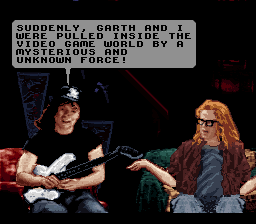
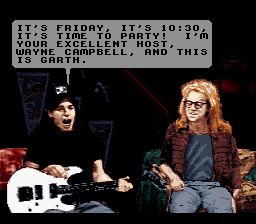
The narrative premise plunges players directly into the world of the iconic public-access duo. After presenting their usual top-10 list of arcade disasters, Wayne and Garth are mysteriously transported into a video game realm, where the dastardly Zantar has kidnapped Garth. From the get-go, the plot leans on familiar catchphrases—“Party time! Excellent!” and “Weeuuu, weeuuu!”—to ground the experience in the film’s brand of absurdist humor.
Although cutscenes are minimal, they serve their purpose: a brief dialogue exchange sets up each level’s objective, and occasional overlay text recaps Wayne’s mission to save his best friend. The game’s sense of humor shines through enemy designs (evil donuts and amp-headed goons) and in-game one-liners, even if they’re delivered as static text bubbles. Fans of the movie will appreciate these nods, while newcomers will find the story simple but serviceable.
Despite its whimsical premise, the plot doesn’t complicate the action with unnecessary twists. Instead, it stays focused on the rescue mission, giving players a clear goal without verbose exposition. The reveal of Zantar’s lair in Suburbia heightens the stakes appropriately, paving the way for a final confrontation that feels earned. Though brief, the storyline ties all four levels together in a coherent arc, making the rescue of Garth feel both urgent and celebratory.
Overall Experience
Wayne’s World stands as a solid, nostalgia-driven platformer that captures the irreverent energy of its source material. Its blend of tight controls, varied level design, and tongue-in-cheek humor make for an experience that’s as fun to play as it is faithful to the film’s spirit. While it doesn’t revolutionize the genre, it excels at what it sets out to do: deliver a lighthearted, music-powered adventure that fans will fondly remember.
Replay value comes from mastering each level’s hidden secrets and beating boss patterns with fewer hits taken. Speedrunners will find modest challenges in shaving seconds off stage completion times, thanks to the game’s dash mechanic and strategic rock blasts. Casual players, meanwhile, will enjoy soaking in the visuals, cracking a smile at the quippy text, and breezing through the relatively short four-stage adventure.
Ultimately, Wayne’s World is a party game that invites players to be excellent to each other. It’s perfect for anyone craving a bite-sized platformer steeped in late-80s pop culture. If you’re looking for a straightforward, well-polished romp with guitar riffs and donuts galore, then lock on that joystick, press start, and get ready to rescue Garth—because party time, indeed, is about to begin.


Reviews
There are no reviews yet.