 Retro Replay Retro Replay gaming reviews, news, emulation, geek stuff and more!

Retro Replay Review
Gameplay
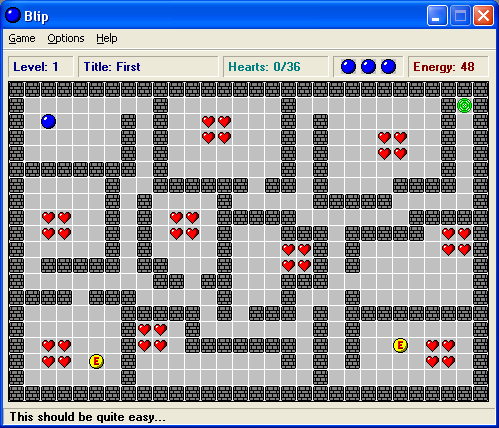
In Blip, you take command of a nimble blue orb, guiding it through each level to collect all the scattered hearts before your energy meter runs dry. Movement is handled entirely via the keyboard, offering simple yet precise controls that let you weave through obstacles and dash toward distant items. The core objective is straightforward: collect every heart, then locate the exit to advance. Yet the clock is not your adversary—instead, it’s your energy, which behaves much like a depleting time limit.
(HEY YOU!! We hope you enjoy! We try not to run ads. So basically, this is a very expensive hobby running this site. Please consider joining us for updates, forums, and more. Network w/ us to make some cash or friends while retro gaming, and you can win some free retro games for posting. Okay, carry on 👍)
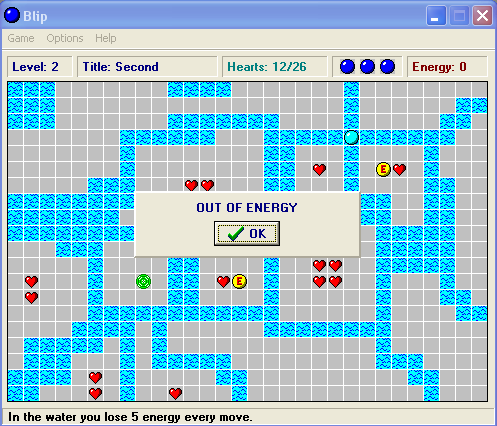
Energy management lies at the heart of Blip’s challenge. Your ball begins each run with a finite amount of energy and loses one unit per second spent roaming on solid ground. Crossing water tiles accelerates depletion, costing you five units instantly for each water cell traversed. Should your energy bar hit zero, you lose one of three lives, forcing you to restart the level or use a continue if lives remain. This mechanic injects a pulse of urgency that keeps every moment tense and rewarding.
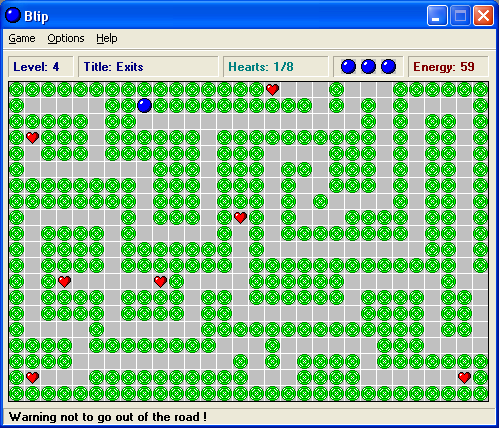
To stave off disaster, the game places Energy Power-Ups around the map. Each power-up grants 20 extra energy units, though you cannot exceed the 200-unit capacity. Beyond hearts and energy, levels feature a variety of interactive terrain: standard free cells, impenetrable walls, and hidden elements that reveal or vanish upon contact. These surprises compel you to adapt on the fly, as a seemingly open path can turn into a barrier without warning.
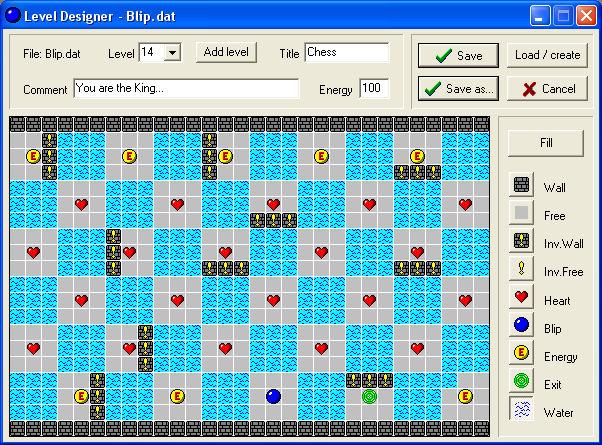
Blip offers 15 handcrafted levels, each growing more intricate as you progress. After conquering a stage, you receive a code to unlock the next, maintaining a satisfying sense of advancement even without an online connection. Complementing the built-in challenges, the included Level Editor invites creative players to design and share their own mazes. This feature significantly extends replay value, as you can jump into community-created puzzles or try to outdo friends’ custom creations.
Graphics
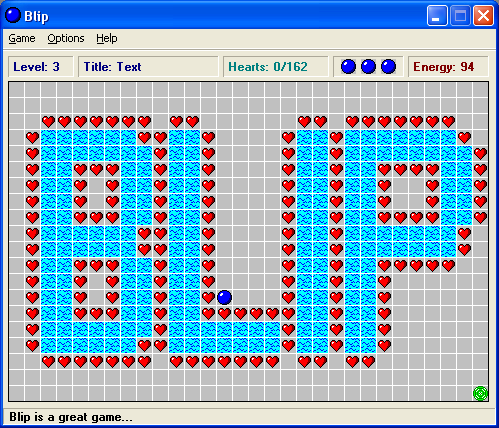
Visually, Blip embraces a minimalist 2D aesthetic that focuses on clarity and function over flashy presentation. The playing field is rendered in simple, brightly colored tiles, making it easy to distinguish terrain types, hazards, and collectibles at a glance. Walls are crisp and solid, while water tiles feature a subtle wave texture that communicates risk without distracting from the gameplay flow.
The blue ball itself stands out crisply against the environment, sporting a soft gradient that suggests volume. Animations—such as the slight bounce when Blip rolls or the flash of a collected heart—are economical but effective, giving the game a polished feel despite its straightforward style. UI elements, including the energy meter and life counter, sit unobtrusively at the screen’s edge, always visible yet never intrusive.
While Blip doesn’t chase photorealism or high-def 3D graphics, its retro-inspired visuals evoke classic puzzle titles of the past. This nostalgic charm aligns perfectly with the tight, old-school gameplay loop. Combined with crisp audio cues—like the satisfying chime of an energy pick-up or the muted splash through water—the game delivers a cohesive sensorial package that’s both clean and approachable.
For players who value readability and solid design, Blip’s visuals hit the mark. There’s no question about what you can and cannot interact with, and every sprite serves a clear purpose. This unpretentious approach ensures you spend your time solving puzzles, not deciphering the screen.
Story
Although Blip does not offer a deep narrative or elaborate plot, it sets a simple premise: you are Blip, a resourceful blue ball on a quest to gather hearts and find the exit. This minimal framework keeps the focus squarely on the puzzles themselves, while still providing just enough context to make your actions feel meaningful.
Each heart you collect represents a small victory in Blip’s world, reinforcing the idea that perseverance and quick thinking can conquer even the trickiest obstacle courses. The lack of an intricate storyline may disappoint those seeking rich lore, but it also frees the game from needless exposition, letting you jump right into the mechanics without delay.
The real narrative in Blip emerges from the levels you play and create. As you progress, the puzzles grow more devious, hidden dangers appear, and your mastery of energy conservation becomes more crucial. In this way, your personal journey—learning the ins and outs of every map and designing your own challenges—becomes the story worth experiencing.
For many players, the sense of ongoing discovery and self-improvement provides all the narrative drive they need. By the time you’ve mastered level 15 or marveled at a community-made stage, you’ll have your own tales of near defeats, lucky escapes, and triumphant runs to share.
Overall Experience
Blip delivers a tight puzzle-platforming experience that balances ease of entry with layers of strategic depth. The simple controls and bright visuals make it instantly approachable, while the energy management and hidden terrain elements ensure that each level remains challenging and engaging. Whether you’re racing the clock or meticulously planning your every move, the thrill of nailing a perfect run never grows stale.
The inclusion of a Level Editor substantially boosts Blip’s longevity. Casual players will breeze through the 15 official stages in a few hours, but creative spirits can spend countless more crafting, trading, and tackling user-generated content. This blend of curated and community levels helps Blip stand out in a genre often limited by a fixed puzzle set.
Some may find the lack of an elaborate storyline a drawback, yet for puzzle enthusiasts, the straightforward premise feels liberating rather than lacking. Blip trusts you to write your own adventure through the patterns you learn, the routes you discover, and the speedruns you attempt. Extras like level codes add a nostalgic flair, reminiscent of classic shareware games and console freebies.
In sum, Blip shines as an uncomplicated yet deep puzzler. Its charm lies in its purity: a simple ball, a handful of rules, and a series of cleverly designed mazes that push your problem-solving skills to the limit. For anyone craving a quick pick-up-and-play challenge with strong replay value, Blip is a heart-collecting, energy-juggling delight.



Reviews
There are no reviews yet.