 Retro Replay Retro Gaming History, Reviews & Emulation


Retro Replay Review
Gameplay
Stone-Jong starts with an inviting rhythm: scan the board, find a tile carrying the image currently shown on the Stone Pile, then watch its opposite image become your next target. It is easy to understand within minutes, but the first satisfying chain makes clear that this is more than a straightforward matching game. You are not simply clearing pairs; every placement rewrites the board’s immediate priorities.
That changing target is where the puzzle earns its teeth. A tile that keeps a promising image in play may be more valuable than the one that clears space right now, and a careless sequence can exhaust the obvious matches. Drawing from the Stone Deck offers a way forward when the board goes cold, but it also changes the target again, so it feels like a tactical reset rather than a free escape. Limited reshuffles give you a little insurance, not enough to remove the tension.
Sparkling tiles add a smart secondary incentive. Catching one can earn redraws, reshuffles, jokers, or points, so you are sometimes weighing a useful immediate match against a potentially valuable bonus. The Two Side mode pushes the core idea further with two Stone Piles and a holding area for deck tiles. Having two possible destinations makes planning more flexible, but it also asks you to keep track of more possible chains. That mode is where Stone-Jong feels most thoughtfully built.
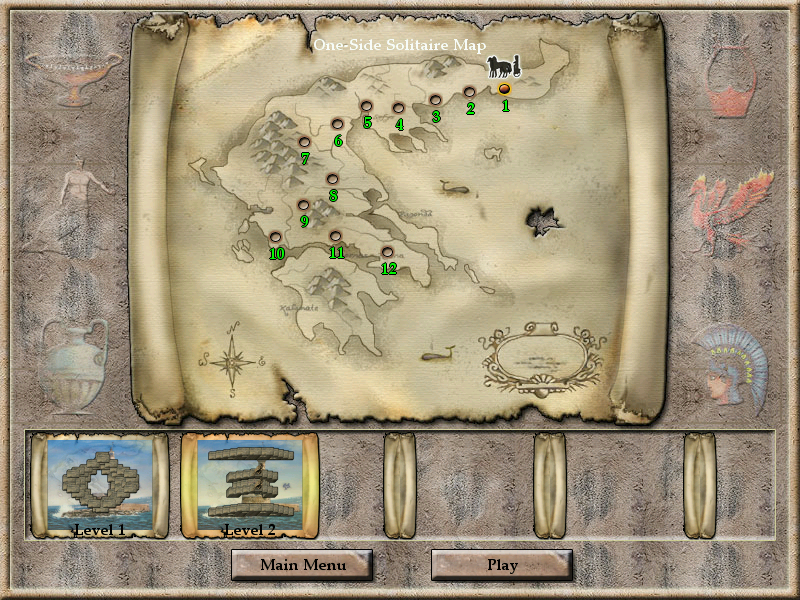
The structure is generous: 12 one-sided worlds and 10 two-sided worlds, each with five levels. Later boards bring tougher layouts and a wider range of images, which should keep experienced tile-puzzle fans engaged. If you prefer games that reward patient scanning and incremental improvement over speed or spectacle, this has a durable, pleasantly demanding loop.

Graphics
Stone-Jong is viewed from above as a tile board, with the important visual information carried by the two images on each tile and the currently exposed image on the Stone Pile. Sparkling tiles stand out as bonus opportunities, giving your eyes a clear reason to pause before making the next match.

Story
Stone-Jong tells its story through momentum rather than characters or plot. Each level begins as a field of possible connections, then gradually becomes a record of your decisions: which image you left active, which bonus you chased, and when you spent a redraw or reshuffle.
The worlds provide a long-form sense of progression. Early levels let you settle into the central chain of matching one side of a tile and inheriting the other, while later layouts and expanded image selections make that same rule harder to manage. The result is a steady escalation rather than a dramatic narrative arc.
Two Side mode creates its own little tale of recovery and opportunity. One pile can preserve a useful target while the other opens a route through the board, and tiles waiting in the holding area can turn a stalled run around. It is a modest kind of drama, but puzzle games live or die on those small reversals.
Overall Experience
Stone-Jong makes a convincing case for its Mahjongg-and-Dominoes-inspired mix because the central rule creates real consequences. You can grasp it quickly, yet you will still have moments where a seemingly harmless placement leaves no match available and forces you to reconsider how aggressively you draw or reshuffle. That friction is the point, and it is usually satisfying.
The payoff comes from learning to see chains instead of isolated matches. Once that starts to click, the board stops looking like a collection of tiles and becomes a set of branching possibilities. The bonuses and joker tiles add useful swings without replacing the need to plan, while Two Side mode gives the idea enough variation to avoid feeling like an extended repeat of the opening boards.
Give Stone-Jong a chance if you enjoy deliberate tile puzzles with a lot of levels and rules that become richer through repetition. It will not suit anyone wanting a fast, flashy diversion, but it is a strong fit for the kind of session where you want to quietly untangle a board, make one clever recovery, and immediately start another level to see if you can do it better.



Reviews
There are no reviews yet.