 Retro Replay Retro Replay gaming reviews, news, emulation, geek stuff and more!




Retro Replay Review
Gameplay
Street Legal offers a unique blend of mechanical simulation and street racing that sets it apart from many contemporaries. At its core, the game revolves around buying, fixing, tuning, and racing cars for either money or respect within the street racing community. As a rookie with $20,000, you’re tasked with selecting your first vehicle—typically an Inline-4 or V6—then dismantling, repairing, and upgrading every component from the engine block to the brake calipers. The hands-on approach gives players a satisfying sense of ownership over their ride.
(HEY YOU!! We hope you enjoy! We try not to run ads. So basically, this is a very expensive hobby running this site. Please consider joining us for updates, forums, and more. Network w/ us to make some cash or friends while retro gaming, and you can win some free retro games for posting. Okay, carry on 👍)
The tuning depth is impressive: you can fine-tune camshafts, adjust gear ratios, fit turbochargers, or even install nitrous oxide systems. Each modification affects performance characteristics such as horsepower, torque curve, and responsiveness. Race events range from short sprints through city streets to longer, more strategic runs where knowing your car’s strengths and weaknesses becomes crucial. Because every part has weight, durability, and performance ratings, the smallest change can tip the balance between victory and defeat.
One of the standout features is the realistic damage model. Collisions with other cars or even light contact with curbs can warp chassis components, dislodge essential parts like starters, or crack critical elements such as engine heads. Repairing damage isn’t just cosmetic—it can cost you both time and money. This risk-and-reward mechanic keeps races tense and encourages tactical driving rather than reckless speed.
However, Street Legal is not without its quirks. The learning curve for engine tuning can be steep for newcomers, and the in-game tutorials are minimal. While veteran gearheads will revel in the complexity, casual racers may find the initial setup process daunting. Patience and a willingness to experiment are rewarded, but be prepared for some trial-and-error sessions before you achieve race-winning performance.
Graphics
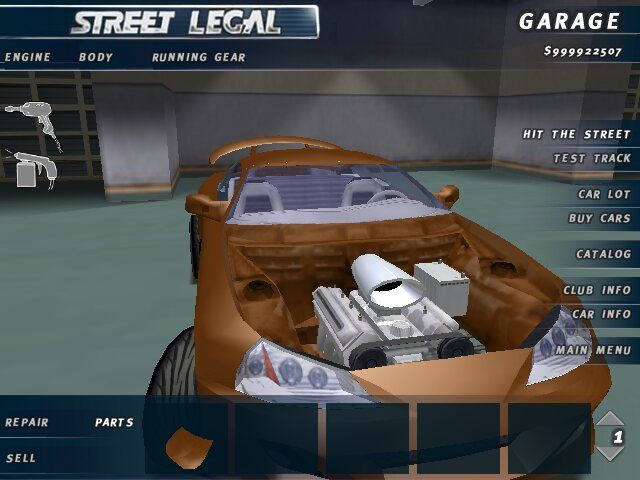
Street Legal’s visuals reflect the early 2000s era of PC gaming, with a focus on functional detail over lush environments. Car models are fairly detailed for their time, showcasing individual bolts on engine blocks, brake rotors with heat-discoloration textures, and bumpers with realistic deformation. When you open the hood in the garage, the rendering quality delivers enough clarity to identify each customizable part, which enhances immersion during the build process.
Racing environments are relatively sparse, featuring urban streetscapes with basic buildings, streetlights, and traffic obstacles. The lighting system provides day-night cycles and headlight beams that realistically cast shadows, but overall textures can appear flat and repetitive. Despite this, the minimalistic design helps maintain performance on mid-range hardware of the period, ensuring smooth frame rates even during intense drag or circuit races.
One standout visual element is the damage modeling during races. Watch in real time as your chassis bends, panels scrape, and windows crack under heavy impact. Smoke and sparks from collisions and tire burnouts add grit to the street-racing atmosphere. Though particle effects are modest by modern standards, they effectively convey the car’s physical state, reminding players that every scrape and dent has consequences.
While modders have since created graphical overhauls and texture packs, the base game’s visuals remain serviceable. If you value precise mechanical representation over photorealistic scenery, Street Legal’s graphics will still hold up as a nostalgic yet functional foundation for your garage-to-finish-line adventures.
Story
Street Legal doesn’t burden players with a heavy narrative. There’s no sprawling plot or intricate character arcs—your journey is defined by the open-ended progression from rookie racer to street-racing legend. You start with modest aspirations and a small bankroll, gradually facing club members of increasing skill as you upgrade your ride. Each victory brings money, reputation, and access to more powerful engines such as the V8 and eventually the V10 turbocharged beasts.
The lack of scripted cutscenes or voiced dialogue keeps the experience focused on cars and competition rather than personalities. Instead, the story unfolds emergently through your achievements and failures on the asphalt. Challenging veteran racers feels like stepping up in rank, and the community respect meter serves as your only formal gauge of status. This minimalist approach may feel sparse to players seeking narrative depth, but it simultaneously grants freedom to carve your own path.
Club rivalries and informal dialogues happen via menu prompts and text notifications, offering just enough context to understand your next challenge. While some gamers prefer a more character-driven storyline, Street Legal’s choice to let the cars take center stage resonates with auto enthusiasts who relish every mechanical detail. The world-building is subtle, conveyed through the garages you visit, the street circuits you unlock, and the variety of opponents you face.
In essence, the story is a backdrop for mechanical mastery and racing prowess. If you don’t need a rich cinematic narrative but crave an authentic progression of skill, reputation, and vehicular power, Street Legal’s storyline will suit you perfectly.
Overall Experience
Street Legal carves out a niche for players who want both the wrench-turning satisfaction of Gearhead Garage and the adrenaline rush of street racing. By seamlessly integrating vehicle construction and real-time racing, it creates a gratifying loop: earn cash on the track, reinvest it in better parts, and hit the streets even faster. The payoff of crossing the finish line in a car you painstakingly built is hard to beat.
On the downside, the interface can feel dated, and certain systems—such as the in-game economy and parts marketplaces—require more polish. Occasional bugs and crashes, especially in unpatched versions, can interrupt the flow. Still, the dedicated modding community has patched many issues over time, providing quality-of-life enhancements and expanded car rosters.
For aspiring mechanics and racing fans, Street Legal offers a depth of customization rarely seen in modern titles. Every race matters, not just for the thrill of speed but for the financial and reputational risks tied to your car’s condition. The balance of risk versus reward makes each decision—whether to fit a high-performance turbo or reinforce the chassis—meaningful.
In conclusion, Street Legal may not look like today’s AAA racers, but its emphasis on mechanical authenticity and street-level competition delivers a uniquely satisfying experience. If you’re ready to get your hands dirty under the hood and then unleash that handiwork on urban circuits, Street Legal remains a compelling choice for niche racing enthusiasts.



Reviews
There are no reviews yet.