 Retro Replay Retro Gaming History, Reviews & Emulation


Game Overview
Gameplay
System Shock 2 starts by making you choose what kind of survivor you want to be, then spends the rest of the game testing whether you made smart decisions. A Marine begins with a combat edge, a Navy officer has a head start with technical work, and an OSA agent can access psionic abilities early. None of those choices locks you into a class. You can spend cybermodules to branch out, and that freedom is a huge part of the game’s pull. You are not simply finding a stronger gun. You are gradually building a person who can shoot, hack, repair, research, or bend the rules with psi.
The shooting is deliberately uneasy rather than power-fantasy smooth. Guns take different ammunition types and firing modes, but they wear down fast enough that every long firefight has consequences. Melee weapons, armor, implants, healing supplies, and temporary boosts turn ordinary exploration into resource management. When you are low on supplies, a hostile corridor is not a shooting gallery. It is a problem to solve while trying not to waste the tool you will need ten minutes later.
That survival focus is why the game remains so tense. Enemies can appear again in explored territory, and you are often underpowered when encountering a new threat. Researching alien gear and enemy organs adds another layer of preparation, rewarding thorough searches for chemicals and useful materials. The systems can feel punishing when a weapon breaks at the wrong moment or your preferred approach is too expensive to maintain, but that friction is purposeful. System Shock 2 makes progress feel earned because it rarely lets you coast.

Graphics
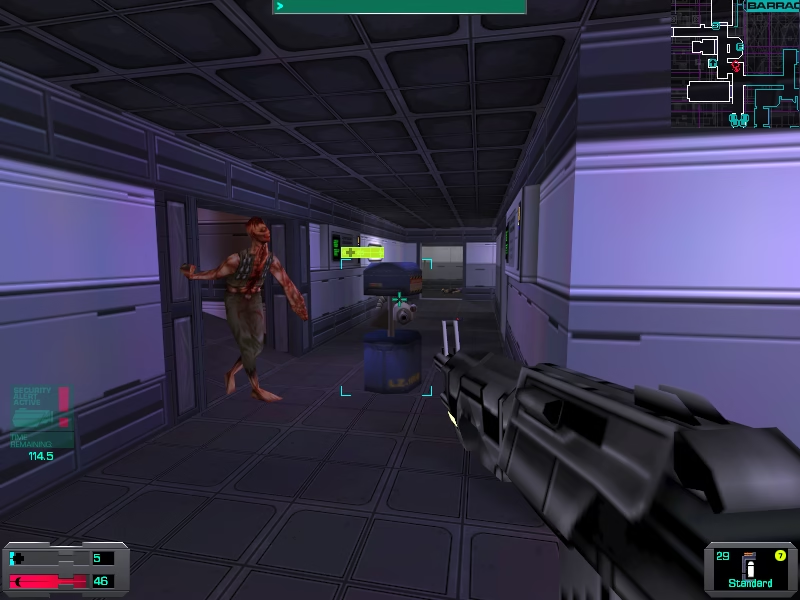
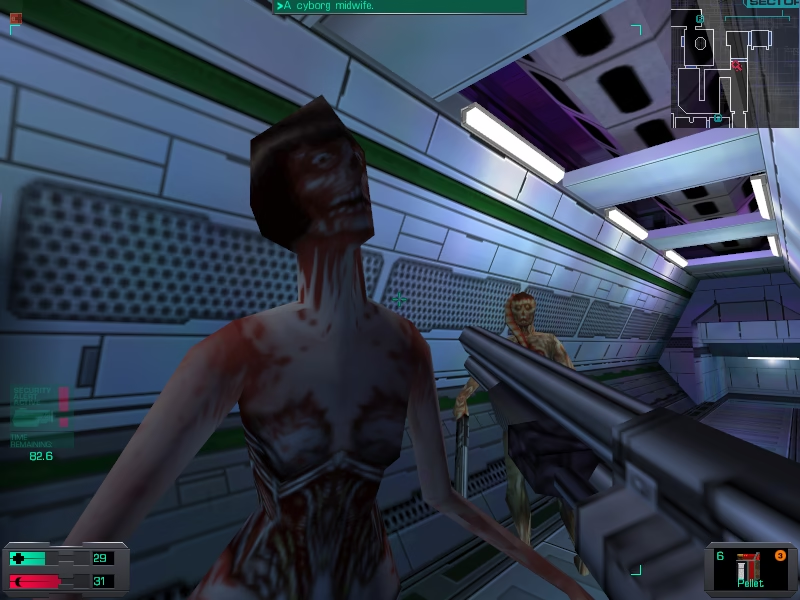
The original Windows version has chunky late-1990s 3D, but its ship interiors still create a strong sense of place. Clean white corridor panels, harsh ceiling lights, dark machinery, and bloodied human-sized mutants make close-range encounters unpleasant in exactly the right way. The enemies look angular and dated, yet their gaunt faces and exposed wounds remain disturbing when one crowds the camera.
There is also a surprisingly colorful urban area early on, with towering brown structures, glowing red and blue signs, and an amber sky overhead. It stands apart from the cramped metallic spaces that dominate the journey and gives the game one memorable splash of sci-fi city color.
Story
You wake from cryosleep aboard the Von Braun with most of your memory missing, a ship full of dead or mutated crew, and a woman on the radio claiming to be the only human survivor. It is a great horror setup because it gives you an immediate direction without explaining away the mystery. You have to move through an apparently ruined mission while deciding how much faith to place in the voice guiding you.
Much of the backstory arrives through messages left by crew members before the infestation consumed the ships. That approach turns exploration into investigation. Every recovered account adds human detail to the disaster, and the gradual assembly of what happened is more effective than dumping the whole premise on you at once.
The story works because it does not separate fear from your day-to-day struggle. The same halls where you hear about the crew’s final moments are where you must conserve ammo, patch yourself up, and push toward the next locked area. If you enjoy science-fiction horror that trusts you to piece together the catastrophe, this is still an unusually gripping journey.
Overall Experience
System Shock 2 earns its reputation by making its shooter and role-playing halves depend on each other. Character growth is not a detached stat exercise, and combat is not a string of disposable arena fights. Your upgrades affect how you survive the ship, while the ship constantly exposes the limits of your chosen build.
It can be a rough companion. Weapon deterioration, scarce supplies, and returning enemies can turn a good run into a frustrating scramble, particularly if you spend cybermodules without a plan. That is also why it has such a distinct personality. The game asks you to adapt, take risks, and live with imperfect choices instead of handing you a reliable path to dominance.
Give System Shock 2 a chance if you want horror with systems to learn and a hostile space-bound setting that makes every resource matter. It remains best for patient gamers willing to explore thoroughly and accept some old-school harshness. The payoff is a tense, flexible, and deeply satisfying descent into disaster.


Reviews
There are no reviews yet.