 Retro Replay Retro Replay gaming reviews, news, emulation, geek stuff and more!
Retro Replay Review
Gameplay
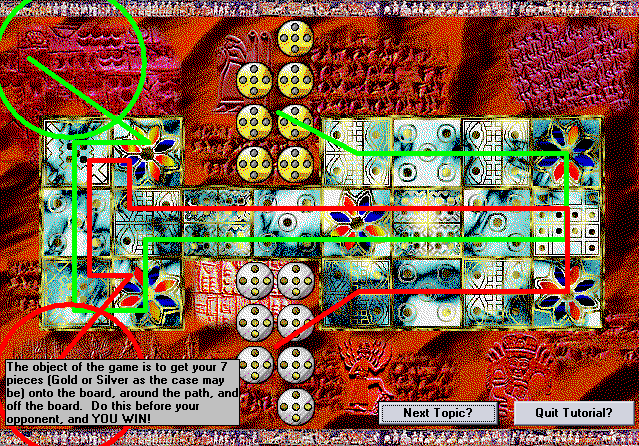
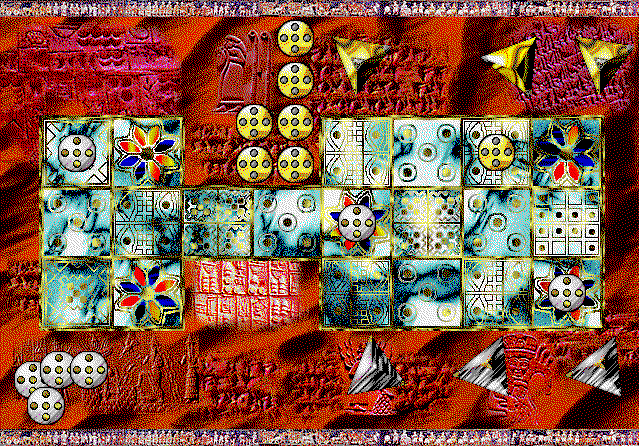
The Royal Game of Ur offers a faithful digital rendition of the 3,500-year-old Sumerian pastime, translating an ancient board title into an intuitive computer experience. Players control seven markers each, rolling three tetrahedral dice that yield between zero and three pips per throw. Movement follows a fixed path on the board, and the objective is to guide all your markers off the end of the course before your opponent does the same.
(HEY YOU!! We hope you enjoy! We try not to run ads. So basically, this is a very expensive hobby running this site. Please consider joining us for updates, forums, and more. Network w/ us to make some cash or friends while retro gaming, and you can win some free retro games for posting. Okay, carry on 👍)
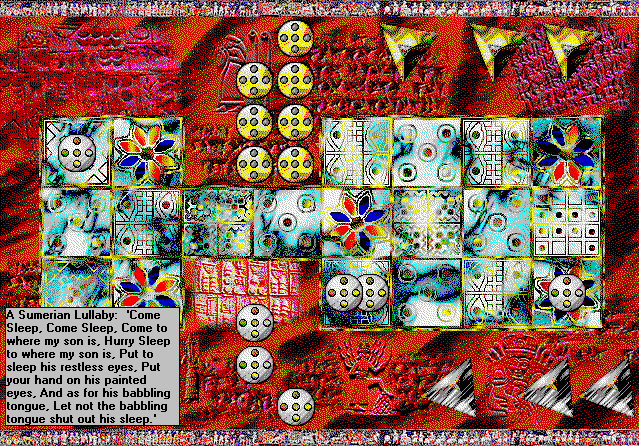
What makes this conversion stand out is how it automates every rule nuance. You only click on the marker you wish to advance after rolling; illegal moves are simply grayed out, so you cannot inadvertently break the rules. Landing on an opposing token “bumps” it back to start, but caution is advised when challenging doubles—two defenders on a square will send your piece home instead. Special rosette spaces reward precise landing with an extra five-square jump, and missing a rosette carries its own penalty by handing initiative to the opponent.
Tutorials and contextual hints guide new players through the mechanics step by step. At the beginning of your first match, a popup demonstrates dice rolls, piece selection, bumping, and rosette rules. If you ever forget a detail, an in-game help file spells out every aspect of play, from entry requirements to end-game conditions. Altogether, the gameplay loop feels quick, strategic, and low-stress, making it ideal for both history buffs and casual gamers seeking a turn-based diversion.
Graphics
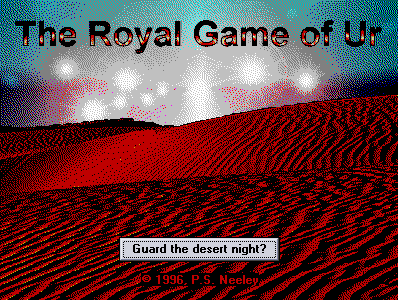
Visually, The Royal Game of Ur strikes a balance between polished modern UI and thematic antiquity. The wooden board texture is rendered with subtle grain details, while the rosettes shimmer in a soft gold tone. Marker designs are minimalist yet distinct—one side uses ivory-white pawns, the other onyx-black—ensuring pieces remain visible against the board’s sandy backdrop.
Dice animations further elevate the presentation. Rather than a simple number pop-up, each tetrahedron tumbles realistically across the board before settling on a face. Camera angles shift slightly with each roll, giving a satisfying sense of weight and randomness. Sound effects—an echoing clatter of dice and a soft chime on rosette landings—add tactile feedback without becoming repetitive.
The menus and HUD are crisply laid out. A sidebar shows current pip totals and available moves, while a turn indicator glows around the active player’s portrait. Even the “Sumer facts” appear in a framed text box that evokes a clay tablet. Overall, the graphics serve both function and atmosphere, immersing you in an ancient world rendered through modern polish.
Story
Strictly speaking, The Royal Game of Ur has no fictional storyline—after all, it’s a board game conversion. However, it weaves in rich historical context through an optional story mode-like feature called “Sumer facts.” At the start of each session, a snippet of Sumerian lore appears: insights into temple rituals, pharaohic rulership, or daily city-state life along the Euphrates.
The included help file doubles as a brief digital chronicle, detailing the archaeology of Ur, the game’s spread to India and the Mediterranean, and the significance of rosette symbolism in Mesopotamian art. This background reading feels more like an interactive museum placard than a textbook, offering bite-sized nuggets of information that deepen appreciation for the gameplay mechanics you’re enjoying.
By combining ancient mythos with practical tips, the game creates an educational overlay without disrupting play. You can toggle these historical blurbs on or off if you prefer a pure gaming experience. Either way, the blend of cultural storytelling and classic board-game action sets a unique tone that stands out in the digital adaptation space.
Overall Experience
The Royal Game of Ur delivers a compact yet endlessly replayable package. Matches typically last under ten minutes, making it perfect for quick breaks or leisurely afternoons. The AI offers multiple difficulty levels—ranging from a forgiving novice to a calculating strategist—so you can tailor the challenge to your patience and skill.
Replayability is fueled by both human-vs-human and AI-only modes. Pass-and-play on a single device facilitates local matches with friends, while online matchmaking (where available) lets you test your luck against distant opponents. The game logs past moves and highlights pivotal turns, allowing you to review and refine your approach over time.
Whether you’re drawn by historical curiosity or simply enjoy turn-based tactics, The Royal Game of Ur stands out as a polished, informative adaptation of one of humanity’s oldest games. Its clean interface, faithful rule enforcement, and cultural annotations create an overall experience that’s more than just a novelty—it’s a small window into ancient Sumer, wrapped in engaging gameplay.

Reviews
There are no reviews yet.