 Retro Replay Retro Replay gaming reviews, news, emulation, geek stuff and more!

Retro Replay Review
Gameplay
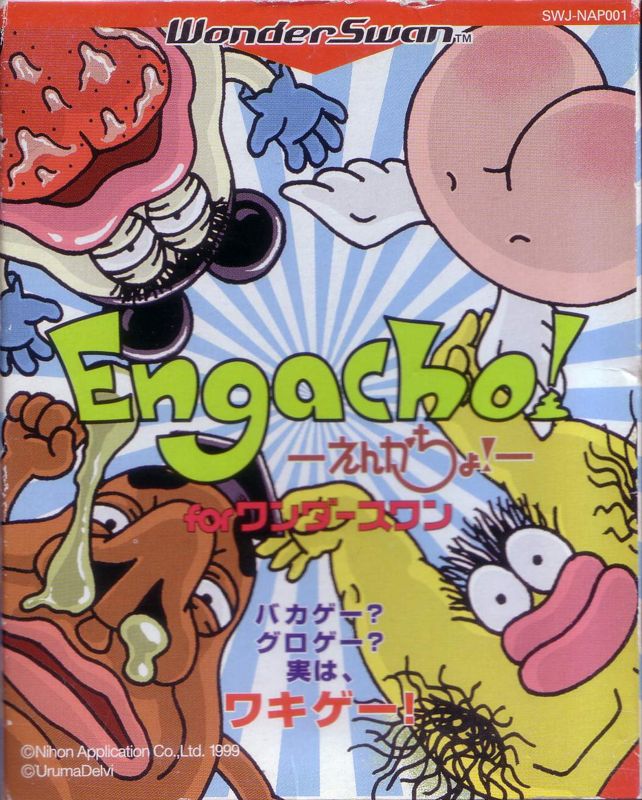
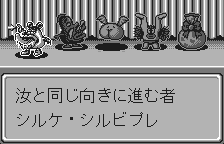
Engacho! on the WonderSwan builds its entire challenge around one deceptively simple mechanic: moving Sunzuki through a grid of rooms while avoiding the Oops Five monsters. Each monster follows a unique movement pattern—some mirror your steps exactly, others move opposite, and a few have more idiosyncratic behaviors. Because every turn you take triggers movement from every monster, success hinges on careful planning and pattern recognition rather than quick reflexes. The result is a puzzle game that feels as much like chess against five unpredictable opponents as it does like a children’s pastime brought to life.
(HEY YOU!! We hope you enjoy! We try not to run ads. So basically, this is a very expensive hobby running this site. Please consider joining us for updates, forums, and more. Network w/ us to make some cash or friends while retro gaming, and you can win some free retro games for posting. Okay, carry on 👍)
The game offers three distinct modes to keep you engaged. Training mode isolates each monster type, letting you learn its quirks at your own pace. Puzzle mode strings together dozens of handcrafted rooms of varying shapes, complete with obstacles and choke points that turn a simple cat-and-mouse chase into a genuine brain-teaser. Battle mode then throws you into large arenas swarming with all five monsters at once, demanding split-second planning and spatial awareness. This tiered approach eases you in gently before ratcheting up the tension, giving both newcomers and veterans a reason to stick around.
Controls on the WonderSwan are intuitive: use the D-pad to choose your direction and the A or B button to confirm. There’s no running or jumping—every move is deliberate and final. Because the game is turn-based, you can pause between moves to consider your strategy or study the map layout without the pressure of a ticking timer. This makes Engacho! an ideal handheld puzzle game for quick sessions on the bus or long stretches at home.
Graphics
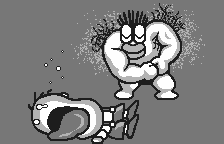
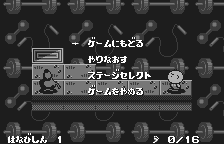
Given the WonderSwan’s hardware limitations, Engacho! makes the most of its screen by presenting clear, high-contrast sprites and tile sets. Sunzuki’s silhouette is distinct and easily tracked against the backdrop of the room, ensuring you’re never confused about your position. The Oops Five monsters each have their own unique visual flair—one hunches forward and points when mimicking, another sprints with lanky limbs when moving oppositely—so you can anticipate their next move from a glance.
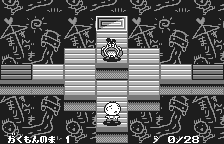
Room layouts are visually differentiated through simple but effective wall textures and floor patterns. Whether you’re navigating a narrow corridor or a wide chamber dotted with obstacles, the clarity remains constant. Animations are minimal—monsters “jump” from tile to tile rather than glide—but this choppy style actually enhances readability, making it easier to plan each step without worrying about frame-rate issues or motion blur.
Backgrounds are kept deliberately sparse, putting the focus on the strategic elements in play. Subtle shading along walls and doors helps zones stand out, and occasional themed rooms (such as castle vaults or overgrown ruins) lend variety without overtaxing the hardware. The overall aesthetic is charmingly retro, with a childlike art style that underscores the game’s playful roots.
Story
At its core, Engacho! weaves a simple but effective narrative: young Sunzuki seeks to prove his courage to an angry father by outsmarting the dreaded Oops Five. Though the storyline is light on dialogue, it provides just enough context to give each puzzle weight. You’re not simply solving mazes for the sake of it—you’re helping a boy overcome fear and earn his family’s respect.
Story segments are delivered through brief text interludes accompanied by static character portraits. While there’s no voice acting or cinematic cutscenes, the minimalist presentation keeps the pacing brisk and focused squarely on puzzle design. Each mode—training, puzzle, and battle—opens with a tiny narrative nod that reminds you why you’re facing off against these strange, disease-spreading fiends in the first place.
For younger players, the premise of evading disease-carrying monsters adds a playful sense of danger without becoming too frightening. The Oops Five are more silly than sinister, and Sunzuki’s earnest determination makes him an easy character to root for. The story never overwhelms the gameplay, but it enriches the overall package by lending emotional stakes to every carefully plotted step.
Overall Experience
Engacho! is a standout puzzle title on the WonderSwan, offering depth and replayability that belie its childlike exterior. Each new room introduces fresh wrinkles in monster behavior and room design, ensuring that the core “avoid and escape” loop rarely feels stale. Whether you’re grinding through training mode to master a single foe or diving into a gauntlet of five monsters in battle mode, the game consistently rewards forethought and patience.
On the downside, the audio is limited to simple beeps and chiptune jingles, which may feel sparse compared to more modern handheld titles. Visually, the lack of color (on early WonderSwan models) can make extended play sessions a bit hard on the eyes. However, these are minor quibbles given how tightly the mechanics are tuned and how satisfying each successful escape can be.
Ultimately, Engacho! for WonderSwan is a must-have for puzzle aficionados and retro collectors alike. Its unique cast of monsters, layered modes, and bite-sized challenges make it perfect for on-the-go gaming, while its strategic depth ensures you’ll return again and again. If you own a WonderSwan and crave a brain-bending diversion, Engacho! delivers a refreshing twist on the classic “avoid the enemy” formula.


Reviews
There are no reviews yet.