 Retro Replay Retro Replay gaming reviews, news, emulation, geek stuff and more!


Retro Replay Review
Gameplay
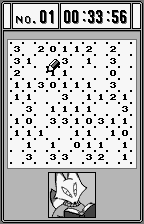
Slither Link delivers a deceptively simple premise that quickly evolves into a deeply satisfying brain teaser. Players navigate a grid of dots, drawing a continuous loop that cannot cross itself nor branch out. Each number on the grid dictates how many sides of that cell the loop must touch, turning what looks like empty space into a strategic minefield of constraints.
(HEY YOU!! We hope you enjoy! We try not to run ads. So basically, this is a very expensive hobby running this site. Please consider joining us for updates, forums, and more. Network w/ us to make some cash or friends while retro gaming, and you can win some free retro games for posting. Okay, carry on 👍)
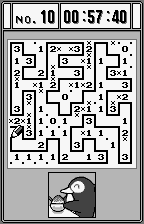
The six difficulty levels cater to both newcomers and puzzle veterans. Early stages introduce the fundamentals, allowing you to experiment with basic logic. As you progress, larger grids and trickier number placements force you to think several moves ahead, balancing the need to complete the loop against the risk of boxing yourself in.
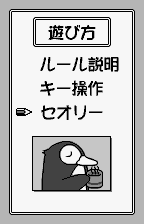
On the WonderSwan’s vertical screen, controls remain intuitive: a D-pad moves your cursor, and buttons toggle between drawing and erasing line segments. The interface is responsive, ensuring your inputs translate cleanly even when you’re making rapid-fire decisions in higher-level puzzles. A handy marker tool helps you pencil in potential moves without committing prematurely, streamlining trial-and-error approaches without losing the core challenge.
Graphics
Visually, Slither Link opts for a clean, no-frills aesthetic that emphasizes clarity over flash. The grid is crisply outlined, with dots and numbers rendered in high contrast against the monochrome backdrop. This straightforward presentation ensures that every line segment and numeral pops, reducing eye strain during marathon solving sessions.
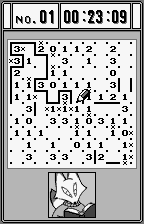
Despite the WonderSwan’s limited graphical prowess, the game’s UI design shines through thoughtful use of shading and line weight. Filled-in loop segments appear distinctly bold, while tentative markers and erasures are drawn with lighter strokes. This layered approach helps you distinguish between confirmed pathways and hypotheses at a glance.
The minimal color palette extends to subtle background textures that give each puzzle screen a sense of cohesion without distracting from core gameplay. Small animations—such as the brief flash when you complete a loop successfully—add just enough visual feedback to keep the experience dynamic, celebrating your triumphs without derailing the cerebral focus.
Story
Unlike narrative-driven titles, Slither Link’s “story” unfolds through the legacy of its puzzles rather than character arcs or cutscenes. Born in the pages of Nikoli’s renowned puzzle magazine—home to the original Sudoku—this game invites you to partake in a rich tradition of number-based challenges. Every puzzle feels like a page turned from a prestigious anthology.
Each level feels like a chapter in a larger exploration of logical deduction. You start by learning to navigate the simple rules, then gradually uncover more intricate patterns and strategies. In that sense, Slither Link crafts its own narrative: the personal journey from puzzled novice to confident solver, each loop completed marking a milestone in your personal saga.
The absence of a conventional storyline actually works to the game’s advantage. There’s no distraction from the pure, meditative rhythm of puzzle solving. Instead, you build your own story—of near-misses, surprise insights, and the ultimate satisfaction of filling in the final segment to close the loop.
Overall Experience
Slither Link on WonderSwan stands out as a masterclass in minimalist puzzle design. Its six tiers of difficulty ensure that you can return again and again, scaling up the challenge at your own pace. Whether you have a few minutes or a few hours, the game accommodates short bursts of play or extended brain sessions.
For dedicated puzzle lovers, the game’s purity is a major draw. There’s no filler content—just hundreds of grids waiting to be solved, each one teasing your logical faculties in subtly different ways. The marker system and responsive controls make experimentation feel natural, encouraging you to push past sticking points without frustration.
While it may lack bells and whistles, Slither Link’s strength lies in its unyielding focus on elegant puzzle mechanics. If you enjoy Sudoku, Kakuro, or any other Nikoli creation, this loop-forming challenge will quickly become a staple in your portable gaming rotation. It’s a rewarding, replayable experience that never overpromises but consistently delivers cerebral satisfaction.



Reviews
There are no reviews yet.