 Retro Replay Retro Gaming History, Reviews & Emulation


Retro Replay Review
Gameplay
Abstacked gets interesting the moment you stop treating it like a standard line-clearing game. The stars begin on the board, and your job is to clear them by placing identical shapes on both sides. That turns the opening board into an immediate puzzle: every star is a problem already waiting for an answer, while falling pieces keep the clock moving.
Dropping pieces in pairs gives each decision extra weight. A useful shape can become a liability if its partner jams a column or blocks the position you were trying to build toward. Rotation matters because you are constantly trying to make two matching shapes meet around a star without letting the stack spread upward in the wrong places. When a planned placement clears a star and tidies the board at once, the rules click nicely.
The pressure comes from the loss condition: clear enough stars before they reach the top of the playfield, or the run ends. That makes this a more targeted kind of falling-block challenge than simply surviving as long as possible. You have to keep solving the board you have, not wait indefinitely for a perfect arrangement.
Five difficulty levels are a welcome fit for a game built on quick judgment. Start lower if you want time to understand how to frame stars with matching shapes; raise the difficulty once the basic sandwiching logic feels natural. Infinity mode should suit anyone who wants to stay in the repeatable puzzle rhythm, while Story mode offers a separate route through the same central challenge.

Graphics
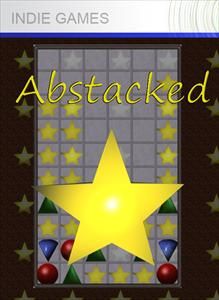
The action is built around a compact playfield of falling paired shapes, stacked columns, and stars embedded in the board. That direct layout keeps your attention where it belongs: on the gap around each star and the shapes arriving from above.

Story
Story is one of Abstacked’s two modes, alongside Infinity, but the game’s hook remains the board-level challenge of clearing stars. The mode name suggests a more guided way to engage with the puzzle rather than changing what makes each drop important.
That focus works in a puzzle game that wants you to learn through repetition. Instead of relying on plot beats to create momentum, Abstacked puts urgency in the rising pieces and the stars that still need clearing.
If you come in wanting a narrative-heavy game, the Story label should not distract from the real attraction. The meaningful progress is learning to see placements sooner: which matching shapes can close around a star, which columns need protecting, and when an apparently harmless pair will make the board harder to repair.
Overall Experience
Abstacked has a clean, specific twist on falling-block play. Clearing stars by trapping them between identical shapes is easy to state, but it asks for more deliberate placement than a simple race to complete rows. The first few games may feel cramped as pairs fill columns, yet that tension is exactly what gives successful clears their punch.
This is worth a look if you enjoy puzzle games that ask you to react quickly while still planning two or three placements ahead. It is less about broad experimentation than mastering a focused rule set, and the two modes plus difficulty range give that rule set room to test you at your preferred pace.
The payoff is the satisfying shift from scrambling to recognizing opportunities. Once you begin reading the stars as positions to frame rather than obstacles to work around, Abstacked becomes a brisk, purposeful little brain-teaser—one where a single smart rotation can save both a star and a run.



Reviews
There are no reviews yet.