 Retro Replay Retro Gaming History, Reviews & Emulation
Retro Replay Review
Gameplay
Pulse Racer grabs you with its most dangerous rule: speed is not simply a meter to fill, but a direct strain on your driver. You can use an unlimited boost, but repeated abuse stresses the vehicle until the character suffers a heart attack and flatlines. At that point, you must stop briefly to recover. It is a smart source of pressure in a genre where boosting is usually automatic muscle memory; every long burst asks whether a few seconds gained now are worth being stranded moments later.
The driving has stranger ideas than its futuristic-kart look initially suggests. Characters are visible in their vehicles, and pulling them lets you fire beams at trackside orbs, latch onto poles, and either slingshot forward or carve tighter corners. Combined with turns handled largely through leaning, that makes the racing feel more physical than a standard hold-the-stick-and-drift approach. When it clicks, you are not only choosing a line but judging when to grab, lean, attack, and push your heart rate toward the red.
Weapons keep the pack hostile rather than merely competitive. Mines, plasma beams, and missiles give you ways to disrupt rivals, and that aggression suits races built around risky bursts of speed. There is a reasonable spread of ways to play—quick race, time trial, career, and four-player split-screen multiplayer—but the bigger replay hook is INFINITRAX. Generating and saving custom tracks is the sort of feature that can keep you experimenting after the fifteen included circuits have become familiar.
Graphics
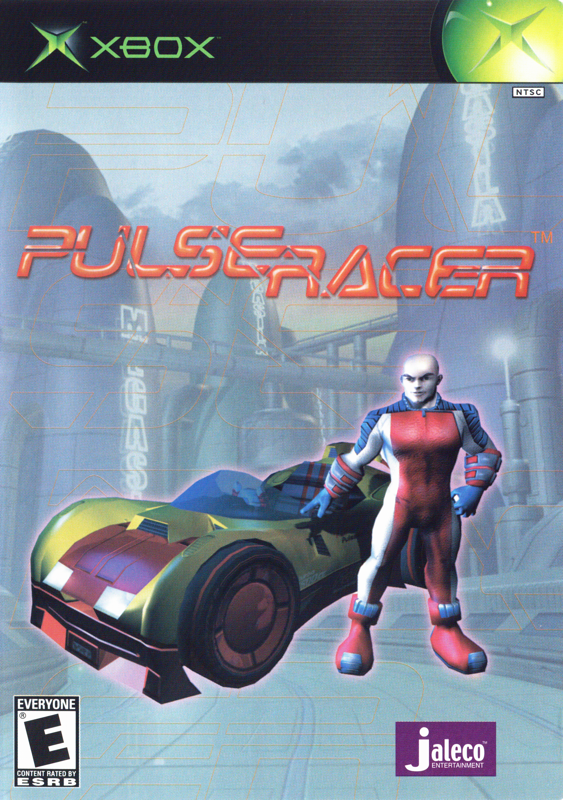
Pulse Racer puts small futuristic vehicles on the track with their drivers plainly visible inside, which matters because the characters’ leaning and pole-grabbing are part of how you steer and accelerate. The kart-like silhouettes make the racers easy to read, while beams stretching from driver to orb give that odd slingshot maneuver a clear on-screen purpose.
Story
The story is carried by a sharp sci-fi racing premise rather than a detailed dramatic setup: it is 2024, the vehicles are linked directly to their drivers, and life energy has replaced ordinary fuel. That connection gives the races a personal edge. Overusing boost is not framed as an engine overheating; it is the person in the cockpit paying the price.
That premise is strongest when the heart-rate risk becomes visible in play. A flatline and forced recovery turn the driver from decorative cockpit detail into the central stake of every reckless decision. It is a simple bit of fiction, but it does more for the racing than a generic future-racing backdrop would.
Career progress also has a practical sense of advancement through unlockable INFINITRAX sliders. As more options open up, you gain greater control over the custom maps you create. It is progression tied to experimenting with the game’s own strange tracks rather than merely collecting another vehicle or weapon.
Overall Experience
Pulse Racer is easy to respect for refusing to treat its future setting as an excuse for interchangeable hover-kart racing. The life-energy boost system gives every race a tension that standard speed pads cannot match, and the driver-led leaning and grappling ideas make the moment-to-moment handling distinctly unusual.
The catch is that the game asks you to buy into several unconventional systems at once. If you want smooth, instantly familiar arcade racing, the need to manage health, pull the driver toward track orbs, and work around forced recovery can become frustrating. Its best moments come when that chaos feels deliberate: you skim a corner, attach to a pole, surge past an opponent, and barely avoid overtaxing your driver.
Give it a chance if an eccentric early-2000s combat racer sounds more inviting than a polished genre staple, especially if local split-screen and custom track creation matter to you. Nine vehicles and fifteen tracks are a modest foundation, but INFINITRAX adds a valuable reason to keep tinkering. Pulse Racer is not consistently persuasive, yet its willingness to make speed feel hazardous gives it a pulse that many safer racers lack.
If you want to see how the game landed at launch, the contemporary Pulse Racer critic reviews show how differently reviewers responded to its unusual ideas.


Reviews
There are no reviews yet.