 Retro Replay Retro Replay gaming reviews, news, emulation, geek stuff and more!
Retro Replay Review
Gameplay
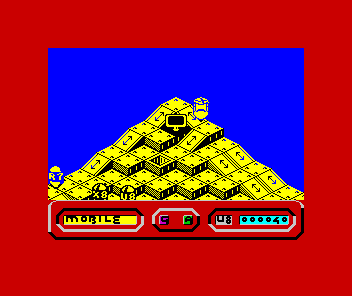
Quazatron’s gameplay builds directly on the DNA of the classic Commodore 64 shoot ’em up Paradroid, but maker Steve Turner and longtime collaborator Andy Braybrook reimagined it in a fully isometric style. You pilot the renegade robot KLP-2 through a tangled network of circuits and platforms, seeking out hostile droids to deactivate. The shift from top-down to isometric lends a sense of verticality and spatial puzzle-solving that keeps familiar Paradroid fans on their toes.
(HEY YOU!! We hope you enjoy! We try not to run ads. So basically, this is a very expensive hobby running this site. Please consider joining us for updates, forums, and more. Network w/ us to make some cash or friends while retro gaming, and you can win some free retro games for posting. Okay, carry on 👍)
The core loop revolves around three distinct methods of neutralizing enemy robots: direct firepower, forcible control (known in-game as “grappling”), or simply pushing adversaries off ledges and into circuits. Each approach has its own tactical merit. Shooting is quick but risks depleting your limited plasma reserves. Grappling offers component salvage but demands precision in a separate sub-game. And physics-based shoves can be deeply satisfying, though they require careful positioning.
Grappling is the true heart of Quazatron’s depth. Entering the grapple screen, you see your target divided into 12 radial sectors. You must flip at least 7 of them to your color to win. The contest plays like a mini-puzzle, challenging you to outmaneuver the CPU’s defenses. Victory not only deactivates the droid but also yields parts—better grappling outcomes guarantee more undamaged modules to augment KLP-2’s capabilities.
Over dozens of levels, you’ll manage your loot, decide when to risk a tough grapple for high-value components, and adapt to increasingly complex enemy layouts. The balance between action, strategy, and resource management gives Quazatron a distinct rhythm: intense skirmishes followed by thoughtful planning, ensuring no two play sessions feel the same.
Graphics
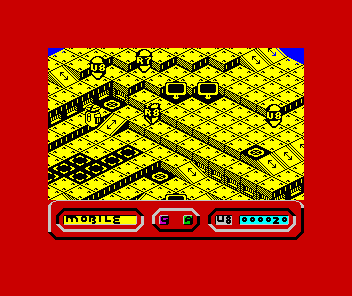
The switch to isometric presentation was not merely cosmetic; it leverages the hardware to deliver clear, crisp corridors and machinery. Walls, floors, and terminals all pop with bold outlines, making enemy positions and navigable pathways immediately readable. For its era, Quazatron’s visuals feel modern and timeless, avoiding the muddiness that plagues many late-’80s titles.
Sprites for both KLP-2 and the hostiles are cleanly designed, with smooth animation frames that convey motion convincingly. Whether you’re pivoting in a corridor or sliding a droid into a kill zone, the sense of weight and momentum is apparent. Subtle shading and color gradients lend volume to platforms, guiding your eye through the maze of circuitry.
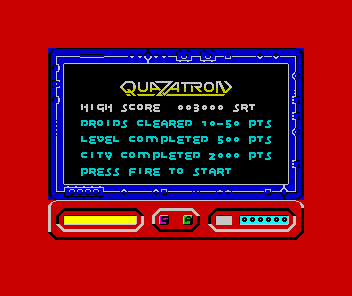
The user interface is unobtrusive yet informative. Status bars show your remaining energy and plasma levels at a glance, while the grapple screen lays out sector information in a straightforward circular grid. Component icons are distinctive—once you’ve harvested upgrades, you can recognize new weapons or shields without needing to pause or consult a separate menu.
Even on monochrome displays or lower contrast settings, the art direction holds up. High-contrast patterns delineate walkable tiles from hazards, and animated sparks or flickering lights on broken terminals reinforce the game’s mechanical ambience.
Story
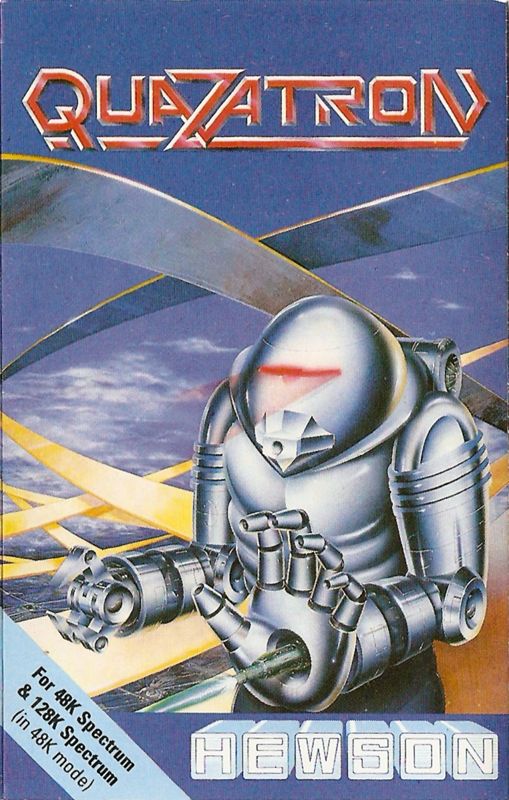
Quazatron drops you into the role of KLP-2, a renegade maintenance droid armed with an experimental control unit. Your mission: infiltrate a rogue robotic assembly line and shut down its murderous droid legions. The premise is succinct but effective, providing just enough context to drive your rampage through enemy territory.
While narrative exposition is sparse, environmental storytelling fills in the gaps. Cracked panels, sparking circuits, and abandoned control terminals suggest past attempts to contain the rebellion. Victory screens sometimes hint at the overarching threat: a factory gone awry, machines turning on their creators, and the specter of total system failure.
Dialogue is minimal—Quazatron lets the gameplay tell the story. Each successful grapple or rubble-filled corridor you clear becomes part of a larger narrative of reclamation. For players who enjoy piecing together worldbuilding from scant clues, the game delivers an engaging mystery behind the mechanical mayhem.
The familiarity with Paradroid’s plot is an asset but not a requirement. Newcomers can jump right in and still feel the weight of KLP-2’s lone-wolf struggle. For retro enthusiasts, those small nods to the original—shared names, similar level objectives—are a welcome homage without overshadowing Quazatron’s unique identity.
Overall Experience
Quazatron stands as a masterclass in adapting and expanding upon a proven formula. Its marriage of shoot-and-grapple combat, resource scavenging, and isometric puzzle elements creates a captivating loop that rewards both reflexes and planning. Few games of its era can boast such seamless integration of action and strategy.
Difficulty ramps up gracefully. Early levels serve as tutorials in disguise, acquainting you with shooting ranges, grapple timing, and environmental hazards. By mid-game, you’ll be juggling multiple objectives: preserve energy, harvest critical components, and clear mazes before they overrun you. The challenge feels fair, inviting repeated attempts rather than punishing quits.
Replayability is high. Randomized enemy placements and the optional risk-reward of high-value grapples mean no two playthroughs are identical. Component combinations also vary your loadout, encouraging experimentation with speed boosts, heavier armor, or advanced weaponry.
For anyone seeking a retro science-fiction romp with rich mechanical depth, Quazatron remains a standout. It honors its Paradroid heritage while forging its own path through isometric innovation, offering an experience both nostalgically familiar and refreshingly novel.


Reviews
There are no reviews yet.