 Retro Replay Retro Gaming History, Reviews & Emulation
Retro Replay Review
Gameplay
Backgammon Royal earns its keep by treating backgammon as the tense, tactical game it is. A good opening roll can make you feel clever; a bad one can leave you scrambling to preserve your position. Since the program follows the full rules, including the doubling cube and beaver, matches have more bite than a casual roll-and-move adaptation. You are not just trying to bring pieces home—you are deciding when a lead is strong enough to press and when a cube offer could turn a comfortable game into a disaster.
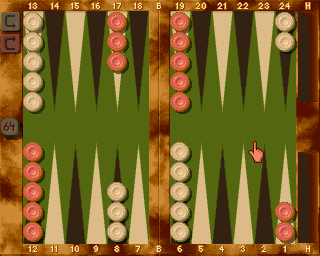
The possible-move highlighting is a genuinely useful on-ramp. In the first hour, it helps you get past the annoying question of whether a move is legal and focus on the more important question: is it wise? Newer backgammon players can use it to understand how rolls translate into choices, while experienced players can simply treat it as a convenience when the board gets crowded.
The tactics editor is the feature that gives Backgammon Royal more personality than a basic computer opponent. Instead of accepting the AI as a fixed opponent, you can train it. That is an intriguing hook for anyone who enjoys studying positions and wants games to feel less rote over time. There are only two difficulty settings, so the editor carries much of the long-term interest; if you want a deep ladder of preset opponents, this is a limitation, but tinkering with the computer’s tactical behavior is a far more memorable alternative.
Backgammon always has room for dice-induced irritation, and Royal does not pretend otherwise. You can make a sound positional decision and still watch a fortunate roll undo it. That frustration is part of the board game’s bargain, though, and the full doubling rules mean you have ways to make your judgment count before luck gets the final word.
Graphics
Backgammon Royal is built around the board and its pieces, with move highlighting giving the play area a practical visual cue when you are learning. The focus stays where it belongs: on following checker positions, available moves, and the changing tactical shape of the board.
Story
There is no authored story here. The drama comes from the match itself: an exposed blot, a blocked route home, or the moment an offer involving the doubling cube forces you to decide how much faith you have in your position.
That absence suits backgammon. You bring the narrative through your own risk-taking—whether you play cautiously after a rough roll or push an advantage hard enough to make your opponent regret staying in the game.
The tactics editor adds a small but worthwhile sense of ongoing rivalry. Training the AI turns repeat matches into something more personal than running the same board game program again; you are shaping the opponent you intend to beat.
Overall Experience
Backgammon Royal is a focused choice for Amiga owners who want proper backgammon rules rather than a decorative version of the game. The doubling cube and beaver rule give each match real stakes, and move highlighting makes the program friendlier than its serious rule set might suggest.
The two difficulty settings may feel lean if your preferred board-game software offers a large spread of AI personalities. Still, the tactics editor is a smart counterpoint. If experimenting with an opponent’s approach sounds more interesting than checking a conventional difficulty menu, Royal has a feature worth spending time with.
Give it a chance if you already enjoy backgammon or want to learn without being left alone to decode every legal move. Its payoff is not spectacle; it is the steady satisfaction of recognizing a stronger position, making a gutsy cube decision, and seeing your tactical choices matter across repeated games. For a related release, you can also look at Backgammon Royale.


Reviews
There are no reviews yet.