 Retro Replay Retro Gaming History, Reviews & Emulation
Introduction: A Console That Became a Legend
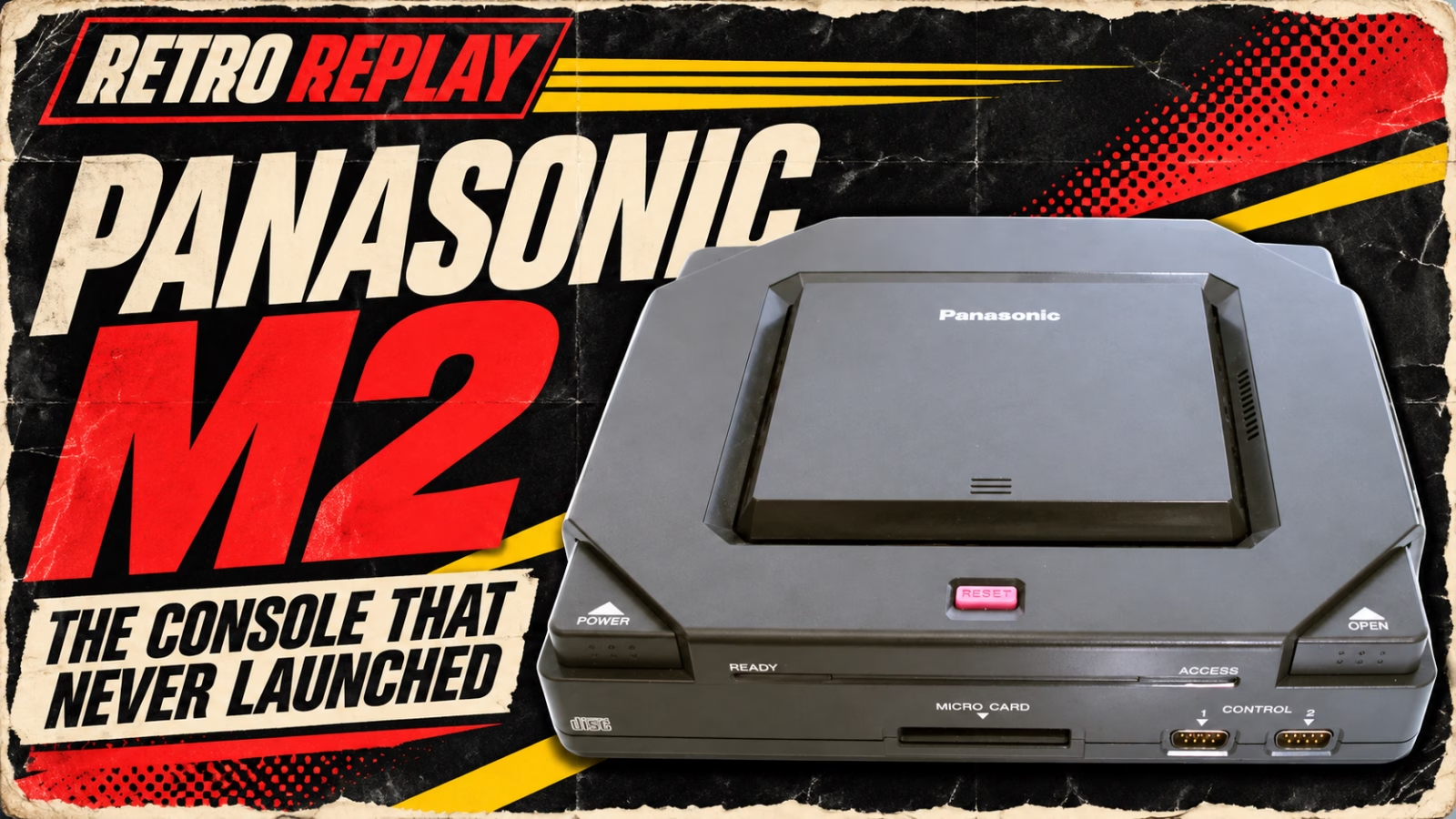
The Panasonic 3DO M2 is one of the strangest legends in retro gaming history. Unlike consoles that failed after release, the M2 never even made it to the shelves. It existed in trade shows, development kits, leaked demo discs, and the memories of industry insiders who claimed it could outclass both the PlayStation and Sega Saturn. For many gamers who grew up in the nineties, it is remembered as the rarest console that never existed.
The canceled M2 has become more than just lost hardware. It represents the fragility of the console wars, where timing and brand recognition mattered just as much as cutting-edge technology. To understand why the M2 still fascinates collectors, retro fans, and historians, we need to go back to its origins in the aftermath of the first 3DO system.
The 3DO Company and Its First Gamble
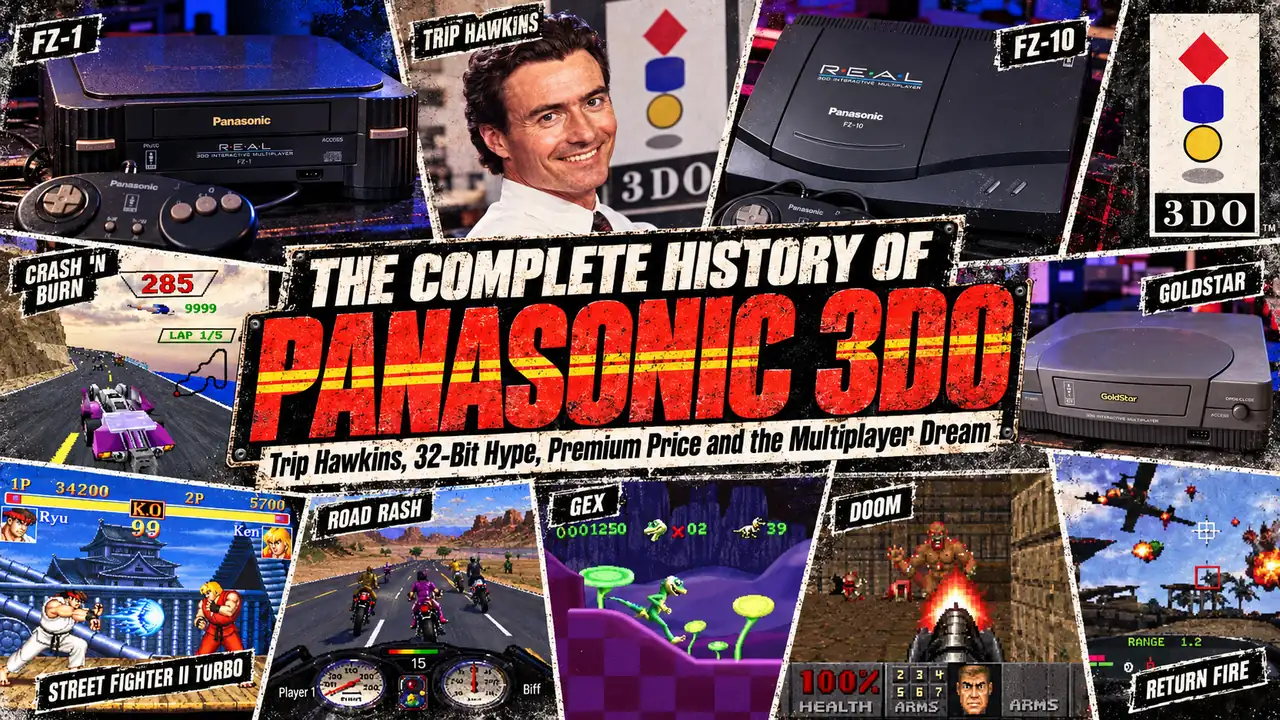
In the early 1990s, Trip Hawkins, the founder of Electronic Arts, set out to disrupt the console industry. Instead of creating a single machine, the 3DO Company licensed the hardware design to manufacturers like Panasonic, GoldStar, and Sanyo. The result was the 3DO Interactive Multiplayer, a console released in 1993 with impressive specs for its time.

The 3DO supported full-motion video, CD-ROM storage, and polygon-based graphics that were ahead of most competitors. Unfortunately, its launch price of $699 in the U.S. crippled its adoption. Consumers balked at paying so much for a console when the Super Nintendo and Sega Genesis were still thriving at far lower prices.
While the 3DO built a cult following, it struggled commercially. By 1995, Sony had launched the PlayStation with aggressive pricing, strong third-party support, and a sleek image that captured gamers worldwide. Sega had the Saturn, and Nintendo was preparing to launch the Nintendo 64. The 3DO looked outdated and overpriced.
Hawkins remembers a financial gulf behind that competition. In his Retro Replay interview, he says 3DO had access to $150 million in capital overall, while Sony spent more than $2 billion establishing PlayStation. Those are his retrospective figures for the two efforts, rather than matching annual budgets. Asked what Sony got right, he credits Ken Kutaragi with knowing what he could build and convincing the company to commit: “He convinced Sony to go all-in.”
But Trip Hawkins and his company were not done. Their next project was supposed to leapfrog the competition. That project was the 3DO M2.
The Ambition of the Panasonic 3DO M2
The Panasonic 3DO M2 began as an add-on for the original 3DO but soon grew into a standalone system. From the very beginning, its ambition was clear. While Sega and Sony were battling it out with 32-bit hardware, the M2 promised something far more advanced.
At the heart of the console were dual 66 MHz PowerPC 602 CPUs, a powerhouse design that set it apart from competitors. It boasted advanced 3D rendering, high polygon counts, smooth texture mapping, and the ability to handle full-motion video seamlessly. The specification was ambitious, but prototype demonstrations and theoretical figures cannot tell us how a finished retail library would have compared with the Sega Saturn or Nintendo 64.
Early M2 demonstrations and footage of IMSA World Championship Racing gave players something more exciting than a specification sheet to look at. Here was a recognizable racing game taking shape on hardware they could not yet buy. Those demonstrations built anticipation, although they were never a guarantee of what a finished console would deliver.
Panasonic’s $100 Million Deal
In October 1995, the 3DO Company announced a $100 million licensing agreement with Panasonic parent Matsushita, followed by a definitive agreement that December. Matsushita received exclusive rights to use M2 technology in consumer and commercial products, plus sublicensing rights. This was seen as a massive opportunity for Panasonic to establish itself as a direct competitor in the booming home console market.
The October 1995 announcement initially promised a CD-ROM product in the second half of 1996, with a DVD-based version expected later. That is a specific glimpse of the plan before the delays: M2 was being pitched as both a game machine and a foundation for other digital products. The December agreement also left 3DO with rights to develop arcade and computer applications.
For months, rumors swirled. Panasonic hinted at a 1997 launch, trade magazines speculated about price points, and some Japanese developers reportedly had access to M2 development kits. Collectors today still chase these prototypes, as only a handful were ever distributed.
The industry expected Panasonic to bring the M2 to market with a bang. The home console was canceled in 1997, although the technology continued into other products.

Why the 3DO M2 Was Canceled
The cancellation of the 3DO M2 came in a crowded market. Competition is clear enough; the exact weight of branding, production cost, and software support inside Panasonic’s decision is harder to pin down. These were the obstacles facing a launch:
Fierce Competition
By 1997, the Sony PlayStation had already taken the world by storm. Developers flocked to Sony’s console because of its developer-friendly tools, huge user base, and marketing dominance. The Nintendo 64 was carving out its own identity with 3D worlds like Super Mario 64 and GoldenEye 007. Even Sega, though struggling with the Saturn, was preparing future hardware plans. For Panasonic, entering the market that late was risky.Lack of Gaming Brand Identity
Panasonic was a respected electronics company but had no deep ties to gaming culture. Unlike Sony, which aggressively marketed PlayStation as edgy and youthful, Panasonic lacked the image to connect with the gaming audience. Without iconic mascots or developer loyalty, the M2 risked being a console with advanced specs but no must-play games.Uncertainty in Cost and Production
Advanced hardware is expensive to produce. Pricing the M2 competitively against PlayStation’s $299 launch would have been difficult. If Panasonic repeated the mistake of the original 3DO’s high entry cost, it would almost certainly fail.
Ultimately, Panasonic pulled the plug before it invested further resources. No retail launch ever happened, and the Panasonic 3DO M2 entered gaming folklore as a console that never reached retail.
The Afterlife of the M2 Hardware
Although the 3DO M2 home console was canceled, the hardware lived on in unusual ways. Panasonic repurposed the M2 chipset for arcade systems and industrial multimedia platforms.
Arcade Use: Companies like Konami adapted the M2 board for titles such as Battle Tryst and Tobe! Polystars. These games gave a glimpse of the hardware’s potential, though they remained niche arcade experiences.
Multimedia Devices: Panasonic released corporate kiosks and workstations like the FZ-21S and FZ-35S, which used M2 technology for interactive media. While far from the excitement of gaming, these machines kept the technology alive.
Prototype Games: Titles like IMSA World Championship Racing and a few unfinished projects surfaced years later. Some were nearly complete and have since been preserved by fans.
For anyone hoping to see M2 doing real work, the arcade branch is especially interesting. Battle Tryst puts the hardware behind a fighting game, while Tobe! Polystars takes it into a colorful scrolling shooter. They are commercial games people could actually play, rather than footage promising what a future living-room machine might do. They belong to the arcade branch of the story, not a home-console launch library.
In 2020, the YouTube channel Video Game Esoterica released footage of rare M2 demo discs, offering retro gamers a chance to finally see the graphics that had once been hyped in the nineties.
Collectors and the 3DO M2 Legacy
Today, the Panasonic 3DO M2 is one of the most sought-after canceled consoles among collectors. Development kits, prototype boards, and demo discs fetch high prices when they appear in auctions. For many enthusiasts, owning a piece of M2 history is like owning a fragment of gaming mythology.
Retro preservationists emphasize the importance of documenting these lost systems. Without efforts to archive and emulate the M2’s software, its story might have faded into obscurity. Instead, it continues to spark curiosity among gamers who want to know how the console wars might have been different if Panasonic had released it.
For more machines that took an unusual route through the console wars, visit our forgotten consoles feature. The original 3DO had a released game library; the canceled M2 successor never received a retail home-console catalog.
The M2’s Unfinished Place in the Console Wars
The Panasonic 3DO M2 arrived in magazine coverage while players were already choosing between PlayStation, Saturn, and Nintendo 64. A new machine would have needed to win room beneath the television, room in the budget, and the next game purchase.
Had the M2 launched in 1996, it might have been a contender. Had Panasonic secured exclusive partnerships with major developers, the console could have built momentum. Instead, it became a cautionary tale.
For modern retro gaming fans, the M2 represents one of the greatest “what if” stories of all time. It is a reminder that for every PlayStation success story, there are canceled consoles like the M2 that almost changed gaming but never got the chance.
Conclusion: The Console That Never Was
The Panasonic 3DO M2 will always be remembered as the rarest console that never existed. It was hyped as a technological leap forward, positioned to compete with PlayStation, Saturn, and Nintendo 64, and it generated enormous excitement among those who saw its demos. But poor timing, lack of brand identity, and the sheer dominance of Sony ensured that the M2 never reached consumers.
Today, it survives through prototypes, rare demo discs, and the dedication of collectors and historians who refuse to let its story fade. The canceled 3DO M2 is more than lost hardware. It is a legend in retro gaming history, a symbol of ambition undone by circumstance, and a permanent entry in the long list of gaming’s greatest “what ifs.”
Super Rare Panasonic 3DO M2 Console Pulled From Sale After Abuse
The Panasonic 3DO M2 has always been surrounded by mystery and rarity, but a July 2025 attempt to sell one of these elusive machines turned chaotic. A collector listed an M2 unit valued at over 20,000 dollars, sparking immediate attention across the retro gaming community. Instead of excitement, the sale triggered a flood of angry messages accusing the seller of dishonesty and even questioning whether the console itself was real.
Overwhelmed by the volume and hostility of the responses, the seller withdrew the console from the market entirely. He confirmed that the hardware was going back into storage and expressed frustration at how quickly what could have been a landmark sale became a lightning rod for abuse.
Incidents like this highlight how fragile the preservation and collecting scene can be. The 3DO M2 is one of the rarest systems in gaming history and only a handful of authentic units are known to exist. Whenever one surfaces, it should be an opportunity to celebrate and study a lost chapter of gaming rather than a chance to tear down those bringing it to light.
You can read the full report from Time Extension here.



My cousin has a 3DO way back in the day. It was ahead of its time and had a few good games. Never heard of the M2 here.
Callin Ferrara I had a 3do. My mom got me one for Christmas god bless her. No idea how she came up with the money for that. She worked her butt off in some dirty factory doing overtime every week to make my childhood special. As for the 3DO, IT WAS AMAZING.
David Becker wow that was very kind. My cousin was a grown man then and many years older than. He was also working in software engineering then so he was into a lot of the latest tech hardware out there. And at that time it was the 3DO which was new and for a little while was really kind of like this phantom piece of hardware in gaming.