 Retro Replay Retro Gaming History, Reviews & Emulation
Retro Replay Review
Gameplay
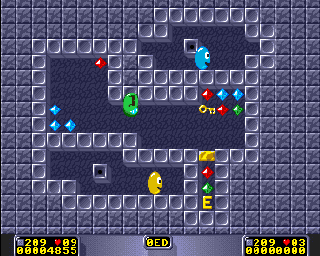
BrainMan makes its intentions clear the moment you start moving: collect the required stars, find the exit, and do not waste pushes. You control a blob directly from a top-down view, but the real challenge is not movement speed. It is planning the order in which the room can safely be changed. That familiar Sokoban-style restriction—blocks can be pushed but never pulled—means every shove deserves a second thought.
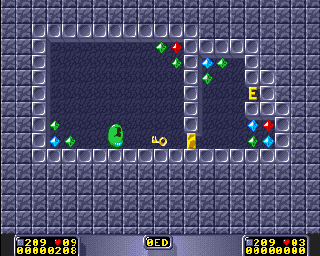
Keys make that basic idea more interesting. They behave like pushable blocks, yet they are also needed to open closed doors. A key is therefore never just an object to clear out of your way. Put it in a corner and you may have destroyed the solution; push it past the route you need and the exit can become unreachable. That tension gives the puzzles a nicely mean edge, because a move can look productive while quietly ruining the level.
The other demands stop the game from becoming a pure crate-routing exercise. You need enough stars before leaving, must avoid touching other blobs, and sometimes work under a time limit. These ingredients can make a board feel busy, but they also create worthwhile priorities: do you secure the key path first, grab stars while the route is open, or head for safety before the clock becomes a problem?
Frustration arrives when you recognize an unwinnable position only after several careful moves. BrainMan does not sound forgiving by nature; failure is built into the puzzle language. If you enjoy restarting with a clearer plan, that sting is part of the reward. If you want puzzles that let you improvise freely, the irreversible pushes and corner traps will wear on you.

Graphics
The game uses a top-down, fixed or flip-screen puzzle layout built around a blob, stars, blocks, doors, keys, exits, and other blobs. That overhead view is the right one for this kind of challenge: you can see the lanes, corners, and blocked routes that determine whether a push is safe.
Story
BrainMan is framed around level goals rather than a narrative journey. You are a blob with a simple job in each stage: collect enough stars and locate the exit.
That spare setup suits the game. The drama comes from the board state—the door still shut, the key sitting in the wrong lane, the star that seems easy until reaching it blocks the way back—not from characters or plot turns.
As a result, you should not come here expecting story momentum between puzzles. The forward pull is your own urge to solve the room that just beat you and see whether the next one has an even nastier arrangement waiting.
Overall Experience
BrainMan sounds like a compact but demanding puzzle game that understands how much trouble a single pushable object can cause. The star requirement, doors, keys, enemy blobs, and occasional timer give its levels several pressures to juggle, while the central rule remains clean enough to understand immediately.
Its biggest strength is also its warning label. Irreversible mistakes are the point, and the game asks you to live with them long enough to learn from them. There is a particular satisfaction in finally seeing that a key had to be positioned before you touched a tempting nearby star, but it takes patience to earn that realization.
Give BrainMan a chance if deliberate, punishing board puzzles sound relaxing rather than exhausting. It is unlikely to win over anyone who dislikes backtracking after a bad move, but puzzle fans who enjoy mapping consequences in their head will find a solid reason to keep trying one more room.


Reviews
There are no reviews yet.