 Retro Replay Retro Replay gaming reviews, news, emulation, geek stuff and more!
Retro Replay Review
Gameplay
Empire: Wargame of the Century centers on one clear objective—to conquer the world through strategic deployment of your armies. You begin with a single city, tasked with producing units ranging from ground troops and tanks to fighter planes, ships, and even submarines. Although there are only eight unit types in total, each possesses unique strengths, movement ranges, and combat values that force players to think several turns ahead.
(HEY YOU!! We hope you enjoy! We try not to run ads. So basically, this is a very expensive hobby running this site. Please consider joining us for updates, forums, and more. Network w/ us to make some cash or friends while retro gaming, and you can win some free retro games for posting. Okay, carry on 👍)
Fans of chess and Risk will appreciate the game’s deep strategic layers. Deciding which unit to build and where to position it can be the difference between a crushing victory or a crushing defeat. Terrain also plays a critical role: coastal cities give you naval advantages, while remote cities can serve as launching pads for surprise attacks. Balancing offense, defense, and production capacity requires foresight, and small mistakes can be ruthlessly exploited by wary opponents.
Multiplayer matches heighten the tension, as human opponents tend to devise unpredictable strategies that can upend your carefully laid plans. The turn-based system allows for deliberate, contemplative play, giving casual and hardcore strategists alike the time needed to weigh each decision. Even in single-player mode, formidable AI opponents provide a challenging sandbox in which to hone your skills.
Overall, the core gameplay loop is elegantly simple yet offers near-infinite replayability. Victory feels earned when you watch enemy strongholds fall one by one, and plotting the next move becomes as addictive as any classic board game.
Graphics
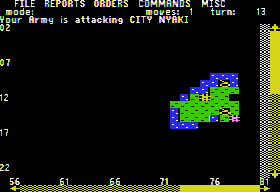
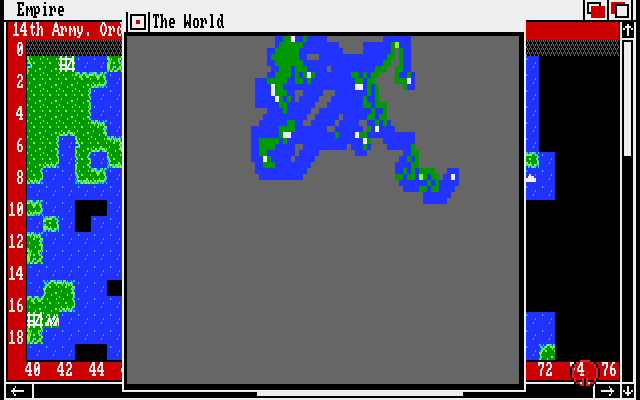
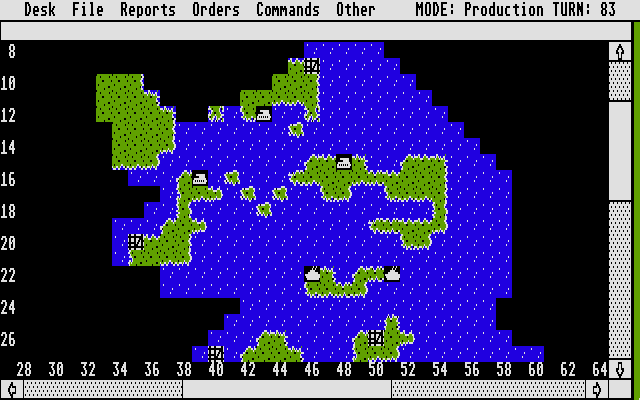
Visually, Empire: Wargame of the Century embraces a clean, top-down, tile-based aesthetic that focuses squarely on clarity and function over flashiness. Units are represented by distinct icons, making it easy to differentiate between infantry, armor, and naval forces at a glance. While it lacks high-end 3D effects, the game’s minimalist approach ensures that strategic information is always front and center.
The color palette is bright and utilitarian, with each faction or player assigned bold hues so you can instantly tell friend from foe on the sprawling world map. Animations are modest—units simply move from tile to tile and engage in brief, stylized combat exchanges—but this efficiency keeps turns moving swiftly and maintains the game’s brisk pace.
Maps range from real-world geography to procedurally generated worlds, all adhering to the same clean interface. Zooming in provides a more detailed look at city fortifications and terrain types, while zooming out helps you orchestrate large-scale campaigns without losing the forest for the trees. Though dated by modern standards, the graphics serve their purpose flawlessly.
For players who value substance over spectacle, Empire’s visuals are more than sufficient. They strike a balance between readability and thematic flair, ensuring that each battle feels both manageable and immersive.
Story
Empire: Wargame of the Century does not rely on an elaborate narrative or cinematic cutscenes. Instead, it offers a sandbox-style framework where you write your own history. Each match unfolds like a board game campaign, with rivalries, shifting alliances, and dramatic comebacks organically emerging from player decisions.
This open-ended format encourages creativity. Will you pursue a all-out blitzkrieg to seize continents rapidly, or adopt a more measured approach, fortifying your cities and wearing down enemies through attrition? Every playthrough tells a different story, shaped by terrain, resource distribution, and the personalities of your opponents.
Despite the absence of a scripted storyline, the game’s world-building is implicit in its mechanics. Naval blockades, surprise submarine strikes, and airborne assaults evoke grand strategic narratives that are more compelling when they arise naturally rather than from preordained plot points.
Ultimately, the “story” in Empire is the tale of your rise to power, recounted in victory flags and captured provinces. It’s less about a fixed set of events and more about the emergent drama that every strategic decision generates.
Overall Experience
Empire: Wargame of the Century stands as a testament to timeless strategy design. Its combination of straightforward rules and deep strategic options ensures that both newcomers and veteran wargamers find something to love. Matches are highly replayable, with different map sizes, unit compositions, and opponent behaviors keeping each session fresh.
The learning curve is approachable yet rewarding. Early turns serve as tutorials in resource management and positioning, while later stages reward those who can juggle production, logistics, and battlefield tactics simultaneously. Even without modern graphical bells and whistles, the game’s clarity shines through, letting strategy buffs focus on planning and outmaneuvering foes.
Multiplayer sessions can become legendary, with alliances forged and broken in a single move, and comeback victories sparking elation that few contemporary games can match. Solo players will also find satisfaction in mastering the AI and experimenting with unconventional strategies.
In summary, Empire: Wargame of the Century remains a must-play for strategy enthusiasts. Its enduring appeal lies in the perfect blend of simplicity and depth, providing countless hours of engaging gameplay that feel both familiar and endlessly inventive.


Reviews
There are no reviews yet.