 Retro Replay Retro Replay gaming reviews, news, emulation, geek stuff and more!

Retro Replay Review
Gameplay
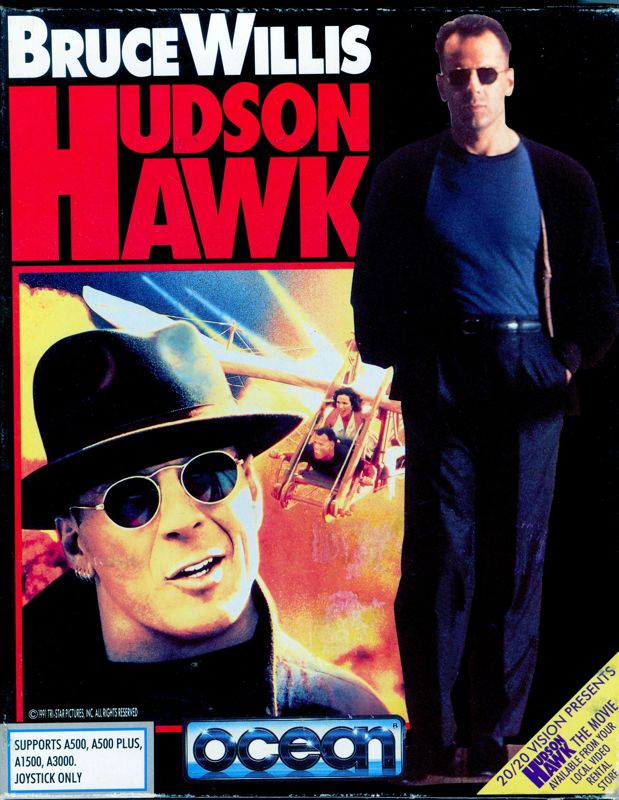
Hudson Hawk delivers a classic platforming experience that embraces the era’s tight controls and level-based progression. Players step into the shoes of Eddie “Hudson Hawk” Hawkins, navigating side-scrolling environments filled with obstacles, enemies, and secret paths. The core mechanic revolves around precise jumping, timing, and the ingenious use of Hudson’s infinite supply of baseballs to stun or distract foes and activate distant switches. This blend of action and puzzle-solving keeps each stage fresh as you figure out how to manipulate your surroundings to advance.
(HEY YOU!! We hope you enjoy! We try not to run ads. So basically, this is a very expensive hobby running this site. Please consider joining us for updates, forums, and more. Network w/ us to make some cash or friends while retro gaming, and you can win some free retro games for posting. Okay, carry on 👍)
The game offers a moderate difficulty curve that ramps up as you progress from New York’s Rutherford Auction House to the Vatican’s hallowed halls and finally to the foreboding Castle Da Vinci in Italy. Early levels ease you into simple guard patrols and basic switch puzzles, while later stages introduce more complex enemy patterns—ranged guards, guard dogs, crazed nuns—and environmental hazards like security beams and spiked floors. With a handful of lives and limited continues, Hudson Hawk demands patience and memorization, rewarding trial-and-error mastery.
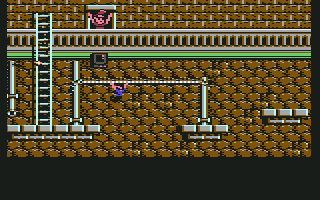
Level design frequently encourages exploration and creative problem solving. You’ll shimmy along pipes, crawl through tight vents, and stack crates to reach out-of-the-way ledges. The baseball mechanic isn’t just another projectile; it doubles as a versatile tool for luring guard dogs off your tail, triggering distant switches, or creating temporary platforms by clobbering certain crates into alignment. These multifunctional uses make each baseball throw feel meaningful and strategic.
One notable downside is the lack of on-screen checkpoints within longer levels, forcing players to replay large sections after a single misstep. While this can be frustrating, it also heightens the sense of accomplishment when you finally conquer a challenging segment. Overall, Hudson Hawk’s gameplay strikes a nostalgic balance between action, puzzle elements, and an old-school difficulty that appeals to veteran platformer enthusiasts.
Graphics
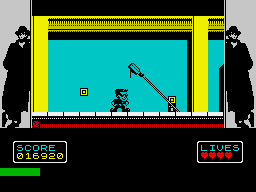
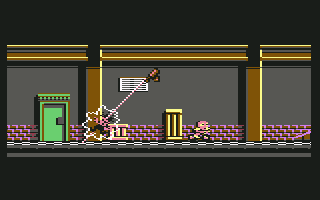
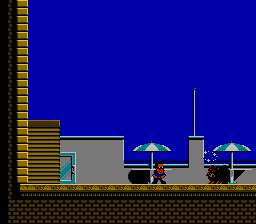
Graphically, Hudson Hawk adopts a clean, colorful art style typical of early ’90s platformers. Character sprites are well-defined and capture Eddie Hawkins’ mischievous grin and athletic build, while enemy designs—from suited security guards to balloon-riding henchmen—are instantly readable against varied backdrops. The color palette shifts appropriately between stages: muted grays and mahogany browns in the auction house, sunlit marble corridors in the Vatican, and mossy stonework in Castle Da Vinci, creating distinct visual identities for each locale.
Background parallax scrolling adds depth to the environments, particularly in outdoor sections where distant rooftops and Italian countryside roll by as you advance. While not as detailed as contemporary 16-bit titles, the game’s animations—Hudson’s crouch crawl, his punch combo, and the satisfying arc of a thrown baseball—feel smooth and responsive. The only graphical hiccups appear in instances of flickering when too many sprites occupy the same scanline, but these are rare and seldom disrupt gameplay.
The developers paid attention to contextual visual cues that tie into gameplay mechanics. For instance, certain crates bear distinctive markings to indicate they can be toppled with baseballs, and security beams glow ominously before activating. Even the smallest details, like the slight spark when a crystal shard is picked up or the changing glow of a puzzle switch, enhance immersion. These touches demonstrate a thoughtful approach to marrying art and function.
Overall, while Hudson Hawk doesn’t push the graphical boundaries of its era, it delivers a cohesive and attractive presentation that complements its gameplay. Fans of vintage platformers will appreciate its legible sprites, varied stage designs, and subtle environmental storytelling—all of which contribute to a visually satisfying experience.
Story
Based on the 1991 comedy-action film, Hudson Hawk’s narrative unfolds through brief cutscenes and onscreen captions that set the stage for each level. You learn that Eddie Hawkins, the world’s greatest cat burglar, has been released from a decade behind bars, intending to retire peacefully. Of course, true to cinematic tradition, his plans go awry when psychotic millionaire yuppies Darwin and Minerva Mayflower coerce him into a series of heists to reassemble a broken crystal capable of turning lead into gold.
The storyline cleverly weaves in elements of Da Vinci mythology: centuries-old bronze-to-gold conversion machines, hidden crystal shards embedded in Da Vinci’s Sforza sculpture, Codex notebooks, and helicopter models. This historical twist elevates the stakes beyond mere burglary, giving Hudson Hawk a globe-trotting adventure that spans New York, Vatican vaults, and Italian castles. Although the narrative delivery is minimal, well-timed text interludes and character animations make each plot beat easy to follow.
While the film’s tongue-in-cheek humor and eccentric supporting characters don’t fully translate into the game, the premise remains engaging. Occasional boss encounters—such as dueling Darwin’s bodyguards in the Auction House or thwarting Minerva’s henchmen atop ziplines—punctuate the plot with memorable set pieces. If you’re already a fan of the movie, these nods feel like satisfying callbacks; newcomers will still appreciate the straightforward “save your friend, save the world” revenge arc.
Though not a narrative powerhouse compared to story-driven adventure games, Hudson Hawk’s plot provides just enough context to motivate your heists and platforming feats. Its blend of historical lore, comedic villains, and high-stakes treasure hunting offers an entertaining backdrop to the action without bogging down the pacing.
Overall Experience
Hudson Hawk stands out as a delightful throwback to the heyday of 2D platformers, pairing agile, puzzle-infused gameplay with a lighthearted cinematic premise. Its blend of stealthy cat burglar action, inventive baseball-based mechanics, and level variety ensures that each stage feels unique. Whether dodging nuns in the Vatican or shimmying across castle battlements, the game maintains a consistent rhythm of challenge and reward.
The game’s occasional frustrations—like sparse checkpoints and memorization-based segments—are balanced by its fair controls and satisfying learning curve. Completists will appreciate the hidden bonus rooms and the thrill of discovering alternate routes, while casual players might relish the straightforward run-and-jump action. Its moderate length allows for a complete playthrough without overstaying its welcome, though replay value hinges on your appetite for mastering every tricky jump.
Graphically engaging and narratively serviceable, Hudson Hawk succeeds in capturing the adventurous spirit of its film counterpart. Memorable set pieces, thematic level design, and a trusty baseball mechanic coalesce into an experience that feels both familiar and fresh. Though it doesn’t revolutionize the genre, it delivers reliable entertainment for fans of classic platformers and movie-based adaptations alike.
In conclusion, Hudson Hawk offers a well-crafted fusion of platforming, light puzzle-solving, and cinematic flair. Its vintage charm and solid mechanics make it a worthy addition to any retro gaming collection or a nostalgic pick for those who remember the early ’90s arcade scene. Strap on your gloves, grab a baseball, and get ready to heist across the globe in this enjoyable platforming romp.



Reviews
There are no reviews yet.