 Retro Replay Retro Gaming History, Reviews & Emulation
Retro Replay Review
Gameplay
The first few minutes of Insects in Space are all about getting your bearings. You are not simply clearing enemies from a scrolling battlefield; bees are hunting babies positioned above and below you, and every stolen baby is a problem that can grow into another monster. That gives the shooting a welcome sense of urgency. A radar warns you about an abduction in progress, so the game constantly nudges you away from aimless blasting and toward a rescue.
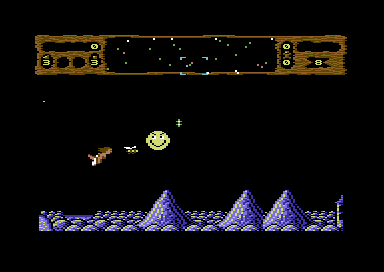
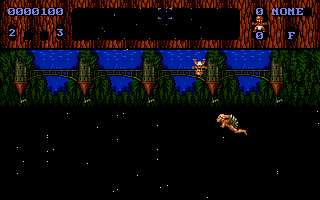
The two-screen-high level layout is its strongest wrinkle. Fly out through the top or bottom of the current area and you shift between the upper ceiling-bound route and the lower route with its floor. Babies can be stranded on either layer, so saving them means thinking vertically as well as racing left and right. Once this clicks, the game starts to feel less like a flat shooter and more like a compact emergency-response game where you are trying to be in the right place before a bee gets there.
Capturing a baby creates a worthwhile decision instead of an automatic victory lap. You can return the child to the ground for points, or hold on long enough to turn that rescue into a power-up. That risk-and-reward choice gives a little texture to the action: cash in safely, or remain exposed while hoping for a stronger payoff. The dust-cloud teleport is another useful panic button, letting Helen jump nearer to a bee target when the radar reveals trouble too far away.
Frustration comes from the same speed and divided attention that make it interesting. A rescue can demand a long chase across the scrolling stage and between its two lanes, while other bees remain active elsewhere. If you like Defender-style games because they make you juggle navigation, pursuit, and civilian rescue at once, this is a solid variation. If you want a shooter built around steady forward progress and uncomplicated enemy waves, its constant scrambling may wear thin.
Graphics
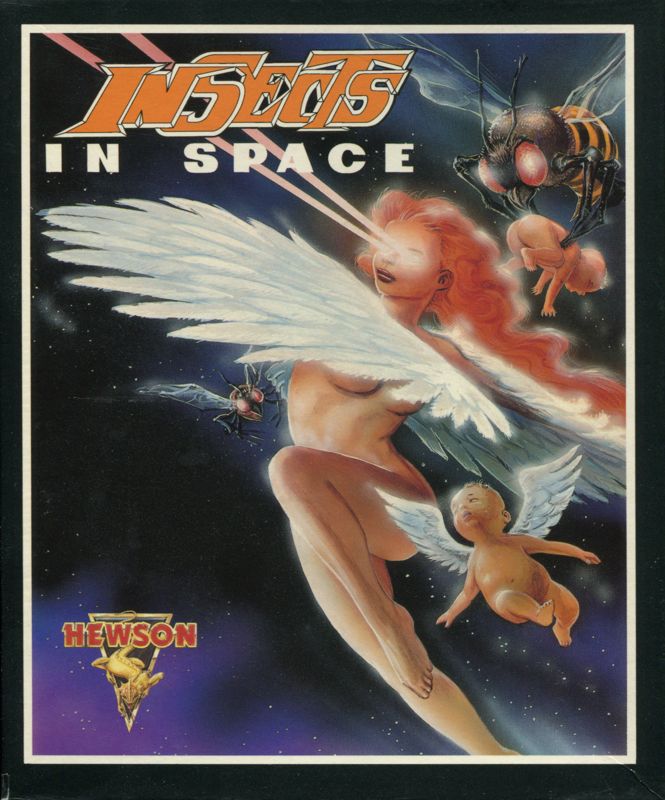
The game uses a side-on 2D view built around two stacked play areas: a lower section with a floor and an upper section with a ceiling. That layout is easy to understand during play, since babies, bees, and Helen’s movement all have clear positional stakes. Helen herself is depicted topless, a conspicuous and dated choice that the game and its manual lean on far more heavily than the premise needs.
Story
Insects in Space begins with a pulpy sci-fi catastrophe: insects have wiped out everyone on Earth except a handful of babies. St. Helen, described as a mystical leader of motherhood, heads to the remains of the planet to save them. It is an efficient excuse for the rescue mechanics, and the idea of bees stealing life energy to create monsters gives each kidnapping a nastier consequence than a simple lost-life counter.
There is a weird charm in how earnestly it commits to that premise. A saintly maternal rescuer battling space insects is already unusual; making the heroine’s breasts a prominent selling point pushes it from odd into unmistakably of-its-era territory. That element has not aged gracefully, and it can make the game feel sillier than its rescue-the-children stakes intend.
Still, the story does one important thing well: it tells you why every enemy matters. You are not fighting anonymous targets for score alone. Bees are actively threatening the babies you are meant to protect, and the possibility of a captured baby becoming a new monster gives your interventions real purpose.
Overall Experience
Insects in Space is a strange, fairly focused shooter whose best idea is turning Defender-like pursuit into a rescue problem spread across two vertical lanes. The radar, the kidnappings, and the choice between returning babies for points or holding them for power-ups create a brisk loop with more tension than its basic side-scrolling structure first suggests.
Its central contradiction is easy to see. The game asks you to take a desperate baby-rescue mission seriously while loudly foregrounding St. Helen’s topless design. Some players will find that goofy exploitation distracting or off-putting, and fairly so. It does not improve the shooting, the rescues, or the underlying premise.
Give it a chance if you enjoy older arcade shooters that demand awareness of the whole battlefield rather than just fast firing. There is genuine satisfaction in spotting a kidnapping on the radar, warping toward the threat, killing the bee, and deciding whether that rescued baby should become points or future firepower. At 6.8, it lands as an interesting and eccentric genre detour rather than an essential classic, but its rescue-driven pressure still gives it a reason to exist beyond the gimmick.


Reviews
There are no reviews yet.