 Retro Replay Retro Gaming History, Reviews & Emulation

Retro Replay Review
Gameplay
The first hour of Magic Marble is largely spent learning that guiding a rolling marble is much less casual than it sounds. You only steer Marvin left and right, but the paths are often little more than tight tile gangways with endless space on either side. That makes every turn feel exposed. You are not wrestling with a complicated control scheme; you are trying to make small, composed inputs while momentum and the layout quietly conspire against you.
The level hazards give that basic movement real bite. Ice tiles are dangerous because a rolling marble and reduced control are a bad match, ramps change how you approach a section, and disappearing tiles make hesitation costly. Switch puzzles add a welcome layer beyond pure steering, forcing you to think about the route rather than simply react to the next corner. When a sequence clicks, it feels satisfying because you have solved both the path and the execution.
The time limit is where the game becomes either compelling or aggravating, depending on your taste for pressure. You cannot crawl through every obstacle with total caution, yet rushing invites a fall. Dollars scattered along the route feed into shops reached by rolling over their tiles, and that economy softens the punishment in smart, practical ways. Extra time, level skips, and legs can rescue a run or help you push past a sticking point, though earning enough money while surviving the course is part of the challenge.
Graphics
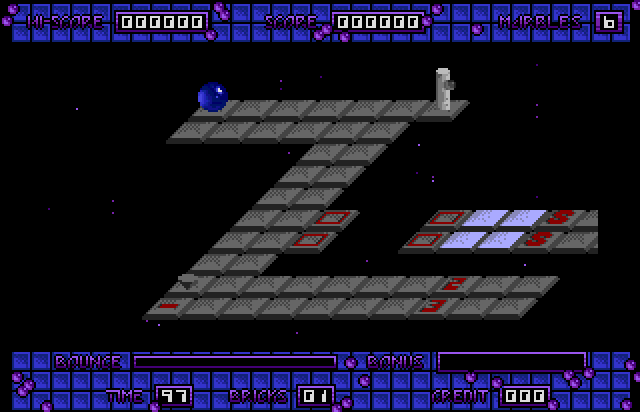
The isometric viewpoint gives the tile paths, ramps, and gaps a clear board-game shape, making it easy to understand why a section is dangerous before you attempt it. Marvin’s small marble form suits the simple arcade focus: your eye stays on the immediate route, the tile types, and the empty drop waiting beside them.
Story
Magic Marble does not waste much time pretending its plot is more than a reason to roll into danger. Marvin must find a new Grytzl for the marble community, and the only route lies through ten forbidden stages in Wrabis. It is a light setup, but it fits the playful oddness of a game about an endangered marble protagonist.
That thin premise is actually a strength here. The goal is clear enough to give the journey a destination, without interrupting the arcade rhythm with unnecessary exposition. You are here to get Marvin across hostile paths, not untangle a complicated fantasy world.
Because the story stays in the background, the stages carry the sense of progress. Each completed level feels like another stretch of forbidden territory survived, and that is all the framing this kind of precision game needs.
Overall Experience
Magic Marble is a compact, hard-edged puzzle-arcade game built around a strong idea: take an almost comically limited form of movement and make every tile matter. Its best moments come from threading through a tricky stretch after several failures, when the correct line and the necessary confidence finally meet. The mix of hazards, switches, and purchasable help keeps the ten levels from feeling like identical balance tests.
Frustration is part of the package. Falling from a narrow gangway can feel merciless, especially when a time limit has already pushed you into taking risks, and the game asks for a tolerance of retries that not everyone has. The shop items help, but they do not remove the central demand for careful steering and route knowledge.
Give it a chance if you like concise Amiga-era games that turn simple inputs into demanding obstacle courses. Magic Marble is not interested in easing you in for long, but its difficulty has purpose: each new tile property changes how you read the course, and each success feels properly earned. For the right player, that payoff is worth the bruised patience.


Reviews
There are no reviews yet.