 Retro Replay Retro Gaming History, Reviews & Emulation
Retro Replay Review
Gameplay
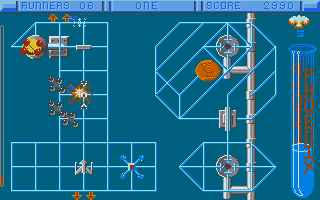
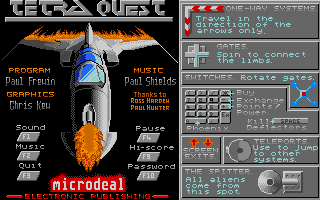
Tetra Quest has the kind of opening that makes you think you understand it immediately. Each level asks you to collect four coins in the right order, and that sounds almost too plain. Then the connected-line movement starts boxing you in. A coin may be visible but unreachable from your current route, an alien may be blocking the one line you need, and the correct solution can hinge on using a switch or teleporter at exactly the right time. It is a compact arcade puzzle first, with shooting used to clear space rather than replace planning.
What clicks is the tension between route choice and survival. You cannot simply wander around the board to fix a bad decision, because movement is restricted to the lines. Enemies follow those routes too, so every encounter can turn a safe-looking path into a problem. Shooting aliens gives you some breathing room, and the extras they occasionally leave behind add a welcome bit of recovery. Still, the cleanest clears come from reading the board before you commit yourself.
The bird transformation is a smart emergency valve. Flying over obstacles can rescue a run that has become tangled, but the substantial point cost means it is not a shortcut to lean on casually. That scoring trade-off gives skilled play a little more bite: do you preserve points and solve the route properly, or pay to escape trouble now? With 384 levels built from four screens each, Tetra Quest has a lot to work through, and the central rules are sturdy enough to carry that volume. Repetition will set in if you need every stage to introduce a radically new idea, but puzzle-minded arcade fans can settle into its steady escalation.
Graphics
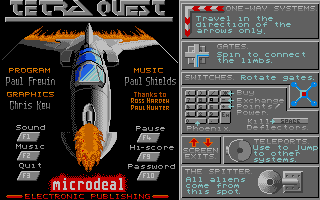
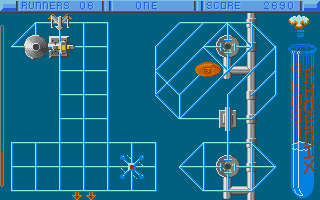
The game uses a top-down view built around interconnected paths across four-screen levels. That perspective suits the action well: you can quickly see the lines you can travel, the coins you need to sequence, and the aliens moving into your route.
Story
The setup is light, but it does give the coin hunt a clear purpose. An evil alien race has shattered the Phoenix Tablet into 64 pieces, threatening the first Galactic Games, and you are collecting the pieces needed to save the event.
That is all the story Tetra Quest needs. The Galactic Games framing turns an otherwise abstract series of boards into a mission, without slowing down the game with narrative detours. You are here to reclaim fragments, not to sit through exposition.
The stakes remain broad and cheerful rather than personal, which fits the late-1980s arcade-puzzle tone. The real narrative momentum comes from clearing another cluster of levels and moving closer to restoring the tablet.
Overall Experience
Tetra Quest is more satisfying than its four-coin objective first suggests. Its best moments arrive when you pause, spot the route through a crowded board, remove an alien at the right time, and collect the last coin without needing to spend points on flight. It rewards thought, but never abandons the immediate pressure of arcade action.
The limitation is also its strength: nearly everything grows from navigating lines, collecting coins in sequence, and managing enemies. If that loop grabs you, the 384 levels are a serious supply of tightly focused challenges. If it does not, the sheer number of boards will feel more like persistence than variety.
Give it a chance if you enjoy old-school games that ask for both planning and quick hands, especially when the challenge comes from making the most of a small ruleset. Tetra Quest does not overcomplicate its premise; it keeps finding new ways to make one wrong turn matter.


Reviews
There are no reviews yet.