 Retro Replay Retro Gaming History, Reviews & Emulation

Retro Replay Review
Gameplay
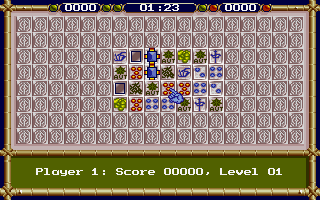
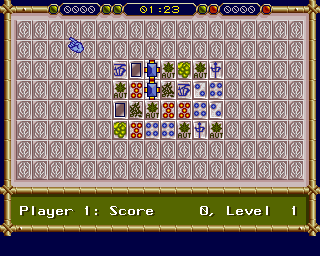
Turn It II gets tense surprisingly quickly. At first, you are simply hunting for two tiles with the same mark, but they only count when their projected line is clear of other tiles. Every pair you remove changes the possibilities for the rest of the board, so the game turns a familiar matching idea into a puzzle about preserving routes.
That rule is the whole reason to play. A match that looks obvious may be exactly the move that strands another set of tiles, creating a dead end through no fault but your own planning. You can mark tiles and cancel the choice before committing, which is welcome, but it does not remove the need to study the board before casually clearing whatever is available.
The time limit keeps this from becoming a completely relaxed, coffee-table puzzle. You have a limited supply of next-move suggestions, and deciding when to spend one becomes part of the pressure. Early boards invite quick pattern recognition; later mistakes can leave you staring at a nearly empty board and realizing you have made it impossible to finish. That frustration is real, but so is the satisfaction of learning to hold back a tempting pair until it is safe.
Its predecessor, Turn It, is worth a look if you want to see where this particular matching challenge began. Turn It II does not need elaborate rules to earn its sequel status: the strict alignment condition gives each board a deliberate, brain-teasing shape.
Graphics
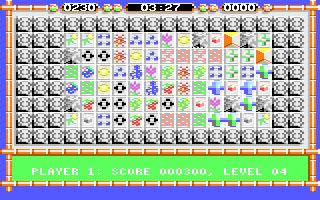
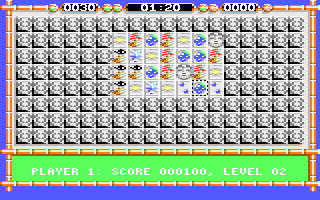
The action is viewed from above on a fixed board, with marked tiles laid out for you to inspect. The important visual task is following the rows and lines between matching pieces, and the board-focused view keeps your attention on that puzzle rather than on decoration.
Story
There is no story campaign pulling you through Turn It II. The board itself supplies the drama: an open line feels like progress, while a blocked arrangement becomes the problem you have to untangle.
That absence suits the format. You are not waiting for a plot twist or a character beat; you are reading tile positions, taking a chance on an elimination, and living with the consequences.
It also makes the game easy to return to in short sessions. Each level creates its own miniature arc, from cautious first matches to either a cleared board or the realization that your route has collapsed.
Overall Experience
Turn It II is a small, stern puzzle game that rewards foresight more than reflexes. The matching is accessible immediately, yet the line-projection restriction keeps easy-looking boards from becoming mindless cleanup. When the logic clicks, you start seeing not just available moves but the moves you must avoid.
The timer and finite hints make the game less forgiving than a leisurely solitaire-style tile puzzler. If you dislike restarting after a strategic error, its dead ends may wear on you. If you enjoy discovering why your earlier choice was wrong and trying a cleaner route, that same severity is the point.
Give it a chance if you want a focused 1991 puzzle challenge with clear rules and stubborn boards. It is not about variety or spectacle; it is about the satisfying discipline of making every removal count before the clock does.



Reviews
There are no reviews yet.