 Retro Replay Retro Gaming History, Reviews & Emulation
Retro Replay Review
Gameplay
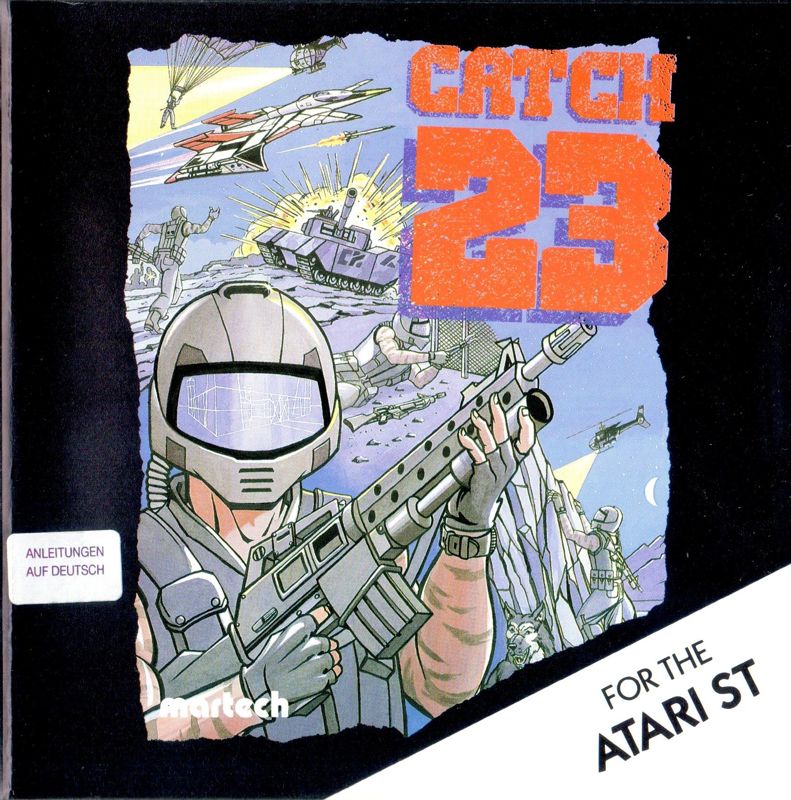
The strongest thing Catch 23 does is make the clock matter immediately. You are parachuted onto an enemy-held island, and even your starting location depends on the wind. From there, sunrise is coming in eight hours. That is a far better hook than simply being told to shoot your way to a finish line: every village search has a reason, every detour risks consuming time, and the final objective is clear from the outset.
Your route involves travelling on foot through a mountainous island guarded by minefields, electric fences, vehicle patrols, and foot patrols. Shuttles connect villages, which gives you a useful alternative to trudging across the whole island. The mission is not just about reaching the development complex, either. You need to locate 17 hidden resistance scientists, each in a building, because their assistance is part of the plan to wreck the complex.
That structure is Catch 23’s best idea and its biggest source of friction. Searching buildings for the right people while managing a fixed deadline can feel like proper infiltration rather than a simple action run. On the other hand, the game asks a lot of patience from you: its objectives are interconnected, the island is hostile, and a wasted trip can feel expensive. Give it a chance if you enjoy mapping out an operation under pressure; skip it if you want a more direct first-person blaster.
Graphics
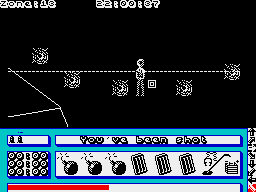
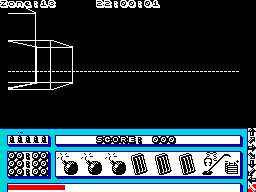
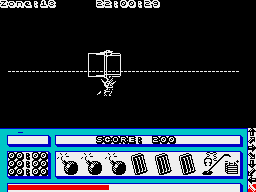
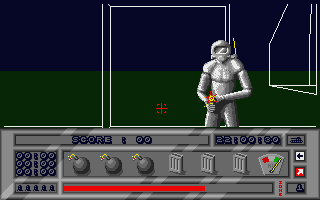
Catch 23 uses a first-person 3D view built around the outlines of buildings. It is a sparse way to see an island of villages and military defenses, and it puts the emphasis on navigation rather than richly drawn scenery. On Atari ST, ZX Spectrum, and Amstrad CPC, the look is firmly from the era: functional for finding your way, but not especially inviting.
Story
The central threat is agreeably pulpy sci-fi. The enemy is developing the CK23, a plane able to take off and land conventionally, remain in orbit for weeks, then return to Earth to destroy everything in its path. That gives the break-in more weight than a routine raid: you are trying to stop a weapon whose danger is deliberately oversized.
The island itself helps the premise. Its residents have been evacuated, leaving behind guarded villages and a small resistance network of scientists hiding alone in buildings. The scientists communicate through computer terminals and have their own sabotage plan, so your character is not presented as a one-person army solving every part of the crisis.
There is not much room here for character drama, and Catch 23 is better judged as a mission setup than as a narrative journey. Still, stealing blueprints and setting a time-delay detonator in a nuclear reactor are concrete goals with a satisfyingly urgent, Cold War-flavored edge.
Overall Experience
Catch 23 is more interesting than it is immediately comfortable. Its first-person island exploration, variable parachute start, resistance search, shuttle travel, and ticking deadline aim for a larger operation than many action games of its period. When its pieces click, you are not merely wandering through enemy territory; you are trying to turn scattered information and limited time into a successful sabotage run.
Its roughness is inseparable from that ambition. The outlined 3D environments and exacting mission requirements leave little room for anyone who needs smooth guidance or quick gratification. Frustration can set in when the search for scientists and the push toward the complex feel like work against the timer rather than momentum toward a breakthrough.
For the right retro gamer, though, that pressure is the payoff. Catch 23 earns a recommendation as a curious, demanding relic for anyone who likes early first-person games with a real objective beyond shooting. It is not an easy island to enjoy, but it has a memorable reason for asking you to keep trying.


Reviews
There are no reviews yet.