 Retro Replay Retro Gaming History, Reviews & Emulation


Retro Replay Review
Gameplay
The first few minutes of Lazer Tag have the clean, immediate shape of an old-school score chase. You are a Lazer Tag Academy cadet, a timer is running, and the assignment is easy to understand: tag targets, avoid being tagged, and finish with as many points as possible. There is no violent edge to the contest; the sci-fi framing turns the real-world infrared sport into a competition of hits and positioning rather than destruction.
Rabbitoid is the mode with the most potential. It plays like a compact deathmatch without deaths, asking you to roam the arena, find opposing competitors, and decide when to take cover versus when to risk exposure for another score. That push and pull is where the game briefly comes alive. A clock always makes you feel that you should be doing something, so even cautious movement carries a little pressure.
Target mode takes a different route by letting the AI handle movement while you focus solely on aiming. It is a reasonable change of pace, and it can be useful if you enjoy the stripped-down challenge of lining up shots under a time limit. It also feels considerably less involving than rabbitoid, since you lose the positioning decisions that give the other mode its small tactical spark.
The problem is that neither mode grows into much more than its basic loop. Chasing points can hold your attention for a few tries, especially if you are the sort of player who likes shaving mistakes off a timed run, but the game does not build enough tension or variety around that goal. Frustration arrives when the simple task of scoring starts to feel repetitive rather than demanding.
Graphics
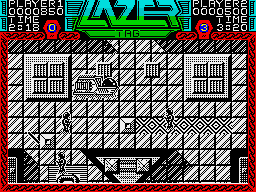
Lazer Tag uses a top-down, 2D scrolling view suited to its arena action. You watch the competition from above, tracking competitors around the playfield as they seek shots and cover; it is a practical angle for this kind of score-driven contest.

Story
The story is little more than a framing device, but it fits the game’s arcade priorities. You play a cadet at the Lazer Tag Academy, working upward by completing laser-tag challenges. That gives the successive timed events a loose sense of purpose without slowing them down with extra narrative baggage.
The science-fiction setting also makes sense for a licensed adaptation of an infrared tag sport. Rather than trying to simulate an everyday game of Lazer Tag directly, it puts the same non-lethal idea into a futuristic training environment. It is a neat excuse for competition, not a reason to play on its own.
Do not come in expecting characters or dramatic turns. The Academy premise mainly exists to connect the challenges and keep the focus on your score. If that sounds thin, it is—though for a 1987 action game built around short rounds, it is at least appropriately economical.
Overall Experience
Lazer Tag is a modest arcade conversion whose best moments come from the pressure of a ticking clock and the urge to improve a score. Rabbitoid gives you enough movement and cover-conscious play to suggest a more interesting arena shooter, while target mode offers a simpler aiming test. Neither has the staying power to carry the whole game for long.
You may get a brief kick out of it if you enjoy early top-down shooters, licensed oddities, or score attacks that explain themselves almost instantly. Give it a chance for that uncomplicated, competitive burst—not for a deep campaign or a richly developed take on the sport. For background on the brand behind it, the history of Lazer Tag is useful context.
Ultimately, the low score feels fair. The game is functional and its two-mode structure is not without merit, but the central action stays too slight to become memorable. A few quick rounds can be pleasant enough; a longer session reveals how little there is to master beyond repeating the same race for points.


Reviews
There are no reviews yet.