 Retro Replay Retro Gaming History, Reviews & Emulation

Retro Replay Review
Gameplay
The first few holes ask you to slow down. You look at the hole layout, take in the wind and distance information, choose from the driver, woods, irons, wedge, or putter, and set direction and strength before committing. That basic loop has real golf-game tension because a poor decision is not buried beneath flashy action; you have to watch the ball travel and live with where it finishes.
What starts to click is the relationship between the large- and small-scale course views. Switching map scale to line up a shot gives you enough room to think about placement instead of simply hitting as hard as possible. Being able to fine-tune direction and strength while the stroke is played adds a small extra layer of involvement, even if it also makes each swing feel more procedural than immediate.
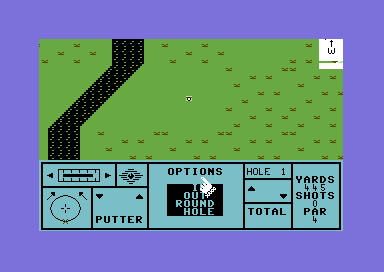
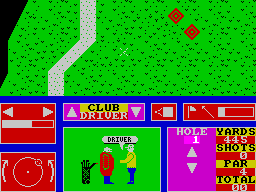
The interface is the main hurdle. The lower screen is divided into several windows, and you move a cursor between them to select clubs, alter the shot, and finally play it. Once learned, the structure is logical, but it can make a round feel like operating a compact golf terminal. Keyboard or joystick support and definable keys help, particularly if you want to make the repeated setup process less awkward.
Its best practical feature is flexibility. You can play the whole 18, stop at the outward or inward nine, or jump into any individual hole. That makes the game easier to revisit than a full-round-only simulation, and it suits anyone who wants to practice a particular hole without committing to a long session.

Graphics
The action is shown from above, with the ball travelling across a map of Royal St. George’s after each stroke. The split-screen arrangement keeps the hole map and shot controls in view, while the caddy briefly handing over the chosen club gives the swing a small touch of character.

Story
There is no narrative detour here. The contest is the round itself: get around Royal St. George’s in as few strokes as possible, one carefully planned shot at a time.
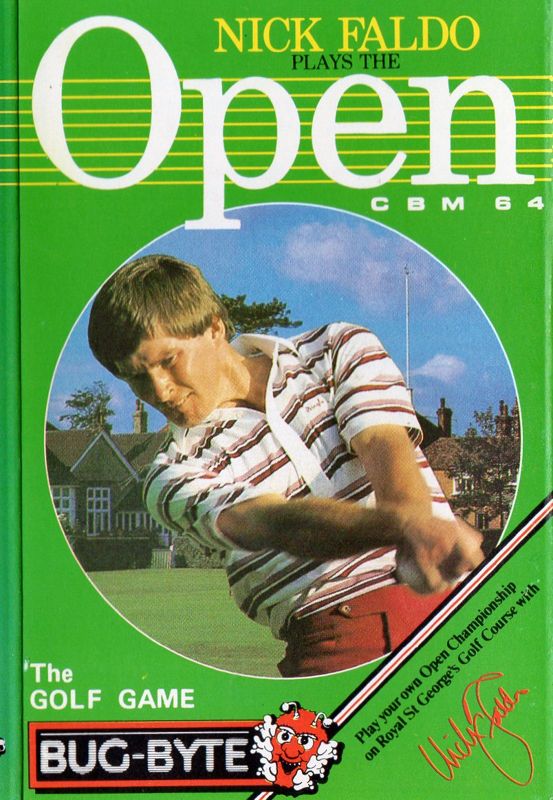
Using Nick Faldo’s name and a real English course gives the game a clear tournament-golf frame, but the focus stays firmly on scorecard pressure rather than personality or drama. You are not being led through a career or a sequence of events; you are left alone with the course, the wind, and your own decisions.
That spare approach fits the design. A good hole produces its own miniature story when a confident drive leaves an awkward next shot, or when a conservative choice protects a score. The stakes remain modest, but the game understands that golf can make a single stroke feel consequential.
Overall Experience
Nick Faldo Plays The Open is a solidly old-school golf game: patient, interface-heavy, and more interested in shot planning than spectacle. Its strongest moments come when you study the overhead layout, choose a club with a purpose, and see that decision play out across the course.
The payoff is worthwhile if you enjoy methodical sports simulations and can accept a cursor-driven routine before every shot. It is less convincing as a casual arcade diversion, because the game asks for attention even when you only want to hit the ball.
At 6.5, it lands as a respectable round rather than a must-play classic. Give it a chance if you want a focused, single-course golf challenge with useful session options; skip it if you need fast swings, simple controls, or constant variety.


Reviews
There are no reviews yet.