 Retro Replay Retro Replay gaming reviews, news, emulation, geek stuff and more!
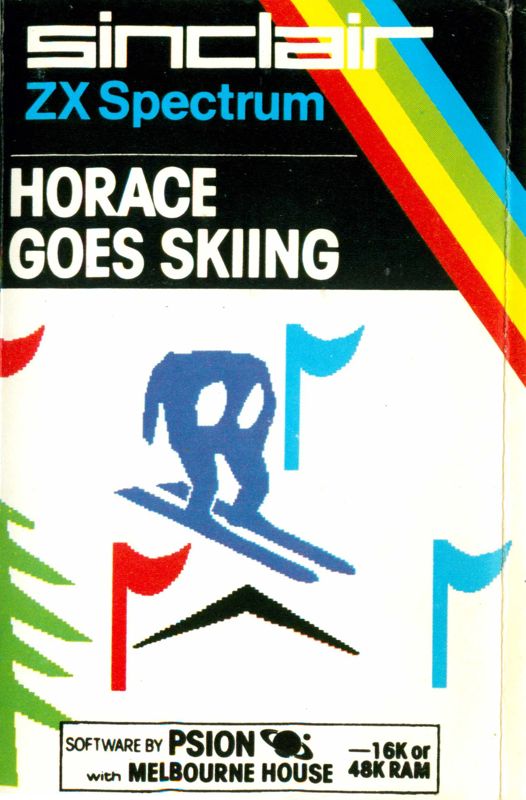


Retro Replay Review
Gameplay
Horace Goes Skiing greets players with a deceptively simple premise: cross the road, buy skis, and then tackle a slalom course. The initial challenge mirrors a classic Frogger clone, tasking you with dodging cars and motorcycles on a busy highway. You start with $40 in your pocket, but every collision with traffic costs you $10 in ambulance fees, and the skis themselves set you back another $10. This creates a tension from the very first seconds, as one wrong move can severely limit your chances of ever hitting the slopes.
(HEY YOU!! We hope you enjoy! We try not to run ads. So basically, this is a very expensive hobby running this site. Please consider joining us for updates, forums, and more. Network w/ us to make some cash or friends while retro gaming, and you can win some free retro games for posting. Okay, carry on 👍)
Once you’ve successfully navigated the traffic, the game transports you to a pseudo-3D ski run. The camera is positioned overhead at a slight angle, giving a sense of depth as you weave between red and blue gates. Precision is key: light collisions with trees merely slow you down, but a heavy impact will snap your skis in two, forcing you to restart the Frogger-like road section all over again. This loop of cross-road peril and downhill finesse forms the core of the gameplay loop.
The controls are responsive but demand quick reflexes. Steering Horace through oncoming cars requires patience and timing, especially as vehicle speed varies. On the slopes, the same left/right controls govern your path through gates, but momentum and angle matter—a hesitation at the wrong moment sends you careening into the trees. The blend of two distinct challenge types keeps each run fresh and encourages mastery of both segments.
Replay value hinges on improving times and perfecting runs. The road section’s randomized traffic patterns mean that no two crossings feel identical, while the downhill courses reward memorization of gate sequences and obstacle placement. For players who relish bite-sized, high-stakes action, Horace Goes Skiing delivers a compact yet addictive experience.
Graphics
Visually, Horace Goes Skiing employs simple but effective pixel art. The road segment uses bright, contrasting colors to differentiate lanes, cars, and motorcycles, ensuring that hazards are always clearly visible. The Frogger-inspired section may look dated by modern standards, but its clean design makes it easy to track Horace’s position at a glance.
The skiing portion introduces a rudimentary form of pseudo-3D, with the course extending toward the horizon. Trees, gates, and flags are rendered in basic sprites, yet the sense of speed is surprisingly convincing. As you pass through each gate, the camera scrolls smoothly, and the shrinking size of objects in the distance conveys forward momentum effectively—an impressive feat given the hardware limitations of the game’s era.
While there are no flourishes of modern lighting or texture detail, the minimalist aesthetic suits the gameplay perfectly. Every element on screen serves a purpose: no background clutter distracts you from the next incoming car or the next flag. For retro enthusiasts, the straightforward presentation holds nostalgic appeal and underscores the design philosophy of 1980s arcade-style action.
Story
True to many arcade-style titles of its time, Horace Goes Skiing doesn’t deliver a sprawling narrative. Instead, it offers a light, tongue-in-cheek premise: Horace has decided to go skiing but must first brave a perilous highway to rent his equipment. This setup is humorously acknowledged in supplementary materials, where the game is jokingly described as “Horace Goes Skiing, but only if he can brave a Frogger clone first.”
There’s no deep character development or branching plotlines—Horace is a stand-in for the player, a mascot whose sole motivation is to enjoy a day on the slopes. The lack of story depth actually works in the game’s favor, allowing gamers to focus purely on the challenges at hand without being bogged down by exposition or cutscenes.
That said, the minimal narrative thread does give the game a distinct identity among its peers. You’re not just avoiding cars or weaving through gates for abstract points; you’re helping Horace achieve a simple goal. This makes each restart feel purposeful, and every successful run a small personal victory in service of that endearing premise.
Overall Experience
Horace Goes Skiing strikes a delightful balance between frustration and fun. The dual-stage format prevents monotony, alternating between the high-adrenaline street crossing and the precision-focused downhill run. Difficulty ramps up quickly, but the game’s short cycles mean failures never feel punitive—only motivational. You’re always just a minute away from redemption.
The pace is brisk, and each attempt lasts only as long as it takes to lose your $40 or snap your skis. This bite-sized design makes it perfect for quick bursts of play, whether you’re reliving childhood memories or discovering the title for the first time. It’s challenging yet fair, rewarding attentive play and punishing careless moves with equal measure.
For modern audiences, the game’s simplicity is both its charm and its greatest limitation. There are no power-ups, no leaderboard system, and no evolving challenges—what you see is what you get. If you crave deep progression or narrative complexity, you might find Horace Goes Skiing a bit too straightforward. However, if you appreciate tight mechanics, retro aesthetics, and a two-stage challenge that keeps you coming back for “just one more try,” this little title delivers exactly that.


Reviews
There are no reviews yet.