 Retro Replay Retro Replay gaming reviews, news, emulation, geek stuff and more!
Retro Replay Review
Gameplay
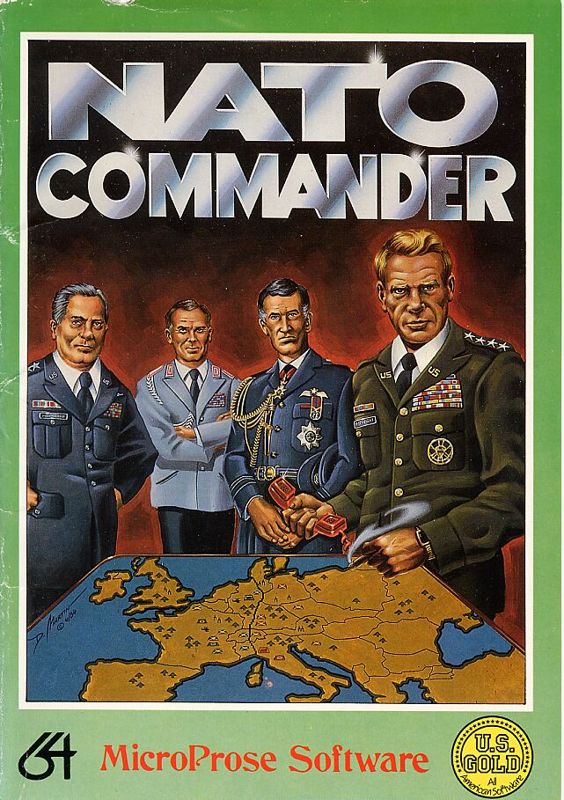
NATO Commander places you in the strategic hot seat as you guide Western European defenses against a full-scale Warsaw Pact invasion. The real-time engine, a hallmark of Sid Meier’s early design brilliance, moves briskly yet allows you to freeze the action at any moment. Once paused, you can meticulously select individual unit modes—whether they’re digging in defensively, launching mechanized assaults, or prepping for chemical or nuclear strikes. This dynamic mix of real-time tension and strategic pause-play gives you the best of both worlds: the adrenaline of on-the-fly decision-making, plus the time to plan your next move down to the smallest detail.
(HEY YOU!! We hope you enjoy! We try not to run ads. So basically, this is a very expensive hobby running this site. Please consider joining us for updates, forums, and more. Network w/ us to make some cash or friends while retro gaming, and you can win some free retro games for posting. Okay, carry on 👍)
Unit management in NATO Commander is elegantly straightforward. You’ll choose between larger divisions or nimble brigades as your standard forces, each offering distinct tactical trade-offs. Divisions provide brute strength and staying power, while brigades excel at rapid redeployment and flanking maneuvers. Air wings also play a pivotal role: allocate resources for air superiority to deny your enemy the skies, send ground support to bolster frontline troops, or dispatch reconnaissance flights to reveal hidden Soviet movements. Mastery of these combined-arms elements is crucial if you hope to shift the balance of power.
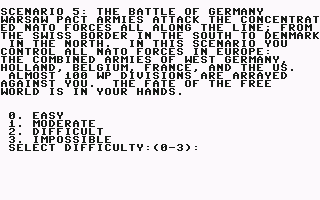
Beyond brute force, victory in NATO Commander hinges on political as well as combat objectives. You accumulate points through city captures, enemy casualty counts, and judicious—or reckless—use of chemical or nuclear arsenals. Pre-emptive strikes can yield massive gains but risk diplomatic backlash, while letting the enemy take the initiative might erode your morale and political standing. With four difficulty levels and five distinct scenarios, each playthrough offers fresh challenges, ensuring high replay value for both newcomers and hardened wargamers alike.
Graphics
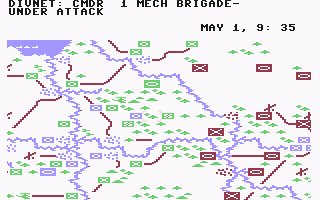
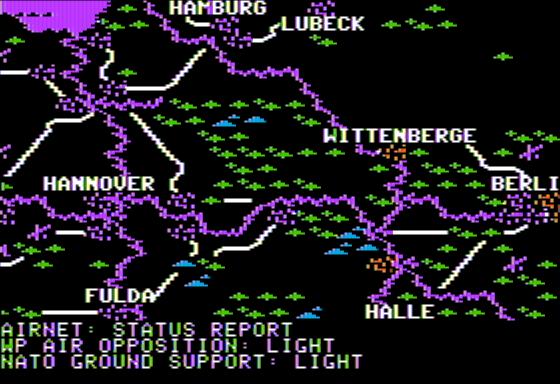
By modern standards, NATO Commander’s visuals are undeniably retro, featuring a top-down hex map and simple iconography to represent armored divisions, infantry brigades, and air squadrons. Yet these minimalistic graphics serve the game’s strategic focus admirably. Every unit type is color-coded and clearly labeled, so you can instantly assess the battlefield state without wading through menus. This clarity helps you focus on tactics rather than aesthetics, a design choice that still resonates with purists of the genre.
Terrain effects are subtly woven into the map: forests slow advancing armor, rivers become chokepoints for infantry, and urban hexes boost defensive bonuses. While there’s no lush 3D modeling or particle effects, the terrain’s strategic importance is unmistakable, and the clean visual style ensures that key details never get lost in visual clutter. For both newcomers and experienced strategists, the straightforward presentation is a reminder that in wargaming, information clarity often beats flashy graphics.
Sound design follows a similar minimalist ethos. You’ll hear brief beeps for unit selection, a distinctive alert when your air wing is intercepted, and occasionally muffled explosion effects when heavy ordinance lands. There’s no sweeping orchestral score, but ambient radio chatter and timely audio cues heighten the tension just enough. These touches, coupled with the retro aesthetic, create an atmosphere that feels both authentic to the era and wholly dedicated to strategy over spectacle.
Story
NATO Commander unfolds against the chilling backdrop of a hypothetical Cold War turned hot, where the Warsaw Pact launches surprise offensives across Central Europe. From the game’s onset, you feel the geopolitical stakes: labor strikes erupt in key territories, neutral states reconsider their allegiances, and every decision can trigger cascading political events. This integration of real-world Cold War dynamics deepens immersion, transforming the hex grid into a living, breathing theater of global tension.
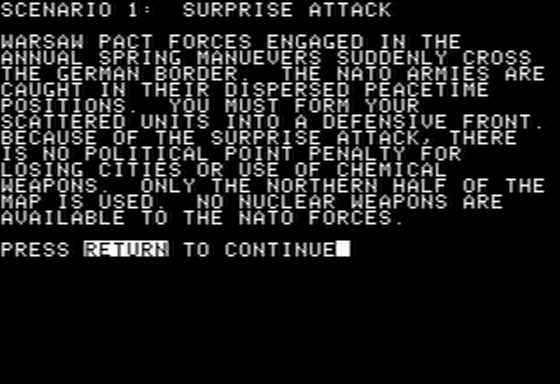
While there’s no branching dialogue or named characters, the emergent narrative arises organically from your choices. Do you rush to secure Paris at the risk of overextending your supply lines? Will you gamble on a nuclear strike to blunt an unstoppable Soviet advance, knowing international condemnation may erode your political points? These dilemmas create personalized stories each time you play, ensuring no two campaigns feel the same. The scenarios range from entrenched defense in the Rhineland to high-stakes counterattacks in the Fulda Gap, letting you explore every facet of this hypothetical conflict.
Key political events, such as declarations of neutrality by Italy or rebellion in Yugoslavia, pivot the strategic landscape in unpredictable ways. These scripted but variable events force you to adapt on the fly, much like a real commander responding to shifting alliances. This blend of historical plausibility and “what-if” speculation gives NATO Commander a timeless appeal, making you ponder the razor’s-edge balances that defined the actual Cold War era.
Overall Experience
NATO Commander may show its age in graphics and interface, but beneath its vintage exterior lies a peerless strategic core. Sid Meier’s pioneering design set the template for countless MicroProse Command Series titles that followed, and even today, you can feel the DNA of this game in modern real-time strategy and grand strategy epics. If you’re seeking a deep, thought-provoking wargame that values cunning over fast-clicking reflexes, NATO Commander remains a rewarding challenge.
For newcomers, the learning curve can be steep: mastering unit modes, juggling political and combat victory points, and responding to unpredictable events demands patience and critical thinking. However, the game’s four difficulty levels and adjustable unit sizes let you ease in at a comfortable pace. Once you grasp the fundamentals, the thrill of outmaneuvering a relentless AI—or another human opponent via hotseat—provides hours of compelling gameplay.
Whether you’re a Cold War history buff, a veteran wargamer hunting for the genre’s roots, or simply a strategy enthusiast looking for a cerebral experience, NATO Commander delivers. Its blend of real-time tension, strategic breadth, and political nuance creates an immersive package that stands the test of time. Despite its dated presentation, the core mechanics remain as robust and engaging now as they were at release, making NATO Commander an essential play for anyone interested in the evolution of computer wargaming.


Reviews
There are no reviews yet.