 Retro Replay Retro Replay gaming reviews, news, emulation, geek stuff and more!


Retro Replay Review
Gameplay
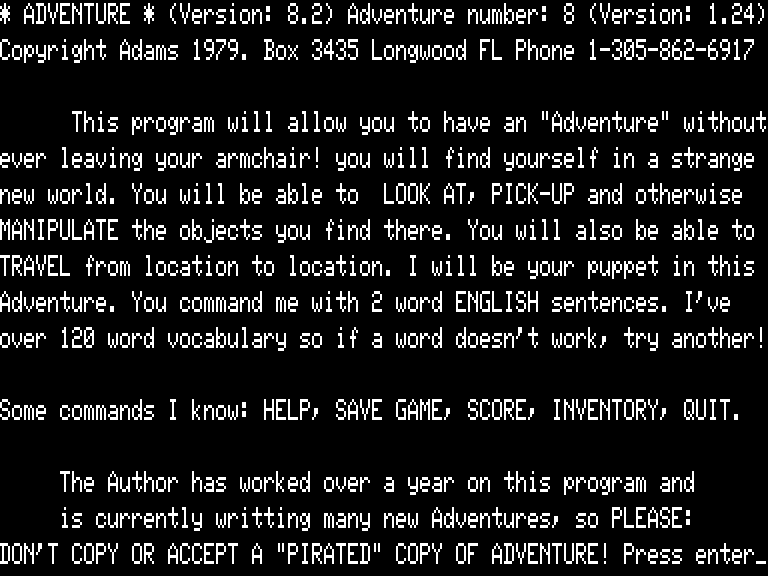
Pyramid of Doom adheres to the classic Scott Adams formula, employing the familiar two-word parser that fans of the series know and love. You input simple verb-noun commands like “open door” or “get lamp,” and the game reacts with concise but meaningful responses. This stripped-down interface allows you to focus entirely on puzzle-solving and exploration rather than wrestling with unwieldy text input.
(HEY YOU!! We hope you enjoy! We try not to run ads. So basically, this is a very expensive hobby running this site. Please consider joining us for updates, forums, and more. Network w/ us to make some cash or friends while retro gaming, and you can win some free retro games for posting. Okay, carry on 👍)
The challenge level in Pyramid of Doom is decidedly moderate. Early rooms will have straightforward puzzles—finding torches, examining hieroglyphs, or moving blocks to reveal hidden passages. As you delve deeper into the pyramid’s bowels, though, you’ll encounter more intricate combinations that require a sharp memory and careful mapping. It’s a satisfying climb in difficulty that keeps you engaged without ever feeling unfair.
Inventory management also takes on strategic importance. You can carry only a limited number of items at once, so choosing what to pick up and what to leave behind becomes a critical decision. Each object you retrieve—from ancient jewels to ceremonial artifacts—can prove essential to overcoming traps or unlocking secret chambers. This balance of exploration and resource juggling is at the heart of the adventure.
Graphics
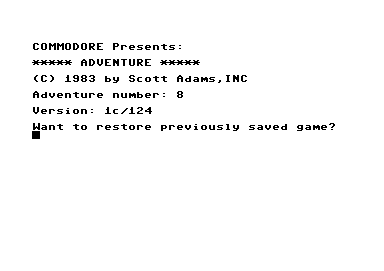
Given that Pyramid of Doom was released in the early 1980s, the visuals rely entirely on text descriptions rather than graphics or illustrations. Don’t expect pixelated sprites or animated cutscenes; instead, your imagination is your greatest asset. The evocative prose used to describe each corridor, sarcophagus, and hidden chamber has a surprising amount of atmosphere for its minimal presentation.
While modern gamers might find the lack of visual flair a hurdle, fans of classic interactive fiction appreciate the clarity and brevity of Scott Adams’s descriptions. He provides just enough detail—crumbling walls, torch-lit passageways, and the faint glimmer of gold—to spark vivid mental images without bogging you down in flowery language. In many ways, this minimalist style encourages deeper immersion than flashy graphics ever could.
Compatibility with contemporary systems is a non-issue; Pyramid of Doom can be played via modern interpreters on PCs, tablets, and smartphones. The text-only format ensures lightning-fast load times and zero hardware strain. If you’re seeking a low-bandwidth, nostalgia-infused journey through Ancient Egypt, this adventure delivers in spades.
Story
As the eighth installment in the celebrated Scott Adams Adventure Series, Pyramid of Doom invites you to step into the sandals of a fearless treasure hunter. You’ve uncovered a previously unknown pyramid buried beneath the desert sands, and legend speaks of untold riches waiting beyond its sealed entrance. Your mission: retrieve the treasures and escape before the tomb’s ancient defenses do you in.
Despite the straightforward premise, the narrative unfolds with surprising depth. Each chamber hints at the civilization that built this labyrinth—cryptic hieroglyphics, sacrificial altars, and booby-trapped corridors all feed your sense of wonder and danger. The story is conveyed entirely through text, but the tight pacing and carefully revealed clues keep you turning virtual pages in eager anticipation.
Scott Adams peppers the journey with moments of suspense and the occasional wry humor. Whether you’re narrowly dodging a rolling boulder, deciphering a riddle etched into stone, or staring at a pit of vipers, the writing strikes a fine balance between tension and levity. By the time you hoist the final treasure and make your getaway, you’ll feel you’ve lived a full-fledged cinematic adventure in just a few short hours.
Overall Experience
Pyramid of Doom is a shining example of early text adventures, offering an engrossing blend of exploration, puzzle-solving, and narrative atmosphere. Its moderate difficulty makes it accessible to newcomers yet still rewarding for seasoned veterans of the genre. You’ll find yourself scribbling notes, sketching maps, and replaying to uncover every hidden relic.
While the two-word parser may feel archaic compared to modern point-and-click or full-parser text adventures, it remains an elegant, no-frills interface that gets straight to the point. If you’ve ever longed for a pure, unadulterated adventure in the spirit of classic pulp fiction, Pyramid of Doom delivers precisely that experience without unnecessary bells and whistles.
In the broader context of the Scott Adams series, this eighth chapter stands out for its atmospheric setting and well-paced design. It’s not just a nostalgic throwback; it’s a testament to the enduring power of storytelling through text alone. For anyone intrigued by Ancient Egypt or the roots of interactive fiction, Pyramid of Doom is an absolute must-play journey.



Reviews
There are no reviews yet.