 Retro Replay Retro Gaming History, Reviews & Emulation

Game Overview
Gameplay
Gorf grabs you because it refuses to stay in one lane. Astro Battles begins with descending rows of invaders and a curved shield between you and them, but the shield opens when you shoot through it. That small twist turns firing into a commitment: you want to clear enemies quickly, yet every shot briefly creates another route for danger to reach you.
The Quark Laser is the smartest idea here. Only one shot stays active, but firing again immediately removes the old one. You never have to watch a missed bullet crawl uselessly offscreen, and that makes aiming feel more active than in many shooters of the era. It also rewards quick corrections instead of rigidly rationing every shot.
The later missions keep changing the pressure. Laser Attack asks you to think about which ships to eliminate first, since taking out a laser ship too early brings in another one while escorts remain. Space Warp shifts the threat toward enemies spiraling out from the center, while Flag Ship becomes a tense precision fight around a shielded warship and its vulnerable reactor. The four-stage loop gives the game more texture than a single repeating formation.
Difficulty ramps hard after each completed cycle, with faster enemies and nastier attack patterns. That makes Gorf exciting when you are locked in, but it can also feel unforgiving when a run ends before you have fully adjusted to the next rank. Alternating two-player turns are a good fit for chasing scores, though the real satisfaction comes from gradually making fewer panicked decisions.

Graphics
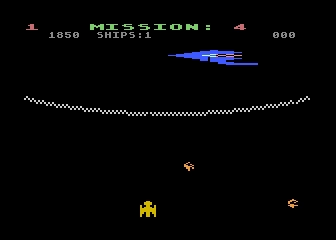
The Atari 5200 version is spare but colorful. Astro Battles sets bright yellow, pink, and blue enemy rows against a deep blue field, with the white curved barrier stretching across the screen above your tiny yellow fighter. Laser Attack’s tall green beam and Space Warp’s red lines give each mission a noticeably different look, even with small, simple sprites.
The Flag Ship is a blocky blue vessel floating against black, and the scattered orange debris makes the encounter look busier than the earlier formation fights. These are basic early-home-console images, but the contrasting colors and distinct stage backdrops make it easy to recognize the danger in front of you.
Story
You command an Interstellar Space Force fighter against the invading Gorfian Empire. That is the entire dramatic setup, and it is enough for a game built around immediate combat rather than elaborate storytelling.
Each mission reads as another layer of the invasion: robot formations closing in, attack groups breaking formation, fighters emerging from a space vortex, and finally a capital ship that must be dismantled to reach its reactor. The escalation gives the sequence a clear sense of forward motion.
Promotion through ranks from Space Cadet to Space Avenger supplies a little extra context for repeat runs. It is a simple arcade-fiction reward, but it fits the game’s goal of making survival feel like a military climb rather than just another score counter.
Overall Experience
Gorf is at its best when you stop treating it like a Space Invaders clone and start respecting the differences between its missions. Movement in two directions, the recallable laser, and the shifting enemy behaviors give it more tactical bite than its plain premise suggests.
This Atari 5200 edition has a real compromise in its four-mission structure, since Galaxians is absent. Still, the included stages are varied enough to avoid the monotony that sinks many fixed-screen shooters, and the Flag Ship finale provides a memorable target after the smaller enemy waves.
Give it a chance if you enjoy old arcade games that demand concentration but give you a few clever tools to fight back. Gorf will not charm you with comfort or spectacle. It wins you over when a risky shot through the barrier, a corrected laser, or a clean reactor hit proves that you are finally playing on its terms.


Reviews
There are no reviews yet.