 Retro Replay Retro Gaming History, Reviews & Emulation
Retro Replay Review
Gameplay
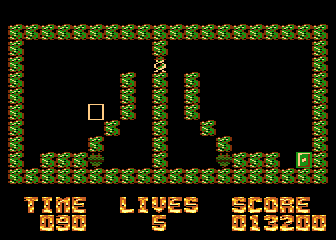
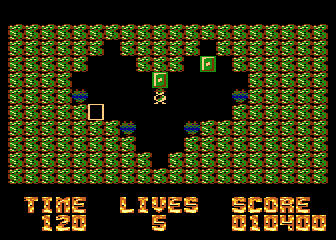
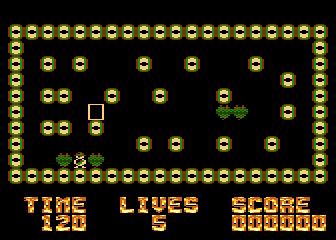
The first room tells you nearly everything that matters, then spends the rest of the game finding meaner ways to use it. Your goal is to gather every heart before time expires, but movement is governed by magnetic walls: Knock and movable tiles travel until the first obstacle stops them. That turns every direction into a commitment. A heart sitting close by may require a long detour because stopping one square too early can leave you with no way to line up the next move.
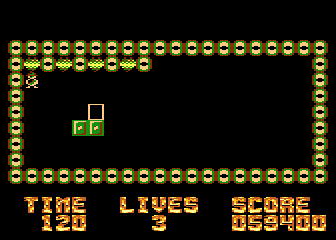
What starts to click is the need to plan positions rather than paths. You are not carefully walking around a room; you are setting up collisions. Tiles can be maneuvered to block movement and create the stopping points Knock needs, so a useful move is often one that appears to take you away from a heart. That makes successful solutions satisfying in the old-school puzzle sense: a cramped board suddenly becomes legible, and a sequence of slides that felt arbitrary turns into a clean plan.
The timer adds bite, though it can also be the source of frustration. Knock asks you to think ahead while denying you much room for casual experimentation. A rushed move can spoil a promising setup, and the magnetic movement rules are unforgiving once you commit. Still, the rules are clear enough that failure points back at your decisions instead of feeling random. Twenty-nine levels is a sensible length for a concept this concentrated; the game has room to challenge you without needing to dilute its central trick.
Graphics
The top-down, fixed-room layout suits the puzzle work. You can see Knock, the hearts, the tiles, and the magnetic walls in the same compact space, which makes it easier to judge where a long slide will end. These are functional puzzle rooms first and foremost, with the board state doing the visual heavy lifting.
Story
Knock does not ask you to carry a larger narrative from room to room. Its entire dramatic setup is immediate: collect the hearts, use the tiles, beat the clock.
That stripped-back approach fits the game’s short-form design. Each level creates its own tiny tension as the remaining hearts become harder to reach and the timer keeps you from treating every board like an unlimited planning exercise.
The result is closer to a succession of brainteaser scenes than an adventure. If you need character or plot to pull you through a game, this will feel bare; if you like puzzles that get straight to the point, the lack of detours is part of the charm.
Overall Experience
Knock is the sort of puzzle game that can make a small rule feel surprisingly rich. Magnetic walls and all-or-nothing movement sound simple, yet they produce boards where positioning a tile correctly is the difference between a dead end and a complete solution. There is a satisfying mental shift from reacting to movement to predicting it.
Its biggest strength is also its filter. You need to enjoy restarting your thought process after a poor slide, and you need some tolerance for a clock that turns careful spatial reasoning into a hurry. The game is not interested in easing you through a broad set of activities; it keeps returning to one demanding idea and expects you to learn its language.
Give Knock a chance if compact, direct puzzle challenges are your comfort food, especially if you enjoy mapping out a solution before touching the controls. It is a focused 29-level test of foresight rather than a sprawling experience, and that focus pays off when a room that looked locked finally yields to one well-planned sequence.



Reviews
There are no reviews yet.