 Retro Replay Retro Replay gaming reviews, news, emulation, geek stuff and more!



Retro Replay Review
Gameplay
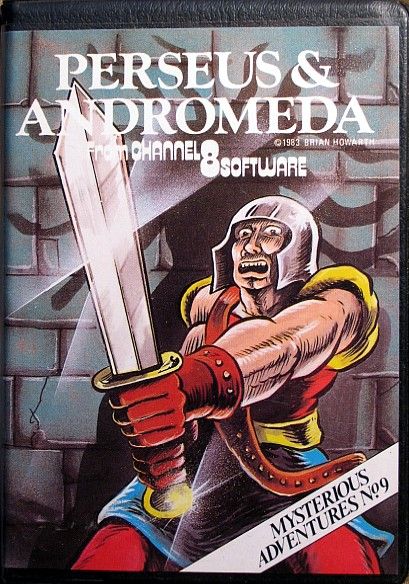
Perseus & Andromeda delivers a classic interactive fiction experience, drawing you into ancient Greek legend through clever puzzles and exploration. You step into the sandals of Perseus, equipped with a sword and shield, and embark on a quest to slay the fearsome Medusa and rescue the maiden Andromeda. The game’s world unfolds through descriptive text, inviting you to enter temples, pray at altars, and barter objects with various NPCs to progress.
(HEY YOU!! We hope you enjoy! We try not to run ads. So basically, this is a very expensive hobby running this site. Please consider joining us for updates, forums, and more. Network w/ us to make some cash or friends while retro gaming, and you can win some free retro games for posting. Okay, carry on 👍)
The puzzle design emphasizes logical exchanges and inventory-based challenges. You might give a golden apple to a temple priestess, who in turn provides you with a potion key to unlock Medusa’s lair. Each interaction feels meaningful, with plenty of lateral thinking required to discern which item belongs where. Although there’s no combat in the graphical sense, facing Medusa is a battle of wits: you must deduce the right sequence of actions to avoid her petrifying gaze.
One of the most notable advances in this ninth installment is its enhanced parser. Moving away from the primitive two-word commands of earlier titles, Perseus & Andromeda supports full-sentence input. This richer interface allows for more natural interaction—typing “use shield to block Medusa’s gaze” or “pray at temple for guidance” feels intuitive and avoids the frustration of guess-the-verb limitations. The improved parser not only streamlines gameplay but also strengthens immersion by letting you communicate as Perseus would.
Navigation through the game world remains straightforward yet engrossing. A simple compass rose and short location descriptions guide you from rocky shores to dark caverns, and sacred sanctuaries to the palace gates of King Cepheus. Frequent reminders of your current inventory help you track crucial items like the winged sandals or reflective shield. Overall, the gameplay loop of exploration, puzzle-solving, and narrative reward keeps you motivated from start to finish.
Graphics
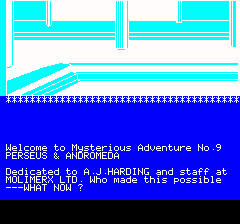
As a text-driven adventure, Perseus & Andromeda does not rely on elaborate visuals or digitized sprites. Instead, it crafts imagery through rich prose and evocative descriptions of environments. When you step into a temple, you can almost feel the cool marble beneath your feet; when you glimpse Medusa, the words paint every serpentine lock of hair with chilling clarity. This minimalist presentation encourages your imagination to fill in the gaps, often resulting in a more personal and engaging experience.
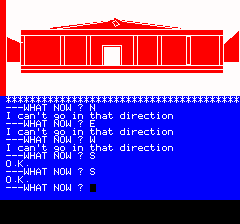
Despite the lack of traditional graphics, the game does include occasional static illustrations that serve as narrative highlights. Simple line drawings or stylized icons accompany key moments—like a profile of Medusa’s visage or the silhouette of Andromeda chained to a rock. These visuals, though sparse, punctuate the storytelling and provide a welcome break from walls of text, adding just enough flavor without distracting from the core interactive fiction format.
The interface itself is clean and uncluttered. Command prompts are displayed prominently, and location descriptions are separated by blank lines to ensure readability. There’s no inventory window to juggle; your carried items appear in list form when you type “inventory,” maintaining the old-school charm of early adventure games. While modern players may find this austere, fans of retro interactive fiction will appreciate the focus on narrative and puzzle design over flashy graphics.
Story
Perseus & Andromeda faithfully retells the myth of the demigod Perseus, weaving familiar elements from sources such as the film Clash of the Titans into its branching text adventure structure. From the oracle’s prophecy to the sea serpent threatening Joppa, each plot beat feels true to the source material. The game invites you to experience pivotal moments firsthand—interviewing seers, forging alliances with gods, and ultimately confronting Medusa in her labyrinthine temple.
The dialogue is sparse but effective, offering just enough flavour to bring secondary characters to life. A kindly old fisherman might trade a silver trident for your sandals, while a mysterious oracle will demand a golden apple in exchange for cryptic clues. Each conversation feels purposeful, driving both character development and puzzle progression. The pacing balances exposition with action; you never spend too long wandering aimlessly, as hints emerge naturally through temple prayers or fortunate chance encounters.
The climax of the story is as thrilling as it is satisfying. When Perseus finally confronts Medusa, the tension is palpable—you’ve spent the entire game gathering tools and knowledge to face this monstrous foe. Rescuing Andromeda feels earned, not just a mechanical end-of-game cutscene. The conclusion wraps up neatly, delivering emotional closure while honoring the traditional myth. It’s a testament to the writers’ ability to blend ancient lore with interactive gameplay, resulting in a narrative that feels both grand and personal.
Overall Experience
Perseus & Andromeda stands out as a polished example of text-based adventure design. Its combination of classic Greek mythology, thoughtful puzzles, and an improved parser makes for an experience that appeals to both veteran interactive fiction fans and newcomers curious about the genre’s roots. The minimal graphics aren’t a drawback—they channel your imagination and keep the focus squarely on story and challenge.
While players accustomed to point-and-click adventures may miss visual feedback or drag-and-drop convenience, the game’s strengths lie in its literary quality and puzzle depth. It offers roughly six to eight hours of engrossing gameplay, depending on how quickly you solve its brain-teasers. There’s enough complexity to keep you engaged without overwhelming you with obscure solutions or dead-end traps.
In the context of the Mysterious Adventures series, this ninth entry shows both continuity and innovation. It respects the franchise’s tradition of logical object-based puzzles while embracing a more flexible parser that anticipates modern players’ expectations. If you’re drawn to mythic storytelling and cerebral challenges, Perseus & Andromeda is a rewarding odyssey through the ancient world—one that testifies to the enduring power of interactive narrative.


Reviews
There are no reviews yet.