 Retro Replay Retro Gaming History, Reviews & Emulation
Retro Replay Review
Gameplay
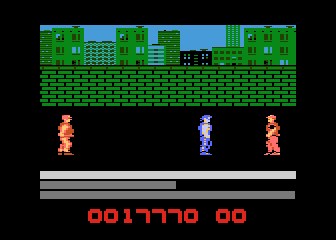
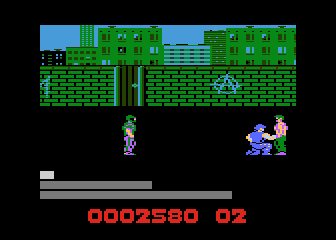
Riot gets to the point immediately. You move right through its neighborhood, enemies arrive—usually in pairs—and the game asks whether you can win the next ugly little street fight. That stripped-down setup has a certain old-school immediacy. There is no long runway before the action starts, and the first few encounters can be entertaining simply because you are testing the range and usefulness of each attack.
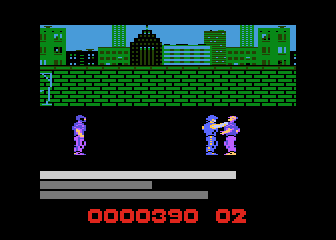
You have punches, kicks, elbows, and a ground choke, which is a respectable spread for such a direct brawler. The elbow and choke give the combat a little more character than endlessly tapping one attack, and you will want to use the available moves rather than treat every opponent identically. The pressure comes from facing two enemies at once, where careless positioning can turn a manageable fight into a quick loss.
That said, Riot’s core loop is very narrow. You advance, fight another pair, and advance again, without much of a stated reason for the conflict or a stronger sense of escalation. Enemies carrying clubs add danger, but they also make the routine more punishing when you are already tied up at close range. Genuflection lets you recover energy, an odd but useful pause that can keep a run alive; it does not, however, add much momentum to the journey.
If you enjoy digging into simple 8-bit brawlers, Riot is worth a short session to see whether its attacks click for you. Anyone wanting varied stages, a richer fighting system, or a compelling reason to keep marching right will likely feel the repetition set in early.
Graphics
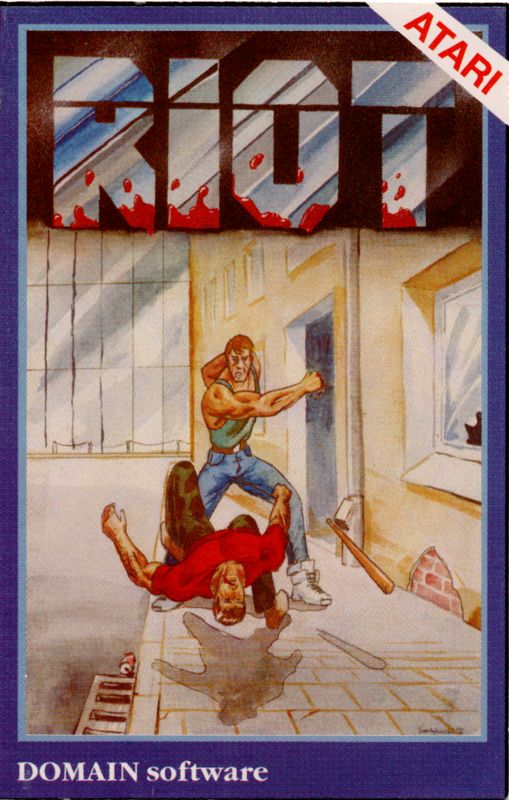
Riot uses a 2D side-scrolling view built around close-range fights between the player character and small groups of opponents. The most distinct on-screen threat is the club carried by some enemies, a practical detail you can spot and react to during a brawl.
Story
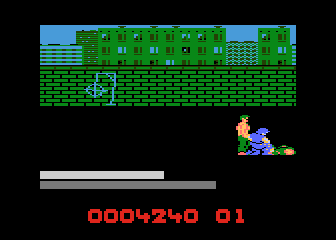
There is barely a story holding Riot together. It is set in a gypsy neighborhood, and the player character walks through it picking fights, but the game offers no particular reason for the conflict.
That lack of motivation makes the action feel unusually detached. You are not pushing toward a clearly defined rescue, revenge plot, or showdown; you are simply moving right because that is where the next fight is.
For some arcade games, a bare premise is enough when the combat carries the whole experience. Here, the thin setup puts more weight on each repeated encounter, and it leaves the game with little narrative payoff once the novelty of the brawling fades.
Overall Experience
Riot has the rough, immediate pull of a compact beat-’em-up: step forward, square up, and try not to get boxed in. There is a modest satisfaction in using punches, kicks, elbows, and the ground choke to survive the next confrontation rather than relying on a single attack.
But it is a game of limited ideas. The repeated two-on-one fights and rightward progression do not build into much beyond more of the same, and club users can shift the mood from scrappy to frustrating without making the encounters substantially deeper.
Give it a chance if you have a soft spot for Atari 8-bit action games and can enjoy a brief, austere brawl on its own terms. For most gamers, Riot is more interesting as a period-specific curiosity than a beat-’em-up you will want to return to often.


Reviews
There are no reviews yet.