 Retro Replay Retro Gaming History, Reviews & Emulation



Retro Replay Review
Gameplay
The first hour of Turbican is about learning the Dark Court as a place rather than simply charging toward an endpoint. You control a young spirit that can move left and right and jump, and the mansion asks you to use those basics while collecting keys and the scattered elements needed for the Destruction Spell. There is a satisfying clarity to knowing exactly what matters: find the five elements, reach the Statue of Evil Spirit, and end the threat.
Thirty chambers across four floors gives the search more structure than a single-screen arcade challenge. The elevator ties the floors together, so progress is not just a straight line from left to right. You are gradually building a mental map of the court and deciding where a key or spell element might open the route forward. That simple loop can click nicely if you like games that make you earn progress through familiarity with a confined location.
Its limitations are equally plain. Turbican does not lean on a wide move set or a complicated system; walking, jumping, and item collection carry the whole game. If you need constant new abilities or rapid-fire arcade escalation, the mansion crawl may feel slight. But the focused scope is also a virtue: it is a short-form objective game where knowing where to go is the main reward.

Graphics
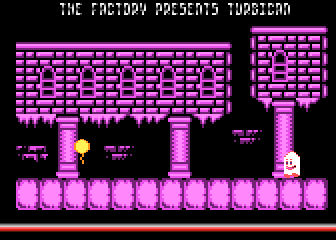
The action is set inside the Dark Court, a mansion broken into chambers on four floors, with an elevator linking the building and colorful balloons marking the ghost’s eventual way out. That gives Turbican a more distinctive backdrop than an abstract score chase: you are navigating a particular haunted residence on the way to the Statue of Evil Spirit.
Story
Turbican keeps its story blunt and functional, which suits an arcade game. A young spirit has to collect the five elements of a Destruction Spell and use them against the Statue of Evil Spirit. There is no ambiguity about the mission, and that makes each collected piece feel connected to the ending rather than like a random pickup.
The Dark Court does most of the narrative work. It is a contained haunted mansion with thirty chambers, four floors, and a route out by balloon once the job is done. The structure turns the story into a physical journey: first you work your way through the court, then you leave it.
Do not come to Turbican for character drama or a heavily developed plot. Its story is a frame for the exploration, but it is a useful one. The spell pieces, the evil statue, and the escape all point in the same direction, giving the game a proper sense of purpose.
Overall Experience
Turbican is a small, straightforward arcade adventure built around a clear task and a compact mansion to learn. Its strongest quality is discipline. The game does not bury its premise under clutter: explore the court, collect what you need, destroy the statue, and escape.
The payoff depends on how much you enjoy self-directed searching in an old-fashioned action format. If mapping out rooms, finding keys, and slowly completing an item set sounds satisfying, Turbican has a solid hook. If you want deep combat options or an elaborate story, its narrow design will leave you wanting more.
For Atari 8-bit fans, it is an agreeable curiosity with a goal-oriented structure that separates it from a pure score attack. Give it a chance when you want a haunted-house arcade game that asks for a little persistence and a little memory, then lets you close the book with a clear final objective.



Reviews
There are no reviews yet.