 Retro Replay Retro Gaming History, Reviews & Emulation


Retro Replay Review
Gameplay
Computer Quarterback starts with the part many sports games skip: commitment. You name a team, draft its players with a fixed pool of money, and then take that roster into a real-time football strategy simulation. That simple setup gives your decisions some ownership. You are not merely selecting a famous club and moving on; you have made a team whose strengths and weaknesses are yours to manage.
The semi-pro version is the best entry point because its 18 offensive plays and 14 defensive plays keep the learning curve reasonable. There are enough choices to make you think about what the other side expects, without drowning you in a giant playbook from the opening whistle. Once you understand the rhythm, pro mode’s 36 offensive and 24 defensive plays is the more interesting long-term option. It asks for sharper recall and makes repeated games less predictable.
Frustration will set in if you want the immediate, hands-on rush of an action football game. This is built around selecting tactics and living with the result, not around split-second stick skills. Its real-time framing adds pressure, while the strategic focus rewards players who enjoy looking for tendencies and changing their calls rather than simply running the same favorite play.
Playing against The Robots gives the solo game a straightforward target, using the semi-pro set of plays. That makes it a good place to test a roster and learn how much the broader playbook in pro mode changes your choices. The optional team disk also adds a different route in, letting you use NFL teams instead of building a club from scratch, though the create-and-draft process remains the more personal way to play.
Graphics
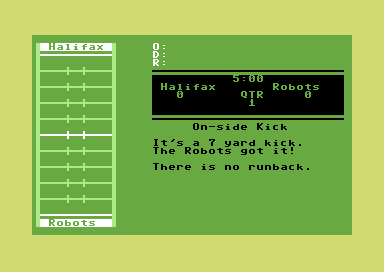
Computer Quarterback comes from an era when a football game’s on-screen look serves the tactical contest first. The draw is in the choices you make with a drafted roster and a compact set of plays, not in lingering over the artwork between calls.
Story
There is no authored football drama pushing you from one scene to the next. Instead, the game lets you create a small sports narrative through your own team name, your draft spending, and the results of the calls you make.
That can be more involving than it sounds if you enjoy making a club feel like yours. A cheap draft choice that works out, or a tactical adjustment that beats The Robots, becomes the kind of personal anecdote these early simulations are good at producing. The stakes come from your investment in the roster rather than a scripted rivalry.
Using the optional NFL team disk changes the flavor of that fantasy. Choosing an NFL team trades some of the blank-slate ownership for the familiarity of an established club. Both approaches fit the game: one favors making your own identity, while the other gets you to the strategy with less setup.
Overall Experience
Computer Quarterback is a compact, earnest football thinker’s game. Its strongest idea is tying tactical play-calling to a self-made roster, because drafting gives the strategy a reason to matter beyond a single game. The semi-pro and pro formats also make sense as a progression: learn the fundamentals with a smaller menu, then move up when you want more possibilities on both sides of the ball.
You should give it a chance if you enjoy early sports simulations that ask for patience and a bit of imagination. The limited play selections can feel restrictive, especially to anyone used to huge modern playbooks, but they also make the game approachable and force you to work within a clear set of options. That restriction is not a flaw so much as the game’s central character.
The payoff is modest but genuine. Computer Quarterback will not replace a modern football game, yet it has a satisfying strategic loop for someone who would rather draft a team and outthink an opponent than chase flashy on-field action. Start in semi-pro, see whether the calls begin to feel meaningful, and move to pro mode only when you want the extra mental load.


Reviews
There are no reviews yet.