Retro Replay Retro Gaming History, Reviews & Emulation
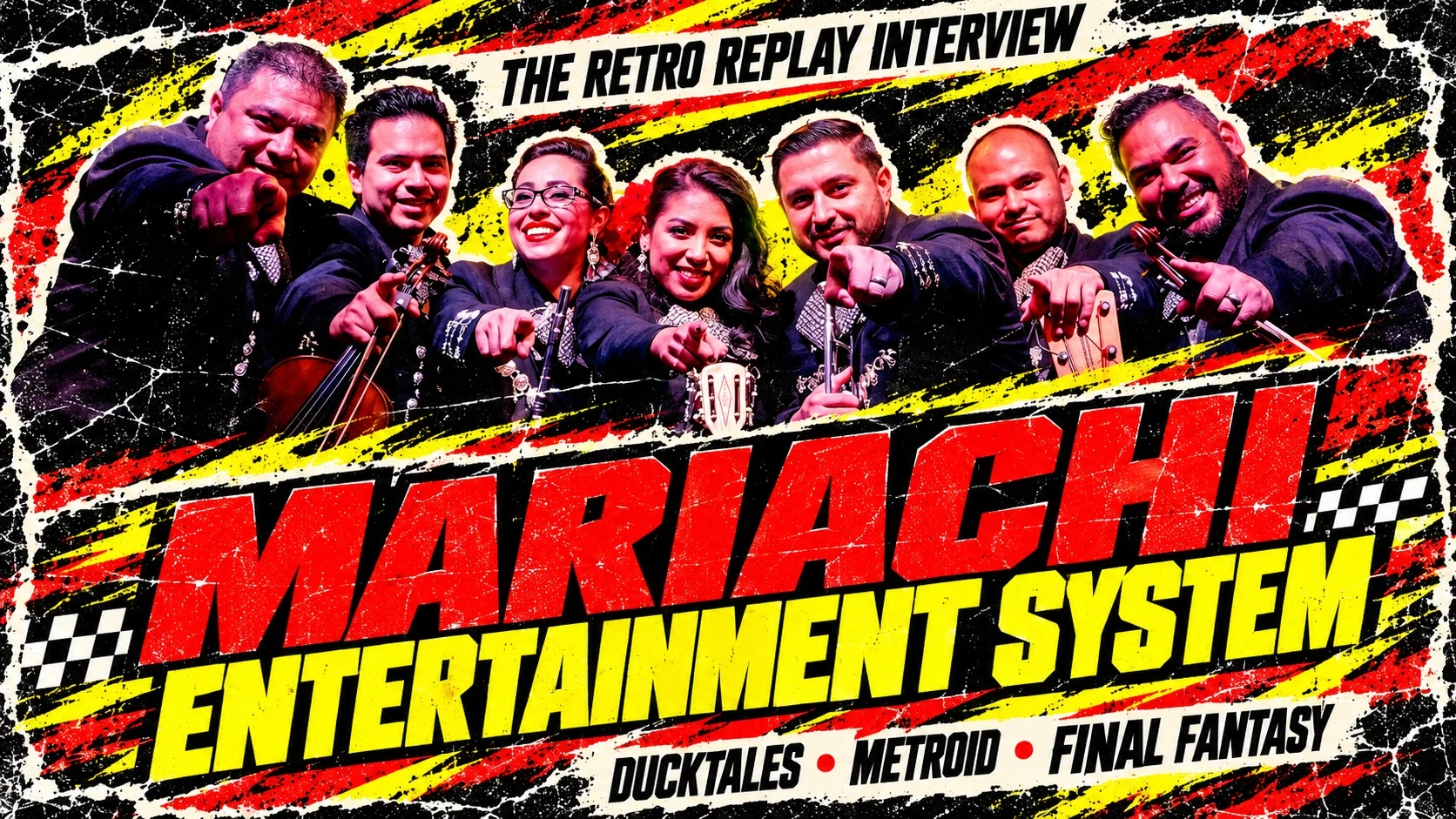
The Moon theme from DuckTales already sounds as though it has somewhere wonderful to take you. David Ortiz heard a trumpet carrying that melody, violins chasing the runs, and guitars and bass filling out the rhythm underneath. In 2015, he called in some friends to read the arrangement. That first experiment became Mariachi Entertainment System.
The San Antonio ensemble brings familiar game music to a full mariachi lineup: trumpets, violins, flute, guitars and the deep voice of the guitarrón. The tunes remain easy to recognise, but there are some wonderfully awkward details to wrestle with. Metroid’s ambiguous harmonies do not politely fall into place on acoustic guitars, and a bass line has to contend with an instrument whose strings, as Ortiz puts it, are about as thick as pencils.
Ortiz is an arranger, musician and educator, and his enthusiasm stretches from classic NES melodies to Uematsu, Shimomura and Mitsuda. His work has also reached the games themselves through projects with Drinkbox Studios and Riot Games. We caught up with him about the band’s beginnings, the arrangements that keep him puzzling, and the families who have found something to share in this music.
Interview by David of Retro Replay. Answers by David Ortiz of Mariachi Entertainment System.

One NES melody, a room full of musicians
Retro Replay: How did Mariachi Entertainment System originally come together?
David Ortiz: I’ve been wanting to do non-traditional mariachi ever since I started learning mariachi back in 2002 or so. 2015 was just the year that I went for it, used the gear I had to just TRY something out; I called in some friends to sight-read a chart I wrote out, and the rest is kind of history.
Retro Replay: Where did the idea of combining traditional mariachi music with video game soundtracks come from?
David Ortiz: I think there were just some video game tracks especially from classic games, that I just heard and felt like a mariachi ensemble could emulate quite dynamically. I think my other musical influences were part of how I heard The Moon from Duck Tales for example; I heard that melody with a trumpet, the runs with the violin, and a nice filled out rhythm section with the guitars and bass. It just kind of made sense to me. I didn’t necessarily think it would catch on, nor did I think I would do more than one or two tunes. I was just doing what I thought might sound cool at the time.
Retro Replay: Was there one particular game theme that made you realize this concept could really work?
David Ortiz: I’m not sure I ever thought it would “work”. I just thought I would like it. Even when people really started listening to it, and we started gaining an audience I didn’t understand what was happening; I guess you could say I still don’t. I don’t think that I hear the music the same way our audience does.
Retro Replay: What was the first video game song the group arranged and performed?
David Ortiz: I arranged The Moon theme from Duck Tales for NES. Just a classic old NES tune with classic NES-style drive. I heard it with a combination of marching band, pop, jazz and rock influence, and just set that to mariachi.
Finding the arrangement
Retro Replay: When you choose a game theme to arrange, what makes you think, “This one will work as mariachi”?
David Ortiz: I think anything can work with mariachi, that’s sort of the point of MES. Mariachi is only limited by the skill of the arranger. One challenge is to arrange without deviating too far from certain conventions and stylistic idioms, but otherwise, anything is possible. If i’ve said no to something it’s because I just couldn’t think of the ways it could work, but there’s someone out there smarter than me that can figure it out.
Retro Replay: Are there certain kinds of game music that translate particularly well to mariachi instrumentation?
David Ortiz: I think there are certain kinds of game music that are easy for ME to arrange just because I’m sort of limited creatively. Classic games with a strong sense of melodic focus tend to be easier for me .
Retro Replay: On the other side, have there been songs you loved but ultimately decided simply would not work in that style?
David Ortiz: There have only been songs that I thought I couldn’t figure out how they could work. For years I stayed away from doing Secrets of The Forest because I just couldn’t figure it out. But it was always my creative limitations. Recently, I heard a version that Mustin of The One Ups did and then I knew how I would make it happen. Aquatic Ambience is another tune that seems like it wouldn’t work, but it’s just a matter of understanding the language of the song and understanding the style of mariachi. I haven’t been able to crack that one either because of the original’s implication of melodic percussion. See, I could use a harp to get away with that but it’s also a bit similar for my taste. So, more investigation and study is needed before I could decide what to do. But anything is possible.
Retro Replay: How much do you try to preserve the original melody and structure of a game theme, and how much freedom do you give yourselves to completely reinterpret it?
David Ortiz: I tend to stay close to the original which is probably an area of great shame for me; I wish I could be more imaginative and really expand certain musical ideas, extrapolate more musical vocabulary. I don’t necessarily put limitations on myself. I feel like I need to do more.
Retro Replay: What is the hardest part of taking music originally written for synthesizers, consoles, or computers and turning it into something that feels authentic to a live mariachi ensemble?
David Ortiz: I think the hardest part is not sounding repetitive. One one hand mariachi is rich with texture, style, rhythm, phrasing. But on the other hand, mariachi CAN be repetitive if you aren’t careful rhythmically. So one thing I work very hard on is always finding ways of giving a unique rhythmic identity to an arrangement. It’s easy to put a rock beat on every classic NES tune, or put a cumbia beat under everything. I do go reuse ideas here and there but I try very hard not to.
Retro Replay: Do you ever have to change the rhythm, harmony, or tempo significantly to make a game composition fit the ensemble?
David Ortiz: The closest ive ever got to doing this was in my Metroid arrangement. There are some things with open harmony (which sounds counter-intuitive) but there’s an open quality to the harmony which makes its tonality ambiguous. Is it major? Is it minor? The tune isn’t explicit. With mariachi, making open harmony (like a power chord) is hard for the guitars and dramatically reduces the potency of the instruments because we don’t have amplification or distortion. So making a harmonic suggestion comes with its challenges because you’re coloring the tune in a way that may or may not sit well with the audience. Additionally, the Guitarron (Mexican mariachi bass) is played in octaves. It doesn’t have to be, you can play on one string, but it isn’t meant to be played that way. There are no frets and the strings are about as thick as pencils with quarter inch action. So that means bass lines do get modified often.
Retro Replay: How do the musicians react when you introduce a new video game piece that some of them may not already know?
David Ortiz: I think they enjoy the challenge of getting to read a new tune regardless of where it comes from. I think they like discovering that they like or dislike it, interpreting it through the lens of their years of experience.
Retro Replay: Is arranging the music generally a collaborative process, or is there usually one person who takes the lead on each arrangement?
David Ortiz: It has very rarely been a collaborative process, although some people have made suggestions here and there that have made the process a little spicier.
Favourite composers and difficult tunes
Retro Replay: Are there any particular game soundtracks or composers that you find yourselves returning to again and again?
David Ortiz: The GOAT Nobou Uematsu.
Retro Replay: Is there one arrangement the group has done that you are especially proud of?
David Ortiz: I liked the Theme of Love arrangement that Alana Urbano (our flute player) did. It was just nice and cohesive and enjoyable. I tend to find my own arrangements lacking in major ways so I have a difficult time enjoying them or feeling proud. I just hope I can grow from each one. Alana has done quite a few that I really like. Animal Crossing was one as well.
Retro Replay: Is there a piece that was much more difficult to arrange than you expected?
David Ortiz: Metroid. The scales, and harmonies were so bananas just not friendly to the instruments. But you have to let the tune tell you what it wants. So the difficulty is letting the song speak because you, as the arranger, want to have the final say about how things are gonna go and if you can’t kill your darlings or let go of certain creative things, then you’re gonna have a bad time.
Retro Replay: What has been the most surprising audience reaction to one of your performances?
David Ortiz: Many people said the Metroid arrangement sounded like a western. That blew my mind. Still does, because I’m not sure where they get that from. But of course, the audience knows what they hear.
What the audience hears
Retro Replay: Do longtime gamers tend to recognize the music immediately, even when it has been transformed into mariachi?
David Ortiz: I think I keep the arrangements pretty straightforward so I think most people tend to recognize everything fairly easy.
Retro Replay: Have you had people discover mariachi music through video games because of your performances?
David Ortiz: Actually, yes. I’ve had some people tell me that they were able to connect with grandparents through our music and share their music together. I recall being a kid, unable to speak Spanish so I never had conversations with my paternal grandmother or grandfather. The only English they knew was to sing “Daaaavy Crocket” when I entered the room. It was endearing. Fans have told me that they’ve put on our music and that it made their grandparents curious. Conversely, we have managed to turn some people on to traditional mariachi through our music.

Retro Replay: On the other side, have you had people who were already fans of mariachi become interested in game music because of what you do?
David Ortiz: Recently, a buddy of mine came in to record. He’s from Honduras, and an accomplished mariachi. He heard the latest mix from our new Noche En Hyrule album. He said it was impressive, gorgeous. But I never told him it was video game music.
Mariachi, classrooms and generations
Retro Replay: I’m also interested in the educational side of the group. How important is teaching younger musicians about mariachi traditions as part of what you do?
David Ortiz: Myself, Sabo (violin), Guardiola (violin), Tina (violin), Alana (flute), Sean (bass), Vince (guitar) are professional educators. I think all of us are focused on teaching tradition as it pertains to mariachi in one way or another. My son doesn’t have a strong connection to mariachi, but we will get there.
Retro Replay: Do video game arrangements help introduce younger musicians to traditional instrumentation in a way that feels more familiar to them?
David Ortiz: That’s a good question. I can’t say that I’ve experienced that, or that I’m familiar with an instance where I knew that was happening.
Retro Replay: Have you seen students become more interested in performing because they recognize music from games they already love?
David Ortiz: I think that generally musicians always become more interested when it’s music they know. There’s a social component, too. I know Chuy (trumpet) saw his high school son playing PUBG one day, and commented that MES had played some PUBG music. His son’s response was to comment on that version of the game being “old”. So I guess it just depends.
Retro Replay: Do you think video game music can serve as a bridge between generations in the same way that film music and popular songs sometimes do?
David Ortiz: I hope so. Recently I’ve been developing a growing ire for classically-trained musicians (I am one myself) and their collective outlook on classical music as foundational to all other kinds of music. For this reason, film scores, and video game scores are often dismissed. These classical musicians are the worst kinds of gate keepers. Another thing I have been seeing in education is that children’s ears are less developed than older generations because while their music may be lyrically rich (or not), melody and harmony have greatly suffered in terms of complexity. I think this makes connecting an emotional experience to music that wants to transcend very difficult.
Retro Replay: What do you think traditional mariachi musicians can learn from video game composition, and what can game composers learn from mariachi?
David Ortiz: Video game composition has become much like film scoring in that the tools used to do both are now the same. Gone, are the limitations of the 8-bit era, which I find to be essential to developing the art. I think mariachi musicians can learn from any other genre of music, but should consider understanding the limitations of 8-bit polyphony; I think that can really help a music student develop their ideas of voice leading and harmonization.
Retro Replay: Video game music has become much more respected as a serious form of composition over the last few decades. Have you noticed attitudes toward it changing during the time you have been performing?
David Ortiz: In a way, yes.

Retro Replay: Are there any video game composers whose work you would particularly love to arrange more of?
David Ortiz: Uematsu. Shimomura. Mitsuda.
From the recording room to the games
Retro Replay: Have any game developers or composers ever reached out after hearing one of your arrangements?
David Ortiz: Yes. Drinkbox Studios (Gacamelee!, Guacamelee! 2) had me write some original mariachi music for Guacamelee! 2, and also arrange their main theme for mariachi, both of which play in a cut scene and over the end credits respectively. Also, RIOT Games (League of Legends) had us rearrange some of their music for a promotion they did some years ago. Those were surreal experiences.
Retro Replay: If you could collaborate directly with any video game composer, living or past, who would you choose?
David Ortiz: Uematsu. I’d love to pick his brain.
Retro Replay: What are you working on with Mariachi Entertainment System right now?
David Ortiz: We are working on the release of our definitive Zelda album called Noche En Hyrule. It will be launched at the same time as a live concert series we are planning for December in San Antonio, TX. If things go well, we hope to expand outside of San Antonio to other cities in Texas.
Retro Replay: Is the group interested in recording more of these arrangements professionally so people can listen outside of live performances?
David Ortiz: Recording has historically been our bread and butter. While we hope to move to a model more focused on live performance, we hope to always be able to provide recordings for everyone to enjoy.
Retro Replay: Where would you like people to follow Mariachi Entertainment System online?
David Ortiz: They can find us on TikTok, YouTube and Facebook.
Retro Replay: Finally, is there anything about the group, the musicians, or the idea behind Mariachi Entertainment System that you wish more people understood?
David Ortiz: I hope they understand that our existence is possible because of the convergence of all of us as individuals, our stories, our journeys, and our cultures. I hope they understand that our music and our beliefs, our humanity, our heritage are mutually exclusive.
Thank you, Mariachi Entertainment System
Our thanks to David Ortiz for making time for such a thoughtful conversation, and to the musicians of Mariachi Entertainment System. There is a lovely generosity in the way he talks about a troublesome arrangement: if he cannot find the answer yet, someone else might hear it. With Noche En Hyrule on the horizon in his interview answers, there is plenty more music to listen out for.
You can explore the band’s recordings and performance news at the official Mariachi Entertainment System website, listen on Bandcamp, and follow their YouTube channel and TikTok. For more conversations about taking game music onto the stage, read our interviews with Console: The VGM Band and Mustin of The OneUps, or browse Game Music & Performance.