 Retro Replay Retro Replay gaming reviews, news, emulation, geek stuff and more!


Retro Replay Review
Gameplay
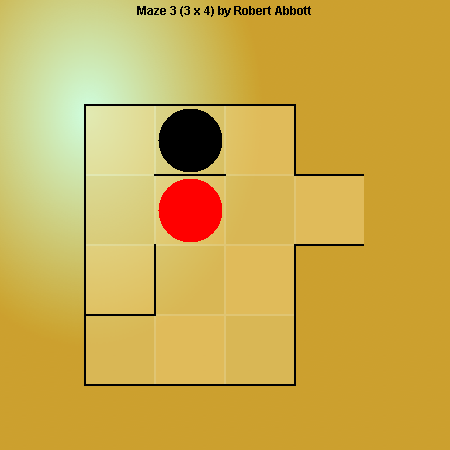
Theseus and the Minotaur delivers a deceptively simple premise that unfolds into a deep logic puzzle with each of its ten handcrafted mazes. You control Theseus, represented by a red circle, moving one tile per turn while the Minotaur, a menacing black circle, moves twice as fast. The core challenge revolves around outsmarting the Minotaur’s deterministic movement rules: it prioritizes closing the vertical gap first, then the horizontal, unless blocked by walls. Learning these patterns is essential to guiding Theseus safely to the exit.
(HEY YOU!! We hope you enjoy! We try not to run ads. So basically, this is a very expensive hobby running this site. Please consider joining us for updates, forums, and more. Network w/ us to make some cash or friends while retro gaming, and you can win some free retro games for posting. Okay, carry on 👍)
Every level introduces new spatial constraints and wall configurations, requiring keen observation and planning. Sometimes you must deliberately skip a turn or reset the maze to lure the Minotaur into a trap. For example, when Theseus and the beast share a row but are separated by a wall, you can exploit this by moving horizontally without triggering the Minotaur. Mastering these quirks is immensely satisfying but demands patience and careful thought.
The keyboard-only controls are straightforward—arrow keys to move, a dedicated key to delay a turn, and others to reset or navigate between mazes. While there’s no in-depth tutorial, the game’s minimalist interface encourages hands-on experimentation. The initial mazes ease you in, but the later puzzles ramp up difficulty dramatically, offering a steep and rewarding learning curve for logic-obsessed players.
Graphics
Graphically, Theseus and the Minotaur embraces a minimalist, utilitarian design that harkens back to early electronic puzzle games. The playfield is rendered in simple two-tone grids with bold red and black circles for the characters. While it lacks flashy animations or complex sprites, every element is clear and functional, ensuring you never misinterpret your position or the Minotaur’s.
Over the years, the basic aesthetic has seen modest refinements. Later versions may include smoother movement transitions or slightly higher-resolution tiles, but the core visual language remains unchanged. This retro styling not only underscores the game’s origins but also keeps the focus squarely on the cerebral challenge rather than on visual spectacle.
Despite its simplicity, the graphics are effective. Color contrasts and clean lines make it easy to track both characters and maze walls at a glance. The absence of extraneous visual effects means there’s no distraction from plotting your next move or recalibrating strategies when you find yourself cornered by the Minotaur.
Story
Though Theseus and the Minotaur is primarily a logic puzzle, it loosely draws on the mythic narrative of Ancient Greece. By casting you as Theseus, the legendary hero, and pitting you against the labyrinth-dwelling beast, the game imbues each maze with a sense of heroic adventure. The simplicity of the narrative framework leaves plenty of room for your imagination to fill in the heroic backstory.
There’s no spoken dialogue or cutscenes; the story exists in your mind as you navigate each labyrinth. Every successful escape feels like a miniature triumph over the monstrous Minotaur, echoing the timeless tale of wit and courage. For players familiar with Robert Abbott’s pencil-and-paper origins, this digital interpretation adds a layer of interactivity to a classic logic puzzle.
While die-hard adventure fans may miss richer narrative arcs or character development, those seeking pure, undiluted puzzle-solving will find the sparse story elements perfectly adequate. The focus remains on the mental duel between Theseus and his pursuer, and that simplicity helps maintain a clean, uncluttered gameplay experience.
Overall Experience
Theseus and the Minotaur stands out as a cerebral, no-frills puzzle game that rewards careful planning and pattern recognition. Its ten progressively challenging mazes offer hours of gameplay for anyone willing to dissect the Minotaur’s movement logic. The learning curve is steep but fair, providing a bright “aha!” moment each time you decode the beast’s behavior and claim victory.
Though the graphics are barebones and the story minimal, the game’s enduring appeal lies in the purity of its design. Every element—controls, visuals, maze layouts—serves the core puzzle experience without distractions. This makes it an ideal choice for players who appreciate classic logic challenges or who are curious about the historical roots of electronic puzzle gaming.
For potential buyers, Theseus and the Minotaur offers a focused, intellectually stimulating journey into the world of logic mazes. If you relish methodical problem-solving and don’t require flashy production values, this title is a gratifying test of wits. It’s a reminder that sometimes the simplest mechanics yield the deepest gameplay experiences.


Reviews
There are no reviews yet.