 Retro Replay Retro Gaming History, Reviews & Emulation
Retro Replay Review
Gameplay
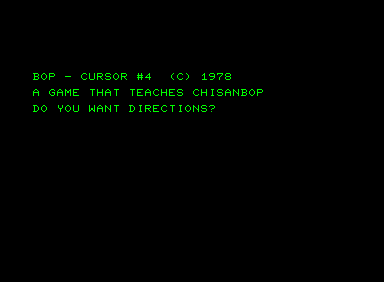
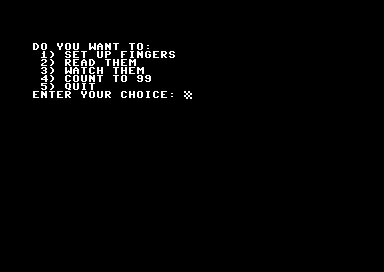
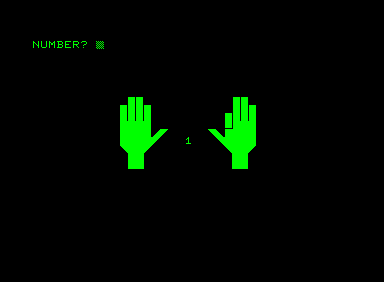
Bop gets to the point fast: you are here to learn how to count with your hands using Chisanbop. The demonstration mode slowly walks from 1 to 99, giving you a patient first pass through every value. That is the right place to begin, because the method is easier to absorb when you can watch the sequence instead of being thrown straight into a test.
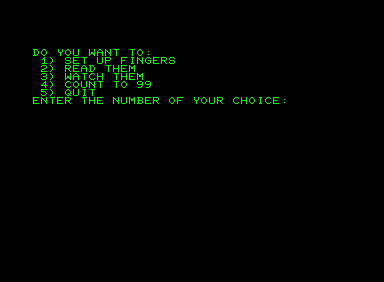
The lookup mode is the most useful part when you hit a snag. Enter a number, check the required hand shape, and return to practice. It turns Bop into a reference tool as much as a quiz, which matters for a system built on memorizing how individual fingers represent value.
Once the patterns begin to click, the exercise modes provide the real test. One asks you to choose the fingers for a displayed number; the other reverses the task and asks you to identify the number shown by a hand. That back-and-forth is smart educational design: recognizing a position and producing one are related skills, but they are not the same thing. Repetition can become dry, yet it is purposeful repetition, and the program is honest about what it wants you to practice.
Graphics
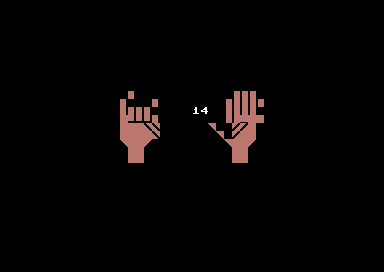
The screen centers on the essential teaching aids: hands and numbers. Seeing a number paired with the corresponding finger position gives the lessons a clear, practical visual focus, especially in the lookup and demonstration modes.
Story
Bop’s subject is its entire hook: Chisanbop, a counting method developed in Korea during the 1940s. Instead of building a fictional journey around that lesson, it keeps your attention on learning how the hand positions correspond to numbers.
The closest thing to progression comes from moving through the count itself, from early examples to larger values up to 99. There is a satisfying little arc in realizing that a hand pose which first looked arbitrary can become an immediate answer.
That plainspoken approach will either suit you or leave you cold. If you need characters, stakes, or a broader theme to stay engaged, Bop has little room to hide the fact that it is a lesson. If the technique itself interests you, the lack of distraction is a strength.
Overall Experience
Bop is narrow, but commendably focused. It teaches one specific skill through demonstration, reference, and two complementary drills, then leaves the value of that skill in your hands—literally. The first hour is likely to feel more like studying than playing, but the moment you can read or make a position without checking the answer gives the program a genuine payoff.
Its biggest limitation is also its defining quality: everything revolves around a single counting system. There is no broader game loop to rescue you when the drills become repetitive. Still, for a Commodore 64 educational title, that concentration works better than a pile of distractions would have.
Give Bop a chance if you are curious about alternative counting methods, enjoy old-school learning software, or want a compact exercise in pattern memory. Skip it if you are looking for an entertainment-first math game. It is modest, disciplined, and more useful than exciting—and for this particular subject, that is a fair trade.


Reviews
There are no reviews yet.