 Retro Replay Retro Replay gaming reviews, news, emulation, geek stuff and more!
Retro Replay Review
Gameplay
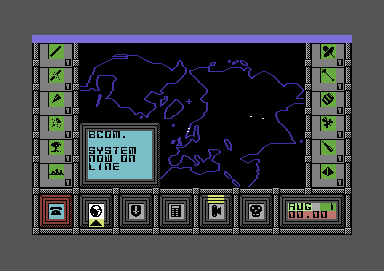
High Frontier places you at the helm of America’s ambitious Strategic Defense Initiative during the height of the Cold War. Your primary objective is to develop and deploy an effective missile defense system before the Soviet threat overwhelms your resources. The game unfolds across six distinct control screens—Research & Development, Shield, Espionage, Threats, World, and Satellite Tracker—each offering unique strategic decisions and a wealth of icons and information panels to master.
(HEY YOU!! We hope you enjoy! We try not to run ads. So basically, this is a very expensive hobby running this site. Please consider joining us for updates, forums, and more. Network w/ us to make some cash or friends while retro gaming, and you can win some free retro games for posting. Okay, carry on 👍)
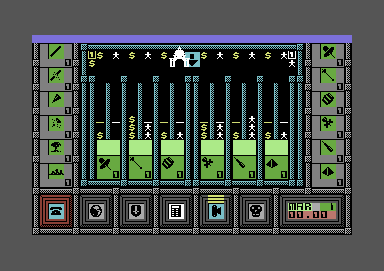
On the Research & Development screen, you allocate budget and personnel across six key components, from laser technology to interceptor missiles. Balancing your investments is critical: pour too much into offense and leave defense weak, or vice versa, and the Soviets may find a fatal opening. The President’s activation codes add an extra layer of tension—only once you’ve researched and funded the right technologies can you arm or disarm your systems.
The Shield screen is where your hard work pays off. Once you’ve secured activation codes and built working SDI installations, you initiate a launch to intercept incoming warheads. Timing and resource management are everything—launch too early, and you waste precious energy; launch too late, and your defense line breaks.
Complementing these core mechanics are the Espionage and Reconnaissance screens, which let you spy on Soviet programs. Intelligence reports are deliberately imprecise, and acting on flawed data can lead to disastrous misallocations. The Threats screen aggregates enemy moods, force strengths, and potential attack vectors, while the World screen governs game turns and global events. Together, they create a web of decisions that keeps every playthrough fresh and challenging.
Graphics
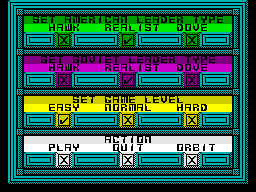
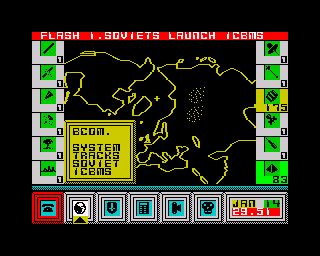
High Frontier’s visual presentation opts for clarity over flash, embracing an icon-driven interface reminiscent of classic strategy titles. Each screen is divided into logical sectors with color-coded icons and data panels, making it easy to glance at defense statuses, R&D progress, or incoming threats without losing context. The minimalist aesthetic ensures that information is never obscured by unnecessary ornamentation.
While there are no high-resolution textures or cinematic cutscenes, the simple visual design underscores the game’s focus on strategy rather than spectacle. Icons for satellites, missiles, and lasers are distinct and intuitive, reducing the learning curve once you familiarize yourself with the iconography. Subtle animations—such as blinking threat alerts or rotating world globes—lend life to the screens without distracting from your decision-making.
The color palette leans heavily on military greens, blues, and grays, reinforcing the Cold War atmosphere. Menus and data windows are laid out with precise grids, ensuring readability even on smaller monitors. Though it may feel dated compared to modern AAA titles, the graphics serve their purpose admirably: delivering vital information at a glance and keeping you immersed in strategic planning.
Story
Set in an alternate history where the United States pours unprecedented resources into the Strategic Defense Initiative, High Frontier captures the palpable tension of the late 20th century. Every decision you make is underscored by the fear of a Soviet missile barrage, and your storyline emerges organically from the ebb and flow of intelligence, research breakthroughs, and unexpected global events.
There’s no linear narrative or voiced plot—rather, the story is woven through spreadsheets of data, R&D milestones, and the occasional crisis event on the World screen. You feel the weight of responsibility when the President taps you for an activation code, and the stress of deciphering ambiguous espionage reports drives home the human cost of Cold War brinkmanship.
Moments of triumph—such as successfully intercepting a wave of warheads or uncovering a secret Soviet project—punctuate the tension, creating a self-authored saga unique to your strategic style. High Frontier’s story is as much about resource allocation and timing as it is about realpolitik and scientific innovation, giving you the sense that you are writing history in real time.
Overall Experience
High Frontier is a deep, methodical strategy experience that rewards patience, foresight, and adaptability. Its learning curve is steep—mastering six distinct screens and a complex web of interdependent systems takes time—but the payoff is immense. Each playthrough offers new challenges as you tweak your research priorities, respond to shifting threats, and refine your launch protocols.
For fans of hard-core strategy and Cold War history, the game provides an engrossing sandbox of technological development and political tension. The absence of flashy graphics or hand-holding tutorials may deter casual players, but those willing to dive into spreadsheets and icon sets will find a richly detailed simulation that stands the test of time.
Ultimately, High Frontier offers a unique blend of strategic planning, risk management, and historical immersion. It’s a title that doesn’t just ask you to win a game, but to navigate the fragile balance of global power in an era defined by the specter of nuclear annihilation. If you crave a cerebral, high-stakes strategy challenge, High Frontier demands your attention and rewards every calculated move.


Reviews
There are no reviews yet.