 Retro Replay Retro Gaming History, Reviews & Emulation
Retro Replay Review
Gameplay
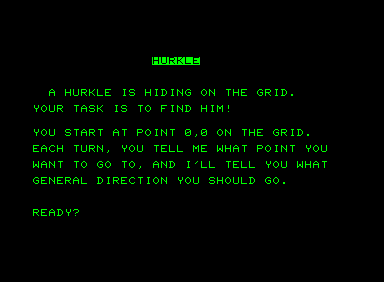
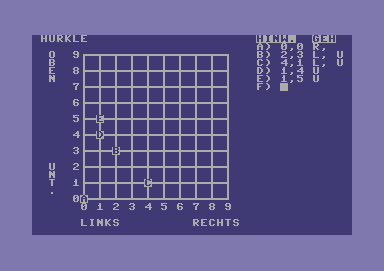
Your first few guesses in Hurkle are likely to be broad, practical probes: put a choice near the middle of the grid, see whether the answer points north, southwest, or elsewhere, and start closing in. That loop is so direct that it barely needs teaching. Every response turns a blind hunt into a smaller geometric problem, and a round can become surprisingly tense once you think you have narrowed the target to a handful of points.
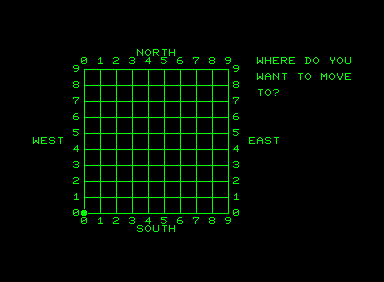
What starts to click is the value of a good opening guess. You are not merely trying to stumble into the Hurkle; you are trying to extract the most useful directional information while spending as few turns as possible. The 10-by-10 board is small enough to hold in your head, yet large enough that careless choices cost you. Hurkle rewards calm narrowing over random poking.
Its limitation is inseparable from its strength. There is one puzzle, one objective, and little room for a round to surprise you after you understand the logic. That can make it feel repetitive if you sit with it too long. Used as a quick mental warm-up or a score-chasing diversion, though, the simplicity feels purposeful rather than thin.
Graphics
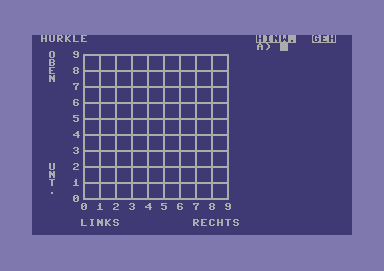
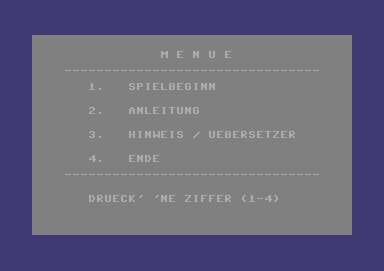
Hurkle is built around a 10-by-10 grid and directional feedback, so the important image is the board itself: a compact field of possible locations that shrinks in your mind with every clue. The fixed, top-down format suits this kind of puzzle because the whole problem stays in front of you at once.
Story
There is no narrative detour here. A Hurkle is hidden somewhere on the grid, and your job is to find it efficiently. That premise is slight, but it gives the abstract search a playful target.
The real drama comes from interpretation. A direction such as northeast immediately redraws the useful part of the board, and each subsequent answer either confirms your reasoning or exposes a wasted guess. In a game this spare, that is enough.
Do not come to Hurkle for characters, scenes, or a developing plot. Come for the tiny story each round creates: uncertainty, a clue, a narrowing search, and the satisfaction of landing on the answer.
Overall Experience
Hurkle is the kind of old-school puzzle that earns its place through clarity. You can understand the goal almost instantly, make meaningful decisions right away, and judge your own performance without any fuss. Its best moments are the ones where a couple of directional clues suddenly make the answer feel inevitable.
The trade-off is obvious: it has very little breadth. Once the deduction becomes familiar, your reason to return is self-improvement rather than discovery. That makes it a poor fit for an all-evening session, but a fine fit when you want a brief challenge that does not waste your time.
Give Hurkle a chance if a compact logic exercise sounds relaxing and you enjoy optimizing a simple process. The payoff is modest but genuine: a clean puzzle that turns a hidden point on a grid into a neat test of reasoning.


Reviews
There are no reviews yet.