 Retro Replay Retro Gaming History, Reviews & Emulation



Retro Replay Review
Gameplay
The first hour of Mars asks you to accept a very early-school kind of adventure contract: you are stranded, your spaceship needs repair, and the route home lies in locating the right items. There is no ambiguity about why you are poking around. Every command serves the same practical goal—understand your surroundings, find something useful, and turn a pile of recovered parts into an escape.
That focus is the game’s strongest quality. Rather than dressing the objective up with a sprawling premise, Mars turns the basic scavenger-hunt structure into the whole challenge. Progress comes from observation and persistence, so it rewards the player who reads carefully, remembers what has been found, and is willing to test ideas when the obvious route dries up.
It is also unmistakably a product of the early home-computer text-adventure era. The pleasure comes from solving the chain of item problems yourself, not from speed, spectacle, or a steady stream of new distractions. That can become frustrating when you are stuck and have no clear lead, especially if you are used to modern games smoothing over dead ends. A notebook—and patience—are much better companions here than a desire to rush.
Graphics
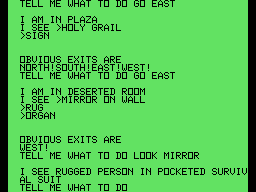
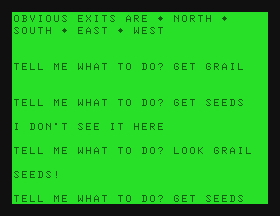
Mars is a text-based adventure, so the planet and the damaged spaceship are chiefly imagined through the words on screen. Its Mars setting gives that imagination a useful frame: you are not merely collecting objects in the abstract, but searching for a way to survive long enough to repair your ride off-world.

Story
The story is stripped down to an immediately understandable predicament. Your spaceship is stranded on Mars, and you need to recover the items required to fix it and leave. That is not a narrative packed with twists or personalities; it is a pressure-setting device for the puzzles.
In a game this concise, that simplicity works more often than it hurts. You always know the larger purpose of an item hunt, and the escape objective gives the adventure a natural finish line. The question is never whether you should care about getting off Mars. It is whether you can figure out the necessary sequence before the game’s logic gets the better of you.
Anyone hoping for elaborate science-fiction world-building may find the premise too bare. But for fans of classic interactive fiction, the spare setup is a feature: it keeps the attention on exploration, objects, and the gratifying moment when a previously useless discovery finally becomes the answer.
Overall Experience
Mars is a no-frills survival puzzle in text-adventure form. Its stranded-astronaut setup pulls you in quickly because the stakes and objective are so clear, then the game asks you to earn the ending through the traditional cycle of searching, collecting, and connecting clues. It has the stubborn, solitary charm of an adventure designed before games routinely explained themselves.
The payoff is worth it if the act of untangling an item puzzle is already something you enjoy. Recovering a needed object feels meaningful because the whole game is built around that search, and repairing the ship offers a concrete reward for seeing the chain through. If you prefer games that provide hints, broad freedom beyond a central task, or a more developed story, you may hit the wall before that satisfaction arrives.
Give it a chance if you want a small slice of early interactive fiction with a crisp sci-fi objective and are comfortable supplying your own persistence. It is not trying to be more than a classic “find the right things and get out” adventure, but within that narrow lane, its directness is its reason to play.



Reviews
There are no reviews yet.