 Retro Replay Retro Gaming History, Reviews & Emulation


Retro Replay Review
Gameplay
The first few rounds of Meteor are disarmingly simple. You stare at a field of stars, wait for a falling sky object, and press any button the moment you spot it. There is no control scheme to learn and no elaborate rulebook standing between you and the test. That immediacy suits the subject: this is about the gap between seeing something and reacting.
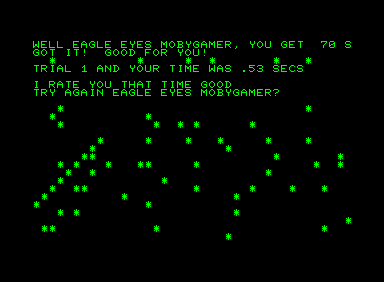
What makes the exercise more interesting is the increasing clutter. As the game puts more stars on screen, finding the falling object becomes a concentration problem rather than a pure button-pressing contest. You may think you are quick until a busy sky makes you hesitate for a fraction longer. That small shift gives the game its best moments, because it turns a basic reaction test into a test of attention under visual distraction.
Frustration can set in if you want a conventional arcade loop with enemies, power-ups, or escalating action. Meteor stays tightly focused on one task, and its repetition is deliberate. Treat it as a short self-test instead of a game for a long evening, and the minimal design feels purposeful rather than thin.

Graphics
The screen is built around a starry sky, with the important visual challenge coming from the growing number of stars surrounding the falling object. That makes the changing density of the field easy to understand: a sparse sky gives your eyes room to work, while a crowded one asks you to pick motion out of clutter.

Story
There is no narrative journey here. The only drama comes from your own performance: waiting, noticing the fall, and wondering whether you reacted sooner or later than you felt you did.
That absence fits an educational title centered on reaction time. A story would only distract from the point, which is to put you in the same small experiment repeatedly and let the changing sky conditions expose how attention can slip.
The closest thing to a conclusion arrives when you decide to stop. Rather than wrapping the session in fiction, the game turns back to your results, making the player—not a character—the subject of the experience.
Overall Experience
Meteor is modest, focused, and more useful than exciting. Its central idea is clear within seconds, yet the increasingly crowded skies give you a real reason to run more than one attempt. You are not mastering a complex system; you are measuring yourself against a progressively noisier visual field.
The payoff is the graph shown when you end a session, which plots reaction times against the number of stars on screen. That feedback is essential. Without it, the game would be little more than a reflex drill; with it, you can actually see whether added clutter affected your responses and compare the feeling of a run with the recorded result.
Give it a chance if you enjoy old educational software that presents a compact experiment rather than disguising lessons beneath a bigger game. Anyone after substantial arcade action will exhaust its one idea quickly. But as a brief, interactive demonstration of reaction time and distraction, Meteor is admirably direct and still has a small competitive pull: you will likely want one more run to prove the busy sky did not slow you down.


Reviews
There are no reviews yet.