 Retro Replay Retro Replay gaming reviews, news, emulation, geek stuff and more!
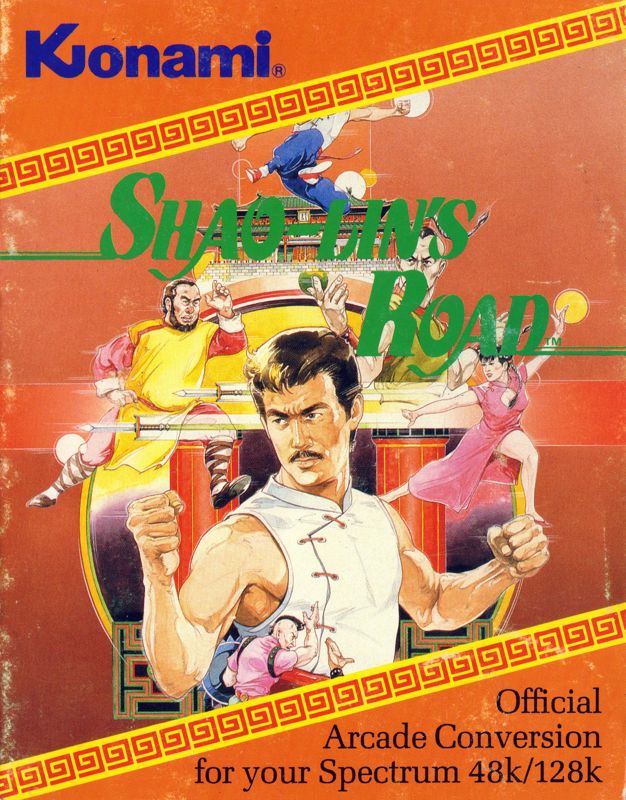


Retro Replay Review
Gameplay
Shao Lin’s Road shifts the action from the tight confines of one-on-one duels in Yie Ar Kung Fu to a sprawling, multi-tiered beat ’em up. You take on the role of Lee, who must navigate vertically scrolling temple corridors brimming with Triad thugs. The levels are layered on different planes, allowing Lee to jump up and down between platforms while dispatching enemies with swift kicks and punches. This verticality adds a surprising layer of strategy, as you can avoid attacks by changing levels or flank foes from above and below.
(HEY YOU!! We hope you enjoy! We try not to run ads. So basically, this is a very expensive hobby running this site. Please consider joining us for updates, forums, and more. Network w/ us to make some cash or friends while retro gaming, and you can win some free retro games for posting. Okay, carry on 👍)
The core combat loop revolves around chaining standard kicks and punches to clear out waves of Triads, but the real twist comes in the form of energy balls. Whenever you defeat an enemy, they may drop a glowing orb. Grab it, and you gain access to a ranged attack that packs a serious punch. Timing and positioning become crucial as you juggle close-quarters fighting with well-placed energy hurls, especially when enemies start swarming from multiple angles.
To keep the challenge fresh, each stage culminates in a showdown against a Super Triad boss who is impervious to your normal moves. Only through gathering and wielding enough magic orbs can you breach their defenses. This risk-reward dynamic forces players to decide whether to focus on rapidly defeating lesser foes to build up magical energy or to push forward and confront the boss early, testing their resource management and combat prowess.
Graphics
Running on mid-’80s arcade hardware, Shao Lin’s Road delivers vibrant, colorful sprites that pop against dark temple backdrops. The Triad enemies are rendered with distinct color schemes—red jackets, blue robes, green vests—so you can quickly recognize threats as they swarm. Lee’s sprite animation is surprisingly fluid, with clear wind-ups for kicks and bursts of speed when he dashes or jumps between platforms.
The temple stages themselves showcase varied architecture: sweeping staircases, pagoda rooftops, and winding corridors etched against mountain vistas. Parallax scrolling is used sparingly but effectively, giving a sense of depth as you ascend staircases or cross bridges. Environmental details—such as lanterns swinging in the breeze or banners fluttering overhead—add atmosphere without distracting from the onslaught of adversaries.
Special effects for energy balls and magic attacks stand out crisply, glowing brightly as you lob them at enemies. When a Super Triad shatters under a finished spell, the explosion animation is satisfying, with spark-like fragments cascading across the screen. While nowhere near modern standards, the graphics encapsulate the charm and challenge of classic arcade action.
Story
In its simplest form, Shao Lin’s Road tells the tale of Lee, a martial artist trapped deep within a temple complex controlled by the nefarious Triads. The narrative is minimal, relying on arcade-style premise cards before each stage and brief interludes featuring the sinister Triad leaders. This “hero ascends, villain falls” structure is typical of the era but serves as effective motivation for repeated attempts on the high score table.
Though there’s no voiced dialogue, the game conveys urgency through pixel art cutscenes and the escalating difficulty of each zone. As you progress, the temple’s architecture darkens, and the Triads grow more numerous and agile. By the final level, flanked by stone gargoyles and shrouded in mist, the setting suggests Lee has reached the heart of the enemy’s domain, primed for a climactic battle.
For modern players seeking a deep narrative, Shao Lin’s Road may feel light on lore. Yet for arcade enthusiasts, the blend of straightforward story beats and focused martial arts motif is enough to drive each punch and kick. The promise of rescuing oneself from a temple stronghold and toppling a criminal brotherhood remains compelling in its pure, action-driven form.
Overall Experience
Shao Lin’s Road stands out as a noteworthy evolution from Yie Ar Kung Fu, expanding the series into the realm of platform beat ’em ups with vertical and horizontal exploration. The game’s pace is relentless, pushing players to learn patterns, master the energy ball mechanic, and strike a balance between aggression and caution. Casual fans might find the difficulty steep, but perseverance is rewarded with satisfying combat combos and explosive boss defeats.
The arcade cabinet’s soundtrack and sound effects enhance the immersion: the rhythmic thuds of kicks, the crackling release of magical energy, and traditional drums that underscore the martial arts theme. At home, the ported versions sometimes lose a bit of this audio punch, but the core gameplay remains intact, making Shao Lin’s Road a worthwhile addition for collectors and retro enthusiasts alike.
Whether you’re chasing high scores or simply craving a snapshot of ’80s arcade flair, Shao Lin’s Road delivers an engaging blend of platforming and beat ’em up action. Its layered levels, energy-ball system, and relentless Triad adversaries make for a challenging yet rewarding journey. If you appreciate tight controls, strategic combat, and classic pixel art, Shao Lin’s Road is a hidden gem that deserves your attention.

Reviews
There are no reviews yet.