 Retro Replay Retro Replay gaming reviews, news, emulation, geek stuff and more!
Retro Replay Review
Gameplay
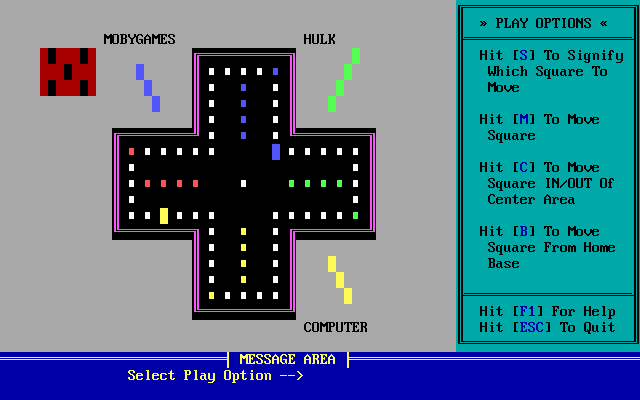
The core appeal of Aggravation lies in its straightforward, turn-based mechanics that capture the essence of the classic board game experience. Each turn begins with a dice roll—only a one or six will let you advance a new token onto the track—so there’s a constant undercurrent of anticipation every time you click “Roll.” Once your token is in play, you navigate it around the ASCII-rendered course, aiming to loop back safely to your home base before your opponents can send you hurtling back to the start.
(HEY YOU!! We hope you enjoy! We try not to run ads. So basically, this is a very expensive hobby running this site. Please consider joining us for updates, forums, and more. Network w/ us to make some cash or friends while retro gaming, and you can win some free retro games for posting. Okay, carry on 👍)
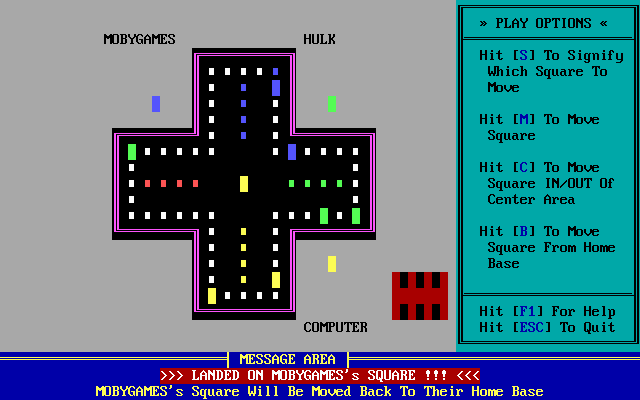
Strategically, Aggravation demands both patience and opportunism. Landing on an opponent’s piece sends it crashing home, creating moments of genuine delight (or mild frustration) depending on which side of the chip you find yourself. Players can’t leap over their own tokens, so planning your moves to avoid blockages becomes an intriguing puzzle. Rolling a six earns you another chance to move, which makes risk-reward decisions—should you push a token forward aggressively or play it safe?—all the more meaningful.
Up to four participants can join a game session, with three AI-controlled players filling in if you prefer solo play or lack human opponents. The computer adversaries offer adjustable difficulty, meaning newcomers can learn the ropes against easy AI before taking on more seasoned virtual rivals. Turns proceed swiftly, keeping downtime to a minimum and ensuring that everyone stays engaged until the very end.
Graphics
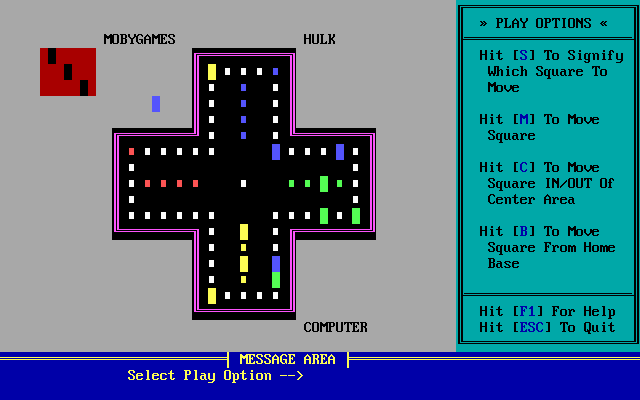
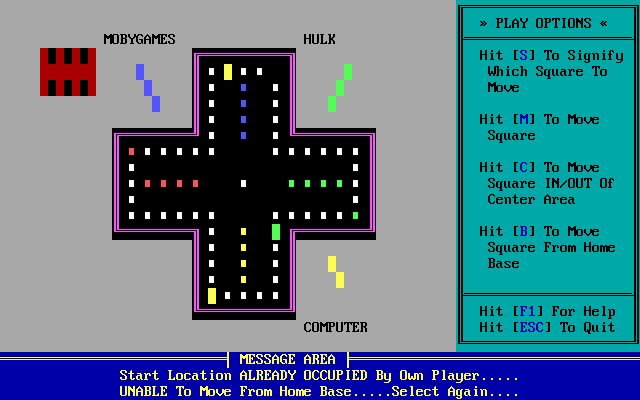
Visually, Aggravation opts for a retro, ASCII-based presentation that feels like a throwback to the early days of PC gaming. The game board is rendered entirely in simple text characters, but clever use of colors and symbols ensures that each player’s pieces remain easily distinguishable. While it lacks the polish of modern 3D renditions, its minimalism has a certain charm that fans of classic board-game adaptations will appreciate.
The interface is clean and uncluttered. A text-driven menu system guides you through options like setting AI difficulty, selecting player colors, or toggling sound cues. Animations consist of pieces “moving” across the board one ASCII cell at a time, which may feel quaint by today’s standards but at least makes each advance clear and satisfying. There are no distracting visual effects—just pure gameplay laid out in black, white, and a handful of accent hues.
For those who value form over function, the lack of high-resolution art may be a drawback. But if you’ve ever felt nostalgic for simple, text-based games or just want a straightforward digital board-gaming experience, Aggravation’s visual style will likely resonate. It’s accessible even to older machines, so performance issues are nonexistent once you’ve got a working PC.
Story
Aggravation is, at its heart, an abstract board game without a deep narrative or character arcs. There’s no epic quest unfolding behind the dice rolls—no dragons to slay, no kingdoms to unite. Instead, the “story” is created by the players themselves through the ebb and flow of competition: the triumphant send-offs when you knock an opponent’s token home, the tense moments when you need a specific roll to secure victory.
In lieu of a scripted plot, Aggravation offers room for emergent storytelling. House rules can easily be added—perhaps your tokens represent racers in a grand tournament or explorers trying to chart new lands. Those freeform elements give friends or family license to imbue the game with their own imaginative twists. The lack of built-in lore means every match can become its own unique saga.
Although there’s no dedicated backstory or campaign mode, Aggravation’s simplicity is a strength here: you’re never distracted by lore dumps or forced cutscenes. Instead, every turn, every roll, and every strategic block fosters an organic narrative of suspense, surprise, and—yes—occasional aggravation. It’s a clean canvas for your group to paint with competitive banter and memorable setbacks.
Overall Experience
Aggravation delivers a pure, undiluted board-game adaptation that’s perfect for casual gatherings or quick solo sessions. Its accessible ruleset makes it easy for newcomers to pick up in minutes, yet the subtle strategic layers ensure you’ll find yourself coming back for rematches. Whether you’re playing against friends or duking it out with AI opponents, the game retains its playful edge throughout.
While its ASCII graphics won’t win any design awards, they do ensure broad compatibility and focus your attention where it belongs—on the dice rolls and tactical positioning. There are no needless menus or flashy distractions. Everything you need is front and center, from color-coded tokens to a clear move log so you can track progress at a glance.
For buyers seeking a digital twist on a familiar parlor game, Aggravation is a solid pick. It captures the competitive thrill of sending an opponent’s piece back to square one and rewards well-timed aggression. If you don’t mind a minimalist presentation and appreciate tight, engaging gameplay loops, this title is an affordable, fun addition to any board-game enthusiast’s library. Just be prepared: when your carefully advanced token is kicked back home, you’ll truly understand why this game earned its name.


Reviews
There are no reviews yet.