 Retro Replay Retro Replay gaming reviews, news, emulation, geek stuff and more!



Retro Replay Review
Gameplay
Aggression offers a refreshing blend of classic strategy mechanics familiar to fans of checkers and chess, yet carves out its own identity through the entrapment feature. Players take turns moving their tiles across the board with the ultimate goal of reaching the opponent’s baseline. The rules are intuitive: a tile moves one space forward, backward, or diagonally, but it’s the ability to surround and immobilize an enemy tile that brings a thrilling tactical depth to each turn.
(HEY YOU!! We hope you enjoy! We try not to run ads. So basically, this is a very expensive hobby running this site. Please consider joining us for updates, forums, and more. Network w/ us to make some cash or friends while retro gaming, and you can win some free retro games for posting. Okay, carry on 👍)
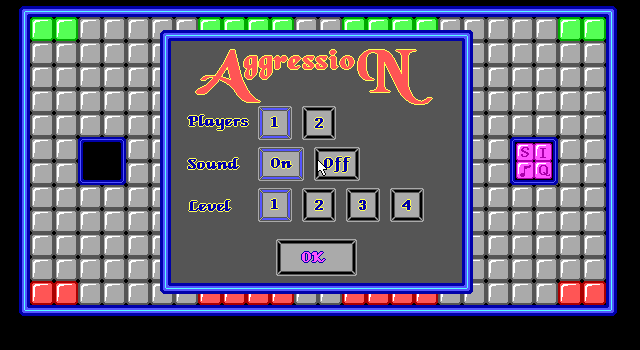
The mouse-driven interface makes navigation painless and responsive, whether you’re plotting a multi-step flanking maneuver or scrambling to rescue a trapped tile. The four difficulty levels ensure that beginners can get comfortable with basic positioning and entrapment tactics, while seasoned strategists can test themselves against a formidable AI. For two-player sessions, hotseat mode is seamless, with clear visual prompts guiding each participant’s turn.
One of the most compelling aspects of Aggression’s gameplay is its dynamic tension. A single misstep can see a strategically positioned tile forced back to its starting row, undoing minutes of progress. This “restart penalty” encourages careful planning and keeps both players engaged, as fortunes can change in a single move. Whether you’re defending against a coordinated pincer attack or spearheading your own, every decision carries weight.
Graphics
While Aggression is inherently an abstract strategy game, its digital presentation is anything but bare-bones. The board is rendered in crisp, contrasting colors that ensure tiles and highlighted squares stand out clearly. Subtle shading gives each tile a slight three-dimensional look, making it easy to track piece positions at a glance.
Animations are purposefully minimal but effective, with a smooth glide for tile movements and a brief glow effect when an entrapment occurs. These simple touches reinforce the strategic moment without bogging down the pace. The optional sound complements the visuals: a soft click for each move and a distinct chime when a tile is captured or returned to the start.
Menus and icons are cleanly designed, providing quick access to difficulty settings, sound toggles, and player mode selection. Even newcomers will appreciate the clear on-screen prompts that guide the flow of play. Overall, Aggression’s graphics strike a balance between functional clarity and pleasing aesthetics.
Story
Aggression is an abstract board game at its core, so it doesn’t deliver a narrative in the traditional sense of heroes, villains, or unfolding plot arcs. Instead, the “story” unfolds on the board itself as two opposing forces vie for territorial supremacy. Every match tells its own tale of tactical ingenuity, daring breakthroughs, and near-misses.
That said, the simplicity of the theme allows players to project their own scenarios onto the board—whether staging a medieval siege, a futuristic skirmish, or a wild west standoff. There’s an intuitive sense of “battle in miniature” that fuels the competitive spirit without the need for elaborate lore or character backstories.
For those who craves context, the rulebook offers a brief introduction to the game’s origins and the design philosophy behind its entrapment mechanics. While it stops short of unfolding an epic saga, it provides enough background to frame each game as a strategic duel rather than just a sterile puzzle.
Overall Experience
Aggression shines as a compact but deeply engaging strategy title that will appeal to both casual players and hardcore tacticians. The blend of familiar movement rules with the twist of surrounding and resetting opponent tiles creates memorable moments of triumph and heartbreaking reversals alike. Its accessibility via mouse control and intuitive UI make it a great entry point for newcomers.
Veteran strategy enthusiasts will find the four-tiered difficulty curve rewarding, as the AI adapts to increasingly sophisticated tactics. Meanwhile, the hotseat two-player option invites lively head-to-head challenges, making Aggression an excellent choice for game nights or quick brain-teasing sessions between friends.
Although it lacks a traditional storyline, the game’s abstract nature is precisely what allows it to shine as a pure test of wits. Paired with clean visuals, responsive controls, and optional sound effects, Aggression delivers a polished package that keeps players coming back for “just one more match.” If you’re looking for a strategic board game adaptation that balances simplicity with depth, Aggression is well worth a place in your digital collection.


Reviews
There are no reviews yet.