 Retro Replay Retro Replay gaming reviews, news, emulation, geek stuff and more!

Retro Replay Review
Gameplay
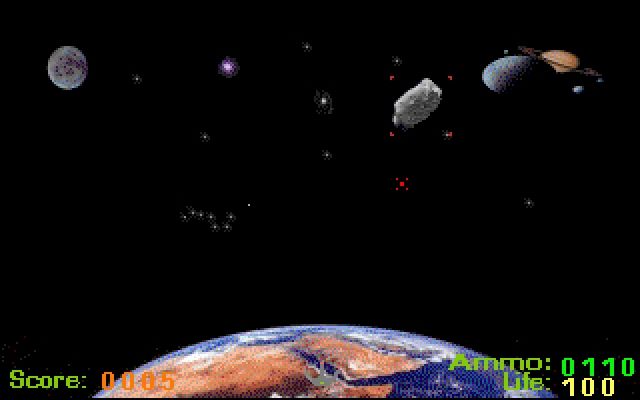
Asteroid delivers a straightforward arcade experience: you pilot a lone spaceship armed with 100 units of plasma ammo, blasting incoming asteroids before they reach Earth’s atmosphere. The core loop hinges on judicious ammo management, since refills are scarce and only awarded incrementally as you survive waves of rock fragments. Each missed asteroid brings the planet one step closer to devastation, and once ten asteroids make impact—or you simply run out of plasma—the game ends.
(HEY YOU!! We hope you enjoy! We try not to run ads. So basically, this is a very expensive hobby running this site. Please consider joining us for updates, forums, and more. Network w/ us to make some cash or friends while retro gaming, and you can win some free retro games for posting. Okay, carry on 👍)
Controls are equally minimalistic and rely exclusively on the mouse. Point-and-click targeting lets you line up shots quickly, and firing is instantaneous, keeping the pace brisk. While some modern players may miss keyboard shortcuts or analog precision, the simplistic control scheme makes the game instantly accessible to newcomers and allows seasoned arcade fans to dive right in without a lengthy tutorial.
Despite its apparent simplicity, Asteroid demands strategic thinking. You’ll often face clusters of fast-moving space rocks that require split-second decisions: do you concentrate fire on one large threat, or spread shots to thin out multiple smaller fragments? Balancing aggression with conservation is the name of the game. Over time, you’ll discover patterns in asteroid trajectories, rewarding careful observation and planning with higher survival streaks.
Graphics
Reflecting its DOS heritage, Asteroid’s visuals employ crisp, pixel-based sprites set against the infinite blackness of space. Asteroid shapes vary in size and hue—darker greys for smaller debris and muted browns for hulking fragments—offering enough variety to keep the screen visually interesting. Explosions are rendered with simple but satisfying animation frames that briefly fill the void with bursts of color.
While the graphics won’t rival modern 3D engines or high-definition textures, they possess a timeless charm. The stark, minimalist presentation places gameplay front and center, eschewing flashy effects in favor of clarity. On older hardware or in emulation, you’re unlikely to encounter slowdown, keeping the action fluid even when multiple asteroids descend simultaneously.
One notable omission is audio: there are no sound effects or music to accompany the on-screen action. This silent approach may feel empty to players accustomed to explosive audio cues and soaring soundtracks. However, the lack of noise can also create an immersive sense of isolation—just you, your ship, and the endless void of space.
Story
Asteroid offers virtually no narrative beyond its fundamental premise: Earth is under siege and you are the lone defender. There are no cutscenes, character biographies, or in-game lore to uncover. This bare-bones approach leaves story details to the imagination, channeling the spirit of early arcade cabinets where immediate action reigned supreme.
For many retro enthusiasts, the absence of an in-depth storyline is part of the game’s appeal. You aren’t bogged down by lengthy dialogue or branching quest lines. Instead, the focus remains squarely on the relentless challenge of protecting Earth from cosmic threats. Each new attempt feels like another desperate mission to stave off planetary annihilation.
The minimalist narrative also means you can invent your own backstory: perhaps you’re the last pilot in a decimated fleet, or an experimental AI-controlled vessel programmed to safeguard humanity. This open-ended premise fosters player creativity, even in a title that otherwise prioritizes pure gameplay mechanics over plot development.
Overall Experience
Asteroid is a lean, arcade-style challenge that thrives on simplicity and urgency. Its mouse-driven control scheme, combined with limited plasma reserves, forces players to constantly evaluate risk versus reward. There’s no filler content—every second you spend aiming and firing directly contributes to your survival. While this no-frills design may disappoint those seeking depth or variety, it offers a pure, unadulterated test of reflexes and resource management.
Technically, the game is a DOS4GW title, meaning you’ll need compatible DOS emulation or legacy hardware to run it. There is no sound support, so it’s best enjoyed with your favorite background music or in a silent setting, allowing the visual tension to build organically. Despite these archaic requirements, the game performs reliably and never overstays its welcome; sessions typically conclude within minutes, making it an ideal quick play for retro gaming enthusiasts.
For potential buyers, Asteroid represents a nostalgic throwback rather than a cutting-edge space shooter. If you relish the challenge of single-screen arcade confrontations and appreciate minimalistic design, you’ll find value here. However, if your tastes lean toward narrative richness, complex progression systems, or modern audiovisual spectacle, you may find Asteroid’s austere presentation and brief runtime somewhat limiting. In the end, it’s a gratifying homage to early ’90s DOS gaming that leaves players craving just one more run.


Reviews
There are no reviews yet.