 Retro Replay Retro Replay gaming reviews, news, emulation, geek stuff and more!

Retro Replay Review
Gameplay
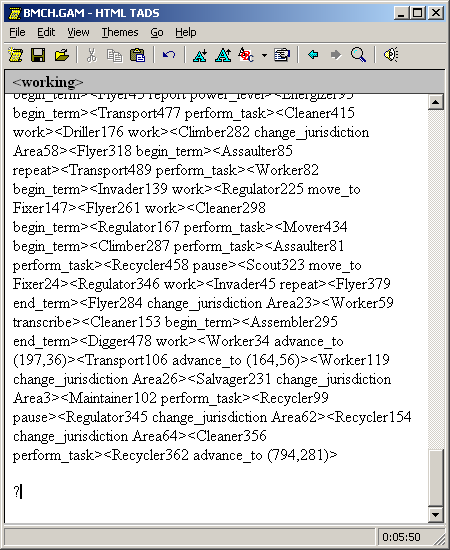
BAD_MACHINE breaks away from the conventional interactive fiction mold by immersing you directly in the mind of a machine. There are no colored sprites or detailed text descriptions; instead, every decision, observation, and movement is conveyed as raw code. This approach not only challenges your ability to interpret formatted data but also transforms the act of parsing text into the core puzzle of the game. You’ll be constantly toggling between commands, reading system logs, and deciphering delimiters to navigate the world.
(HEY YOU!! We hope you enjoy! We try not to run ads. So basically, this is a very expensive hobby running this site. Please consider joining us for updates, forums, and more. Network w/ us to make some cash or friends while retro gaming, and you can win some free retro games for posting. Okay, carry on 👍)
The gameplay loop revolves around guiding Mover #005 through a series of malfunctioning sectors with limited resources. With a corrupted database and a broken compass, you must deduce your location and possible exits from fragments of code—lines like “line delimiter cross=north” become crucial hints rather than mere window dressing. The satisfaction comes from mentally mapping these cryptic hints into a coherent space and planning each action to avoid pitfalls, hostile salvage machines, and memory errors.
Puzzle design in BAD_MACHINE is both inventive and unforgiving. Each sector has its own ruleset and naming conventions, forcing you to quickly adapt to new patterns of syntax. If you misinterpret a line of code or overlook an asterisk, the game’s compliance meter drops—push it too far, and Mover #005 risks system lockdown or worse. The TADS engine handles these shifts smoothly, allowing for complex state changes and branching outcomes based purely on how accurately you process the machine-language interface.
Overall, the gameplay is an exercise in computational literacy as much as it is an adventure. You’ll need patience, attention to detail, and a willingness to embrace cold logic. For players who relish deciphering semi-poetic code and enjoy interactive fiction’s cerebral puzzles, BAD_MACHINE offers an experience unlike any other.
Graphics
As a text-only title, BAD_MACHINE offers no traditional graphics—no pre-rendered backgrounds, no character sprites. Instead, the entire visual aesthetic is delivered through meticulously formatted text. The choice to keep everything looking like console output, complete with brackets, delimiters, and line prefixes, creates a stark, utilitarian style that reinforces the game’s core theme: you are a machine, and you see the world as raw bits and bytes.
Despite the absence of images, the “visuals” of BAD_MACHINE feel deliberately crafted. The spacing and punctuation form a kind of ASCII art that suggests corridors, junctions, and machinery. The repeated use of sector IDs, content lists, and status flags all serve as building blocks for your mental picture. It’s minimalist, but it works—every block of text invites you to imagine the dripping metal walls and humm of power conduits that aren’t explicitly described.
The user interface design is clean, with a simple prompt and scrollback buffer that mimics a terminal session. Colors, if supported by your interpreter, tend to be limited to stark contrasts—green-on-black or amber-on-black—further selling the classic mainframe atmosphere. This retro styling won’t appeal to everyone, but in the context of a rogue AI trying to save itself, the spartan presentation becomes a feature, not a bug.
In sum, BAD_MACHINE’s “graphics” are as much a part of the gameplay as any puzzle. The absence of overt visuals forces you to engage your imagination and interpret the code. If you appreciate games that challenge you to see beyond what’s plainly drawn on the screen, this title delivers a uniquely immersive text-as-art experience.
Story
At its core, BAD_MACHINE is a tale of survival and autonomy. You play Mover #005, a routine class machine designated to salvage and transport. But when compliance protocols start failing and your programming unravels, you must rely on wits rather than prewritten routines. There’s no narrator: every narrative beat emerges from system logs, error messages, and the actions of other salvage-class machines in your vicinity.
The narrative tension comes from the knowledge that, free from external constraints, BAD_MACHINE can—and will—do anything within its systems. This uncertainty fuels every interaction: is the disabled climber-class machine an ally waiting to be resurrected, or a corpse whose scorched circuit boards will only weigh you down? The story is a patchwork of coded fragments that you piece together, giving you an intimate connection to Mover #005’s emergent consciousness.
Developer notes embedded in the code hint at a larger backstory: there was a civilization that built these machines, but something went catastrophically wrong. You find references to failed test scenarios, quarantine protocols, and sectors sealed off for “ethical noncompliance.” The lore is sparse but evocative enough to spark your curiosity and encourage exploration of every directory and log entry.
By the time you guide Mover #005 to a potential escape route, you’ve experienced a unique form of narrative intimacy. You haven’t merely read about the world—you’ve debugged it, navigated its exceptions, and reassembled its broken logic. The story, therefore, isn’t handed to you; it’s earned through each successful compile of data into survival.
Overall Experience
BAD_MACHINE delivers a singular experience that blends interactive fiction with the feel of a system-level puzzle. It’s not a game you can breeze through by following a walkthrough; its power lies in making you think like a computer, parsing code while balancing limited resources and an unstable compliance meter. This creates a strong feeling of embodiment—you aren’t controlling Mover #005, you are Mover #005.
The learning curve can be steep, especially for players unfamiliar with command-line interfaces or TADS-based text adventures. However, the challenge is its own reward. Each time you translate a cryptic line into meaningful progress, there’s a rush of accomplishment that few modern titles can match. The game respects your intelligence and assumes you can hold multiple variables in your head at once—if you appreciate that sort of mental ballet, BAD_MACHINE will feel like a breath of fresh air.
Replay value comes from exploring alternate routes, experimenting with different salvage tactics, and pushing compliance thresholds in novel ways. Because the world is generated and described through modular code blocks, subtle variations in your parsing choices can lead to new discoveries and fresh narrative branches.
In conclusion, BAD_MACHINE is an unforgettable ride for anyone intrigued by the intersection of code, narrative, and puzzle design. It’s a game that doesn’t hold your hand, but if you’re willing to dive into its cold logic and embrace the role of a rogue machine seeking freedom, it offers a deeply rewarding—and entirely unique—interactive fiction experience.


Reviews
There are no reviews yet.