 Retro Replay Retro Replay gaming reviews, news, emulation, geek stuff and more!




Retro Replay Review
Gameplay
Carrier Command delivers a unique blend of strategic thinking and direct vehicle control that was groundbreaking at its release and remains engaging today. At its core, you oversee an advanced cybernetic aircraft carrier, dispatching fighters, amphibious assault vehicles, laser defenses, and decoy drones to secure and expand your foothold across a sprawling island chain. The challenge lies in balancing high‐level base management with hands‐on combat: you’ll plan which structures to build—resource gathering outposts, factories, or defensive emplacements—and then personally pilot units to fend off enemy incursions or capture neutral islands.
(HEY YOU!! We hope you enjoy! We try not to run ads. So basically, this is a very expensive hobby running this site. Please consider joining us for updates, forums, and more. Network w/ us to make some cash or friends while retro gaming, and you can win some free retro games for posting. Okay, carry on 👍)
Resource management is both intuitive and tense. Islands rich in raw materials fuel your factories, enabling you to replace lost vehicles or develop more potent weaponry. However, every asset you create must be carefully positioned and guarded. Leave your resource or factory islands undefended, and the enemy will strike, potentially crippling your supply lines. This constant tug‐of‐war forces you to prioritize expansion versus defense and to adapt quickly when your fronts are under pressure.
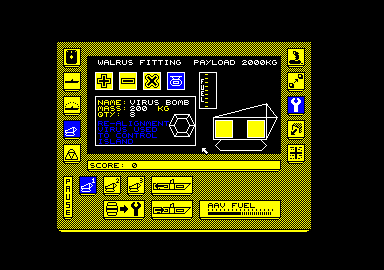
One of the most memorable aspects is the ability to switch into first‐person view for your attack aircraft or amphibious tanks. Whether you’re strafing enemy bunkers with configured missile payloads or deploying a virus bomb to seize control of a base’s systems, these segments offer a thrilling break from top‐down planning. The weapons customization system lets you tailor your loadout for specific missions—opting for wire‐guided surface‐to‐surface missiles against fortified positions or high‐explosive bombs for rapid island assaults. This interplay of macro‐strategy and micro‐combat gives Carrier Command a depth that will satisfy strategy enthusiasts and action fans alike.
Graphics
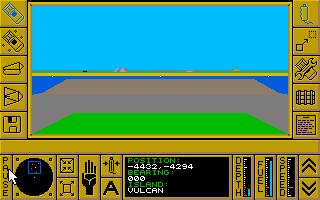
While Carrier Command’s visuals reflect its pioneering era, there’s a timeless quality in its minimalist, functional presentation. The island chains and carrier decks are rendered with clear, easily distinguishable icons and polygons, ensuring you can quickly assess the battlefield at a glance. The simple color palette—blue seas, green islands, and grey hulls—avoids clutter, letting you focus on strategy rather than flashy effects.
In first‐person vehicle segments, the cockpit instrumentation is sparse but effective. Gauges, radar blips, and weapon readouts occupy the screen edges, leaving your view uncluttered as you target ground installations or enemy aircraft. Though modern gamers accustomed to high‐fidelity textures may find the graphics primitive, there’s an appealing retro charm to the crisp lines and unadorned interface that underscores the game’s focus on gameplay over aesthetics.
Animations are functional and purposeful: fighters launch with a satisfying sequence, amphibious tanks drive ashore with heavy metal clanks, and factory buildings animate as they churn out new vehicles. The laser and missile effects, while basic, are clear enough to differentiate between defensive turrets and missile salvos. If you approach Carrier Command expecting cutting‐edge visuals, you’ll be disappointed; if you appreciate clarity and an undistracted view of the battlefield, you’ll find the graphics serve the game’s strategic ambitions admirably.
Story
Carrier Command’s narrative is refreshingly straightforward: two super‐carriers, yours and a terrorist faction’s, race across an archipelago to establish bases and undermine one another’s supply networks. There are no elaborate cutscenes or branching dialogues—just concise mission briefings that outline objectives and hint at the broader stakes. This minimalist approach keeps the focus squarely on your decisions and actions.
As you build resource islands, factories, and defenses, you get a sense of an escalating conflict. Each captured island brings you closer to locating and destroying the enemy carrier, while the chilling possibility of a terror group unleashing advanced weaponry looms in the background. The story unfolds organically through your conquest, and every victory feels like a step toward thwarting a nefarious plot against global stability.
Although the narrative isn’t character‐driven, it’s effective in motivating your strategic choices. Deploying a virus bomb to seize an enemy base or choosing to cut off supply lines rather than face a head‐on assault injects your campaign with emergent drama. Carrier Command proves that a tight premise, smart pacing, and player‐driven events can deliver a compelling story without relying on heavy exposition.
Overall Experience
Carrier Command remains a landmark title in the real‐time strategy genre, offering a depth of gameplay that feels remarkably modern despite its age. The seamless transition between macro‐level planning and first‐person vehicle action gives the game a dynamic pace that keeps you engaged. Resource management, base building, and customizable weapon loadouts combine to form a cohesive strategic sandbox with real stakes.
While the graphics and audio may not match today’s blockbuster standards, they complement the game’s focused design. There’s no superfluous flair—every visual element serves the purpose of conveying information quickly and clearly. The lack of hand‐holding means you’ll likely experience a learning curve as you juggle multiple islands and fend off relentless enemy attacks, but mastering these systems is immensely rewarding.
For fans of strategy who appreciate a balance of tactical planning and on‐the‐ground combat, Carrier Command is a must‐play classic. Its emergent storytelling and innovative gameplay loop set the stage for modern RTS and hybrid action‐strategy titles. Even decades after its initial release, the thrill of hunting down the enemy carrier, sabotaging supply lines, and orchestrating island invasions remains as satisfying as ever. If you’re looking for a strategic challenge that tests both your big‐picture thinking and your piloting skills, Carrier Command delivers an experience that’s hard to beat.



Reviews
There are no reviews yet.