 Retro Replay Retro Replay gaming reviews, news, emulation, geek stuff and more!




Retro Replay Review
Gameplay
Dune II: The Building of a Dynasty sets the blueprint for modern real-time strategy by combining resource management, base construction, and tactical combat in a seamless flow. You start each mission by deploying harvesters to scour the sandy expanses of Arrakis for Melange—commonly called Spice—which is your sole source of credits. Balancing the risk of sending unarmed harvesters into Spice fields against the reward of a steady income forms the core strategic tension of the game.
(HEY YOU!! We hope you enjoy! We try not to run ads. So basically, this is a very expensive hobby running this site. Please consider joining us for updates, forums, and more. Network w/ us to make some cash or friends while retro gaming, and you can win some free retro games for posting. Okay, carry on 👍)
Base building hinges on a clever terrain mechanic: all structures must be erected on stone, while Spice only spawns on sand. This forces players to plan the layout of refineries, barracks, and turrets carefully, ensuring that their bases expand into ever-more precarious territory. Adding to the depth, every one of the three rival Houses—Atreides, Harkonnen, and Ordos—boasts a unique special unit and gains a powerful palace effect once their palace improvement is complete, leading to varied tactics depending on your chosen faction.
Progression comes in two flavors: early missions task you with amassing a credit threshold, while later battles demand total annihilation of enemy forces. The frantic cat-and-mouse dance of maneuvering light vehicles, heavy tanks, infantry squads, and spy units through narrow chokepoints keeps the adrenaline high. And lurking beneath the dunes, the colossal sandworms serve as a constant environmental hazard—no army is ever truly safe when a writhing behemoth can swallow an entire squad in one gulp.
Graphics
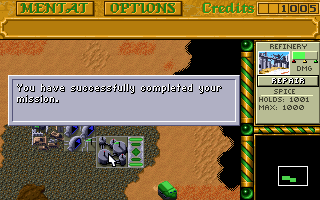
By today’s standards, Dune II’s visuals are undeniably retro—blocky sprites rendered in a limited palette—but they exude a character all their own. The isometric battlefield conveys elevation changes and terrain types with remarkable clarity, distinguishing stone from sand and marking ripe Spice fields with a distinctive golden hue. Each House’s buildings bear heraldic colors and emblematic shapes that make it easy to identify friend from foe at a glance.
Units animate with satisfying mechanical detail: the ripple of a harvester’s conveyor belt, the flash of tank barrels firing, and the skitter of infantry squads advancing through the dunes. Even the legendary sandworms are realized in rudimentary but effective form—just enough animation to signal impending doom and prompt quick reactions. The limited zoom and fixed camera angle keep the action tight, ensuring you never lose sight of a critical skirmish.
The user interface, though austere by modern conventions, is intuitive and functional. Simple iconography for building commands, unit production, and radar overlays allows players to jump into the action without wading through multiple menus. The stark menus and map screens reinforce the game’s utilitarian aesthetic, immersing you in the high-stakes contest for Arrakis without unnecessary flourish.
Story
At its heart, Dune II is a straightforward tale of imperial machinations on the desert world of Arrakis, where the coveted Spice underpins the galactic economy and interstellar travel. The Padishah Emperor’s decree pits three mighty Houses—Harkonnen, Atreides, and Ordos—against one another in a bid for economic supremacy. What begins as an ostensibly peaceful competition quickly escalates into all-out war, setting the stage for a power struggle as brutal as the desert sands themselves.
Each campaign unfolds through a series of discrete missions rather than a fully scripted narrative, but the strategic map that follows every successful operation adds a layer of choice and continuity. Selecting the next battle zone personalizes your journey across Arrakis, though the overarching goal remains constant: secure maximum Spice production and crush your rivals. This non‐linear approach to mission selection makes each playthrough feel slightly different, even if the story beats remain familiar.
While Dune II doesn’t delve deeply into the philosophical themes of Frank Herbert’s novels, it captures the essence of desert peril, political intrigue, and the scramble for a resource that can make or break empires. Sandworms, stealthy saboteurs, and the cutthroat rivalry between Houses give the game an unmistakable Dune flavor without becoming bogged down by complex lore or dialogue.
Overall Experience
Playing Dune II today is like stepping into the birthplace of a genre. Its design choices—single-resource economy, base expansion on mixed terrain, fog of war, factory-based unit production, and mission-based progression—all became staples of RTS titles that followed. Veterans will appreciate the game’s historical importance, while newcomers can still find satisfying depth in its elegant simplicity.
The campaign offers plenty of replay value: switching between the Houses alters your strategic options, and the free-form mission selection on the map ensures no two runs feel identical. Short loading times and brisk missions maintain a compelling pace, inviting you to jump back in again and again in pursuit of refining your tactics or trying out new unit compositions.
Ultimately, Dune II: The Building of a Dynasty remains a must-play for serious strategy fans and anyone interested in the evolution of video games. Its dated presentation may raise eyebrows, but beneath the retro veneer lies a timeless design that continues to influence and inspire modern RTS titles. For players seeking a challenging, bite-sized tour of real-time strategy’s origins—set against the epic backdrop of Arrakis—this is an essential journey into the sands of gaming history.



Reviews
There are no reviews yet.