 Retro Replay Retro Replay gaming reviews, news, emulation, geek stuff and more!
Retro Replay Review
Gameplay
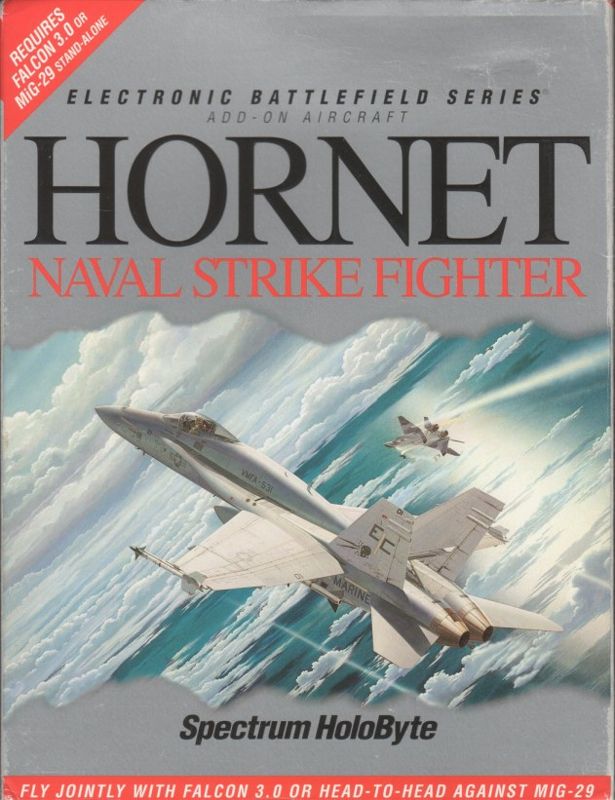
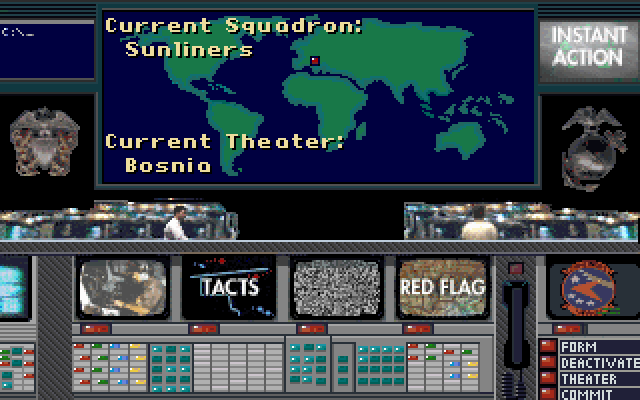
Hornet: Naval Strike Fighter is the second official add-on for Falcon 3.0, allowing players to take the controls of a U.S. Navy or Marine Corps F/A-18 Hornet. Beyond simply swapping aircraft, this expansion introduces the Bosnia and Herzegovina theater, complete with realistic mission objectives and airspace dynamics. All new sorties are fully intercompatible with both the base game and the earlier MiG-29: Deadly Adversary of Falcon 3.0 add-on, giving you unprecedented flexibility in designing joint or opposing campaigns.
(HEY YOU!! We hope you enjoy! We try not to run ads. So basically, this is a very expensive hobby running this site. Please consider joining us for updates, forums, and more. Network w/ us to make some cash or friends while retro gaming, and you can win some free retro games for posting. Okay, carry on 👍)
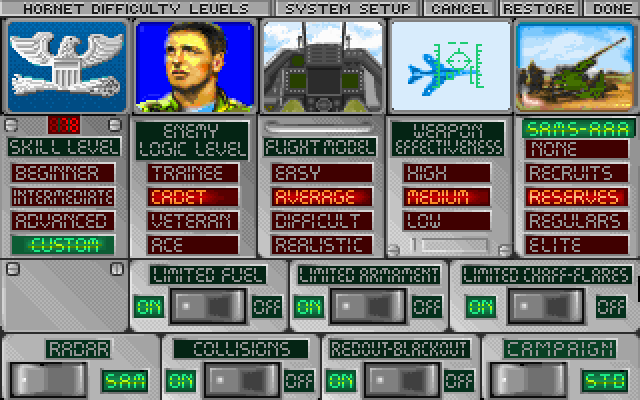
The flight model retains Falcon 3.0’s signature depth, simulating angle of attack, fuel consumption, radar physics and weapon delivery with high fidelity. Cockpit systems follow the real-world F/A-18 layout: TACAN, HUD symbology and multi-mode radar demand careful study, transforming each sortie into an intricate ballet of switches, gauges and throttles. Beginners may find the learning curve steep, but a robust series of training missions eases you into carrier launches, aerial refueling and complex radar intercepts.
Mission variety underscores the add-on’s staying power. From Suppression of Enemy Air Defenses (SEAD) runs deep in hostile territory to close air support for friendly ground columns, every assignment feels distinct. Dynamic weather and time-of-day settings further sharpen the challenge, forcing you to adapt your tactics on the fly. Multiplayer compatibility ensures that squadron tactics—be it wingman coordination or mixed-aircraft strike packages—remain a thrilling option.
Graphics
Visually, Hornet: Naval Strike Fighter reflects early to mid-’90s simulation standards. Terrain textures across Bosnia’s valley floors and rugged highlands are relatively low-resolution by today’s benchmarks, but they effectively convey the sense of flying over a NATO enforcement zone. Rolling hills, clustered villages and strategically placed SAM sites break the monotony of flat landscapes, providing ample terrain cues for navigation and target acquisition.
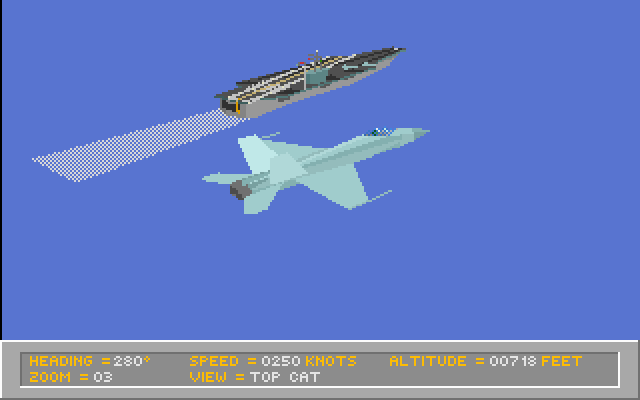
The F/A-18 Hornet cockpit and external model represent a noticeable step up from the base game’s jets. Instrument panels are crisp and logically arranged, with clear color-coded readouts for radar, weapons and engine status. Externally, the Hornet’s smooth lines and distinctive twin-engine nacelles are faithfully rendered, making for an unmistakable silhouette against the horizon. Smoke trails, flares and missile contrails add welcome immersion during dogfights.
Environmental effects deserve special mention. Sun glint off the canopy, rudimentary cloud layers and dynamic runway lighting on carrier decks immerse you in each mission. While draw distances remain modest, key landmarks—air bases, mountain ridges and urban sprawl—are sufficiently detailed to orient you during low-altitude nap-of-the-earth flights. In sum, the graphics serve the simulation’s goals without unnecessary frills.
Story
Although Hornet: Naval Strike Fighter is a simulation rather than a narrative-driven title, its missions are framed by a believable Cold War-era Balkan conflict. Campaign briefings reference UN no-fly zones, humanitarian corridors and NATO enforcement operations, grounding your sorties in a plausible operational context. Each mission begins with a concise overview—threat assessments, rules of engagement and primary objectives—mirroring real-world military planning.
The Bosnia and Herzegovina theater evokes the tense atmosphere of peace enforcement during the early 1990s. Ground forces, protected convoys and civilian safety zones add moral complexity to your orders. Briefings occasionally task you with “show of force” flights or high-altitude reconnaissance, balancing kinetic strikes against the need to avoid collateral damage. This mix lends each mission a quasi-story arc, even if there’s no branching dialogue or character development.
Interoperability with the MiG-29 add-on allows you to flip perspectives: one moment you’re flying F/A-18s under NATO command, the next you can oppose them in Soviet-built fighters. This flexibility encourages creative mission design and sandbox play, effectively letting you script “what-if” scenarios within the same theater. Though there’s no overarching plot, the interplay of aircraft and factions delivers a satisfyingly varied campaign experience.
Overall Experience
Hornet: Naval Strike Fighter builds upon Falcon 3.0’s reputation for uncompromising realism, offering one of the era’s most detailed F/A-18 simulations. Its careful systems modeling, combined with a challenging mission set in a politically charged theater, marks it as a standout add-on for flight-sim aficionados. Casual players may be daunted by the depth, but those willing to invest time will find each successful mission deeply rewarding.
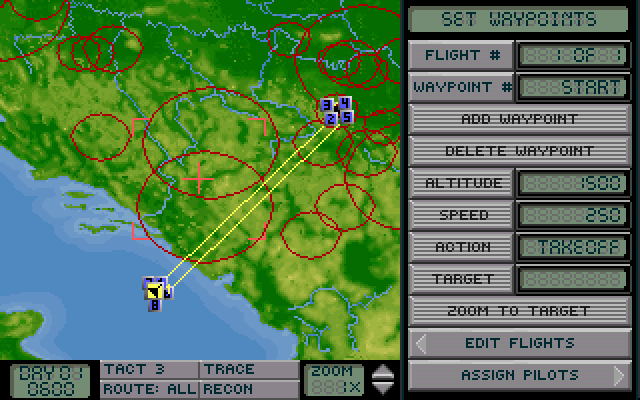
The add-on’s seamless integration with both the base game and MiG-29: Deadly Adversary ensures maximum replayability. You can import missions, edit waypoints and build custom campaigns across various aircraft and alliances. Multiplayer fan communities have long extended the life of this title, sharing mission files that range from historical recreations to entirely fictional engagements.
In an age where instant gratification often trumps simulation fidelity, Hornet: Naval Strike Fighter stands as a testament to the genre’s golden era. It demands patience, precision and perseverance, but in return delivers an unmatched sense of accomplishment. For anyone serious about virtual naval aviation, this add-on remains a compelling purchase.


Reviews
There are no reviews yet.