 Retro Replay Retro Replay gaming reviews, news, emulation, geek stuff and more!
Retro Replay Review
Gameplay
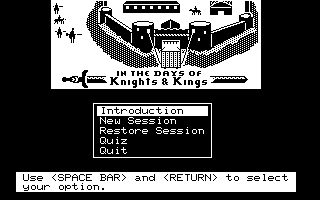
In the Days of Knights & Kings offers a classic turn-based strategy framework set against the backdrop of the Norman Conquest. Players assume the roles of William the Conqueror or Harold II, issuing orders, moving units across a schematic map of 11th-century England, and vying for control of key territories. Each turn requires careful planning: should you press your advantage in the north or reinforce the southern coast? Conquest unfolds gradually, giving the player time to analyze the board, predict enemy moves, and adapt tactics.
(HEY YOU!! We hope you enjoy! We try not to run ads. So basically, this is a very expensive hobby running this site. Please consider joining us for updates, forums, and more. Network w/ us to make some cash or friends while retro gaming, and you can win some free retro games for posting. Okay, carry on 👍)
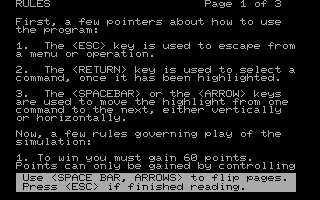
The taxation system is central to progress in the game. To win, a player must amass 60 points by controlling lands and taxing peasants. Tax collectors, essential for raising the tax rate, allow you to choose between low, medium, or hard taxation. Low taxes boost unit potency in combat and maintain peasant goodwill, while higher rates generate more immediate points—1 per peasant at medium and 2 per peasant at hard—at the risk of reduced potency and possible unrest.
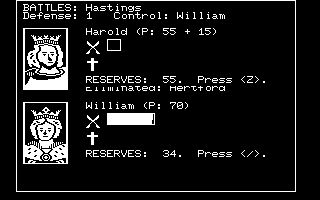
Combat is straightforward yet tense. When one of your units enters an enemy-occupied area, a battle is triggered. Victory not only secures the region but also yields strategic momentum. Spies add an extra layer of intrigue: they remain undetected around 80% of the time, regardless of who holds the land, enabling reconnaissance or surprise attacks. Unlike many war games, killing the enemy monarch does not always end the match. William can claim the crown by either defeating Harold or accumulating 30 points and then marching to London—an engaging twist that rewards multifaceted strategies.
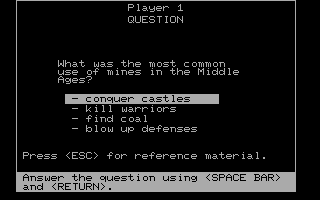
Beyond warfare and taxation, the game weaves in educational content through an in-game encyclopedia and quiz segments. Before each turn, you may be prompted with historical questions; a wrong answer curbs your movement for that turn. This mechanic keeps players engaged with the real events of 1066, reinforcing learning through consequences. For those who prefer pure quizzing, a dedicated Quiz mode lets you switch off the strategic layer altogether, adjusting question sets and difficulty to suit classroom or casual settings.
Graphics
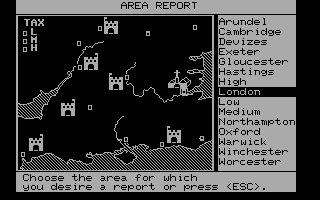
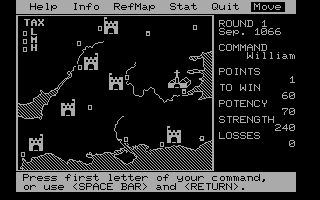
The visual style of In the Days of Knights & Kings leans toward clarity over spectacle. The game map is rendered in a clean, two-dimensional schematic, with provinces outlined and color-coded to indicate control. This minimalist approach prioritizes information delivery—each region’s borders, resource values, and troop deployments are easily decipherable at a glance, which is ideal for both new players and educators conducting group sessions.
Unit icons are simple yet distinct, representing infantry, cavalry, and specialized agents like spies or tax collectors. Animations are modest—units hop from region to region rather than march across the battlefield—but these subtle movements keep the focus on strategic decision-making rather than flashy graphics. Combat and taxation screens employ clear charts and gauges to show potency, point gains, and peasant morale.
Spies add a small flourish: when you deploy them, a translucent silhouette drifts over the map, hinting at their stealthy nature. Conquest moments come with a brief banner and a fade-in effect to highlight territory changes. While these flourishes are not ultra-high definition, they imbue the game with character without distracting from its educational goals.
The in-game encyclopedia features parchment-style pages and period-appropriate iconography, complete with illuminated letters and woodcut illustrations. It feels like a medieval chronicle, reinforcing the historical theme and providing quick access to context for battles, kings, and customs. This integration of graphics and pedagogy helps maintain immersion, especially for players learning about the Norman Conquest for the first time.
Story
Though not a narrative-driven RPG, In the Days of Knights & Kings delivers its story through dynamic simulation and contextual commentary. You experience the ebb and flow of 1066 as Harold and William vie for control, encountering historical events as they unfold on the map. Each conquest, diplomatic decision, and quiz question ties back to real figures, battles, and political tensions of the era.
Flavor text appears when significant milestones are reached—crossing the River Thames, besieging York, or approaching London—providing snippets of period lore. These vignettes deepen the sense of being part of a monumental moment in English history. The game’s structure lets you rewrite—or relive—history, testing whether you can alter the outcome of Hastings or reinforce your defenses against Norman cavalry.
The built-in encyclopedia and quiz feature strengthen storytelling by offering a layered perspective. As you answer questions about feudal customs, medieval warfare, or Anglo-Saxon culture, you gain appreciation for the real-world context behind the strategic map. Wrong answers don’t just cost movement; they remind you of the value of understanding your era, encouraging players to explore the reference material.
This blend of simulation and education means the game’s “story” is both emergent and informative. You aren’t merely reading a script: you’re co-authoring an alternate history while absorbing the facts and personalities shaping it. That dual focus ensures the Norman Conquest remains both engaging and enlightening.
Overall Experience
In the Days of Knights & Kings strikes a satisfying balance between accessible strategy and historical learning. The turn-based system, combined with taxation mechanics and spy deployment, offers enough strategic depth to hold the interest of seasoned gamers, while the quiz elements provide an educational edge perfect for classroom use or self-study. Matches can be played solo against AI or with a friend, making it versatile for different play styles.
On the downside, some players may crave more immersive graphics or a deeper diplomatic layer. The schematic map and icon-driven UI prioritize function over form, and there are no cinematic battle sequences. However, for its intended audience—those seeking a historically grounded strategy experience—the simplicity of presentation ensures clarity and focus.
Ultimately, this title excels as both a teaching tool and a competitive game. If you’re passionate about medieval history, want to challenge friends in a head-to-head conquest, or simply wish to test your knowledge of the Norman Conquest while making real strategic choices, In the Days of Knights & Kings delivers. Its thoughtful integration of quizzes, encyclopedia entries, and modular gameplay modes makes it a standout in the educational strategy genre.
For prospective buyers—educators, history buffs, or strategy enthusiasts—this game offers a unique window into the dynamics of 11th-century England. While not a blockbuster in terms of visual spectacle, it more than compensates with engaging mechanics, historical authenticity, and replayability that continues to enlighten long after the final crown is claimed.

Reviews
There are no reviews yet.