 Retro Replay Retro Replay gaming reviews, news, emulation, geek stuff and more!
Retro Replay Review
Gameplay
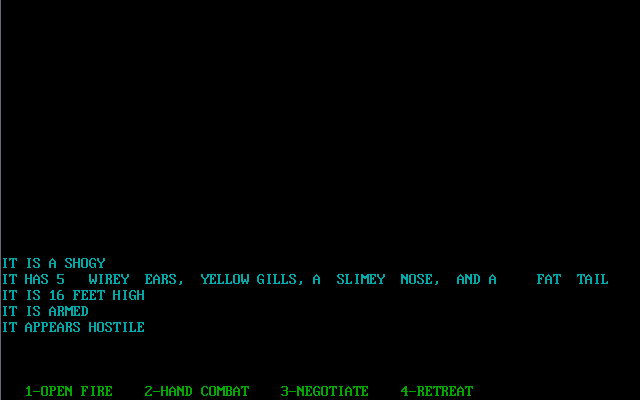
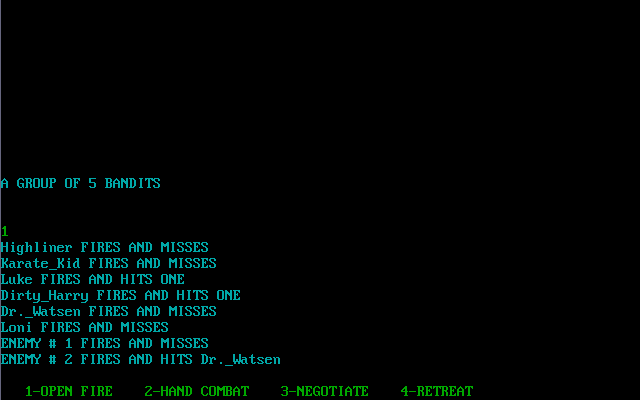
Landing Party’s gameplay is an exercise in strategic decision-making wrapped in a minimalist text-based interface. As the Captain, you guide a handpicked crew of five through a hazardous alien planet in search of precious Energy Crystals. Each turn grants you four actions to allocate among shooting, melee combat, negotiation, or retreat, forcing you to weigh immediate gains against long-term survival. The scarcity of resources and the high stakes of every encounter keep tension high from the first teleport drop to the final escape.
(HEY YOU!! We hope you enjoy! We try not to run ads. So basically, this is a very expensive hobby running this site. Please consider joining us for updates, forums, and more. Network w/ us to make some cash or friends while retro gaming, and you can win some free retro games for posting. Okay, carry on 👍)
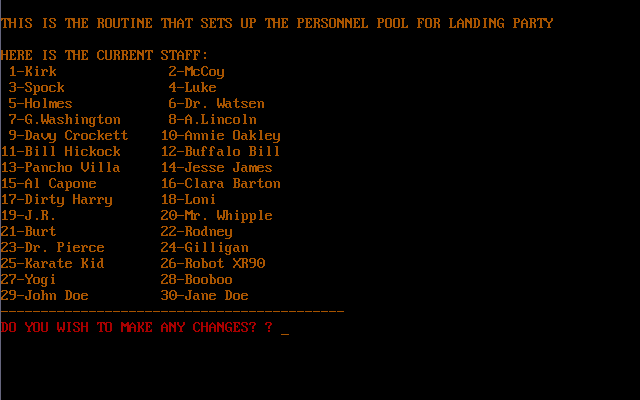
What sets Landing Party apart is its dynamic replayability. Before starting, you assign names to your crew—be they historical icons, celebrities, or loved ones—infusing your adventure with personal stakes. Because each member may react differently to encounters based on their backstory or your own associations, no two runs ever feel identical. This naming mechanic breathes life into text descriptions, making negotiations more amusing, skirmishes more emotional, and retreats more gut-wrenching.
The risk-versus-reward loop is finely balanced. Charging head-on might net more credits quickly, but reckless aggression can decimate your squad before you reach the mines. Conversely, overly cautious play risks running out of actions or energy crystals before you can buy the supply you desperately need. This constant balancing act ensures every decision—shooting a lurking creature or choosing to parley—holds weight and makes for a genuinely engaging strategic puzzle.
Graphics
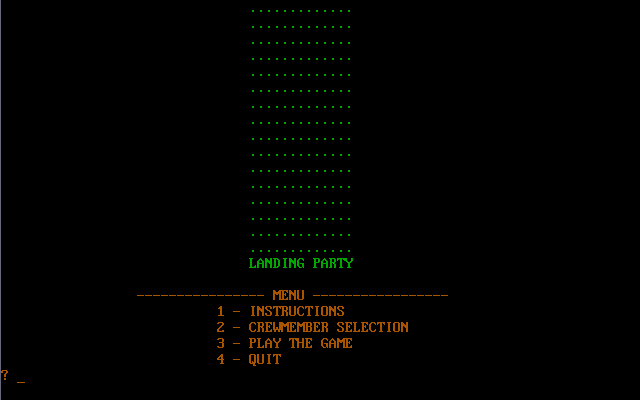
Although Landing Party is fundamentally text-based, its presentation is polished and thoughtfully designed. The interface uses clear typography and color-coding—red for threats, green for allies, and blue for neutral or informational text—to quickly convey the nature of each encounter. Subtle ASCII art flourishes, such as stylized monsters or simple planetary landscapes, punctuate the prose and help visualize your perilous surroundings.
The minimal graphical elements serve to enhance immersion without detracting from the narrative focus. Backgrounds remain unobtrusive, allowing players to concentrate on the storyline and decisions at hand. Sound effects—like the hum of the teleport pad, the crack of laser fire, or the low growl of an alien predator—add an atmospheric layer that complements the text, elevating the overall sensory experience.
Loading screens feature rotating mission logs and brief snippets of planetary data, reinforcing the sci-fi setting and hinting at deeper lore. While there are no fully rendered 3D models or cinematic cutscenes, these design choices showcase how a text-driven game can still feel modern and engaging when presented with thoughtful visual and auditory cues.
Story
The narrative thrust of Landing Party is elegantly simple. Stranded in orbit with your starship’s power reserves nearly exhausted, you sacrifice most of your remaining energy to teleport six bodies—including yourself—to the planet below. Your mission: navigate treacherous terrain, defeat or parley with its monstrous denizens, and secure enough Energy Crystals to save the entire crew. The core premise establishes immediate urgency and reveals layers of desperation and hope as you inch closer to survival.
Character dynamics emerge organically through the naming mechanic. When you christen your crew after well-known figures or loved ones, the stakes become personal. A crew member’s fate no longer feels like a generic text outcome but rather a meaningful narrative moment. Do you risk “Einstein” to draw fire and let the rest slip past, or does “Mom” deserve the best chance at negotiating a peaceful passage? These emergent story beats invite laughter, tears, and tense discussion among players who share their run experiences.
Encounters are peppered with descriptive flavor text that evokes both wonder and dread—glimmering caverns filled with crystalline formations or shadowy groves where unseen predators stalk. The brief lore passages hint at a long-forgotten civilization that once harvested these crystals, adding an air of mystery and potential for deeper world-building in future updates. Even in its brevity, the story packs enough drama and intrigue to keep you invested through multiple playthroughs.
Overall Experience
Landing Party delivers a surprisingly deep and replayable strategy experience within a text-based framework. Its accessible interface, combined with meaningful choices and emergent narratives driven by customizable crew names, makes each session memorable. Casual players will appreciate its straightforward turn-based rhythm, while hardcore strategists can dive into optimization, balancing risk, and resource management to push their success rate ever higher.
The game’s concise sessions—often wrapping up in 20 to 40 minutes—make it ideal for both quick bursts of play and longer marathon runs. With no two expeditions unfolding the same way, the title encourages experimentation with different crew compositions and tactical approaches. The tension of “just one more try” proves addictive, especially when you narrowly escape certain doom or unlock a new negotiation option against a particularly formidable monster.
While some players accustomed to flashy graphics may initially balk at the text-centric design, Landing Party demonstrates that a well-crafted interactive narrative can be just as compelling as any visually intensive blockbuster. For enthusiasts of strategy, sci-fi, and emergent storytelling, this game offers a unique and rewarding experience that will keep you making that fateful teleport decision again and again.


Reviews
There are no reviews yet.