 Retro Replay Retro Replay gaming reviews, news, emulation, geek stuff and more!



Retro Replay Review
Gameplay
From the moment you launch Ogre, it’s clear that the developers’ primary goal was to faithfully recreate the tension and tactical depth of Steve Jackson’s classic board game. Each turn unfolds on a hex-based map where conventional forces—infantry, tanks, and artillery—must coordinate their movements and firepower to halt the titular supertank. The hex-grid mechanic forces you to weigh positioning, lines of sight, and relative unit strength with every move, creating a steady build-up of strategic pressure.
(HEY YOU!! We hope you enjoy! We try not to run ads. So basically, this is a very expensive hobby running this site. Please consider joining us for updates, forums, and more. Network w/ us to make some cash or friends while retro gaming, and you can win some free retro games for posting. Okay, carry on 👍)
Controlling the Ogre itself is a vastly different experience. As the supertank, you feel a constant rush of power, bulldozing through light infantry and withstanding counterattacks from howitzers and tanks. Yet even this behemoth is not invincible; savvy opponents can draw you into crossfires or lure you into range of high-yield ordinance. The push-and-pull dynamic keeps both sides engaged, whether you’re planning an ambush with your tanks or calculating the optimal path to break the enemy lines.
One of the highlights of Ogre is its scenario editor, which lets you modify unit counts, map layouts, and victory conditions. This customization extends replay value drastically, as you can craft skirmishes around chokepoints, open plains, or even defensive fortresses. Multiplayer hotseat and AI-matched skirmishes round out the experience, though the latter can vary in challenge depending on the settings. Overall, the gameplay loop is simple to learn but difficult to master—a hallmark of a great strategy title.
Graphics
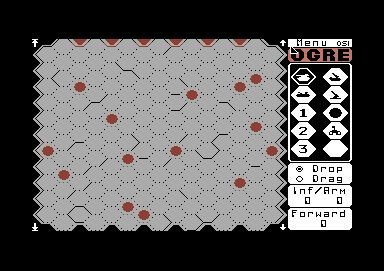
Graphically, Ogre opts for a clean, utilitarian 2D presentation that mirrors the look of the original board pieces. Units are represented by crisp, color-coded icons atop a muted hex map. While the visuals lack flashy animations or high-resolution textures common in modern strategy titles, they serve the game’s purpose impeccably by keeping the focus on tactical decision-making rather than spectacle.
Zooming in and out on the battlefield is smooth, and unit counters are easy to distinguish even on smaller screens. Damage effects—such as burning wrecks or artillery craters—add just enough visual feedback to make engagements feel impactful without bogging down performance. If you’re looking for a fully rendered 3D battlefield, this may feel barebones, but for purists wanting a faithful board-game conversion, the minimalist style is a welcome nod to the classic source material.
The interface is intuitive, featuring straightforward tooltips when you hover over a unit, along with clear indicators for movement range, attack zones, and terrain modifiers. While some modern conveniences—like drag-and-drop movement or animated path previews—are absent, the overall clarity of the presentation ensures you spend more time planning strategies than deciphering the UI.
Story
Ogre offers a minimal narrative backdrop, focusing on the immediate thrill of tactical warfare rather than an elaborate plot. The premise is simple: a towering cybernetic supertank known as the Ogre marches across the battlefield, and it’s up to a conventional army to stop it by any means necessary. This high-concept setup harkens back to pulp sci-fi and tabletop wargaming, evoking a sense of nostalgic charm.
While there is no sprawling campaign with cutscenes or character arcs, the game does provide a variety of pre-set scenarios with distinct objectives. Each scenario delivers its own micro-narrative: defend a mountain pass, break through an enemy blockade, or survive waves of mechanized onslaught. The lack of an overarching storyline might disappoint players seeking a deep narrative, but it tightens the focus on pure strategy and board-game fidelity.
The scenario descriptions themselves are succinct but evocative, hinting at dire stakes and intense skirmishes. This approach encourages players to project their own stories onto the battlefield, imagining tales of heroic stands or crushing defeats as they move their units hex by hex. For fans of strategic gameplay, this blank-slate narrative design is more of an asset than a shortcoming.
Overall Experience
Ogre shines as a digital adaptation of a beloved board game, capturing its strategic essence with precision and reverence. The gameplay mechanics are robust and finely tuned, the graphics clear and functional, and the scenario editor adds significant replayability. While it doesn’t push genre boundaries with cutting-edge visuals or an epic storyline, it doesn’t need to—the pure tactical challenge speaks for itself.
For newcomers to hex-based wargaming, Ogre provides an accessible entry point, with tutorials that gently guide you through unit capabilities and combat resolution. Veteran strategy fans will appreciate the depth of each engagement and the way small decisions ripple outward to influence the flow of battle. Multiplayer options, though basic, provide an extra layer of excitement when facing human opponents.
Ultimately, Ogre succeeds by staying true to its roots. It’s a lean, effective strategy package that invites you to outthink and outmaneuver your foe—whether you’re charging as the unstoppable supertank or rallying conventional forces for one last stand. If you value tactical depth over cinematic flair, this faithful board-game conversion will keep you engaged for countless turns to come.


Reviews
There are no reviews yet.